
B2B Conversion Rate Optimization: A Practical Guide
 Harvey Carpenter Published 14 min read
Most b2b conversion rate optimization advice still starts in the wrong place. It obsesses over headlines, button colors, and hero copy while the actual leak is often somewhere else, in qualification, routing, tracking, or sales follow-up. If you only fix the page, you can win more form fills and still lose pipeline.
That matters because B2B benchmarks are already tight. Average B2B website conversion rates are often reported around 1.8% to 2.9%, depending on how conversion is defined, and the spread by vertical is wide, from B2B SaaS at 1.1% to legal services at 7.4% in the benchmark roundup from VWO's statistics page. A small movement inside that range can change the amount of qualified demand that reaches sales, especially when paid traffic is expensive and intent is high. For a broader view of optimization fundamentals, the 2026 guide to conversion optimization is useful context, but B2B teams need a harder-nosed lens than most generic CRO content provides.
The better model treats CRO as a pipeline system. That means looking at what happens after the click, after the form submit, and after the CRM record is created, not just what happens on the landing page. It also means accepting a blunt truth, more submissions are not always more revenue. In B2B, the winner is the flow that creates the most accepted, qualified pipeline with the least operational drag.
Why Most B2B CRO Advice Stops Too Early
Most b2b conversion rate optimization advice still treats the landing page as the finish line. That is useful, but it is only one part of the system. A paid click can hit a strong page, submit a form, and still become wasted spend if routing is slow, qualification is loose, or attribution breaks before sales gets the record.
The stronger lens is revenue efficiency. That framing shows up in practical CRO guidance for B2B because the goal is not more form fills, it is more qualified pipeline. In B2B, the conversion event is usually a signal, not a sale, so the handoff to sales or a lead buyer matters as much as the page itself. The 2026 guide to conversion optimization gives useful broader context, but B2B teams need a harder-nosed approach than generic CRO advice usually provides.
The bottleneck is often after submission
Once a lead submits, the problems often start. The lead may be routed to the wrong rep, sent without clean source data, or accepted by sales and then rejected later because qualification was too loose. Pipeline-focused teams track the full chain, from visitor to lead, lead to qualified lead, and qualified lead to meeting or opportunity, because that is where page wins can disappear.
A better habit is to optimize the stage with the biggest benchmark gap, not the stage with the prettiest screenshots. If your reporting stack still cannot connect ad source, lead creation, and CRM status in one view, fix that before you debate button copy.
Practical rule: if the team argues about copy before it can trust the lead source, the stack is backwards.
The backlog should start with the parts that affect accepted pipeline, speed-to-lead, and routing integrity. Page design still matters, but it sits inside a wider operating system. The gains that hold up usually come from removing friction where buyers feel it and where operations breaks it.
Diagnosing Funnel Drop-Off Before You Test Anything
Start by mapping the funnel as a sequence of measurable events, not as a vague journey. The minimum useful path is paid click, landing page view, form start, form step progression, form complete, and CRM record created. A funnel like that reveals where money is leaking before anyone spends time arguing over test ideas.
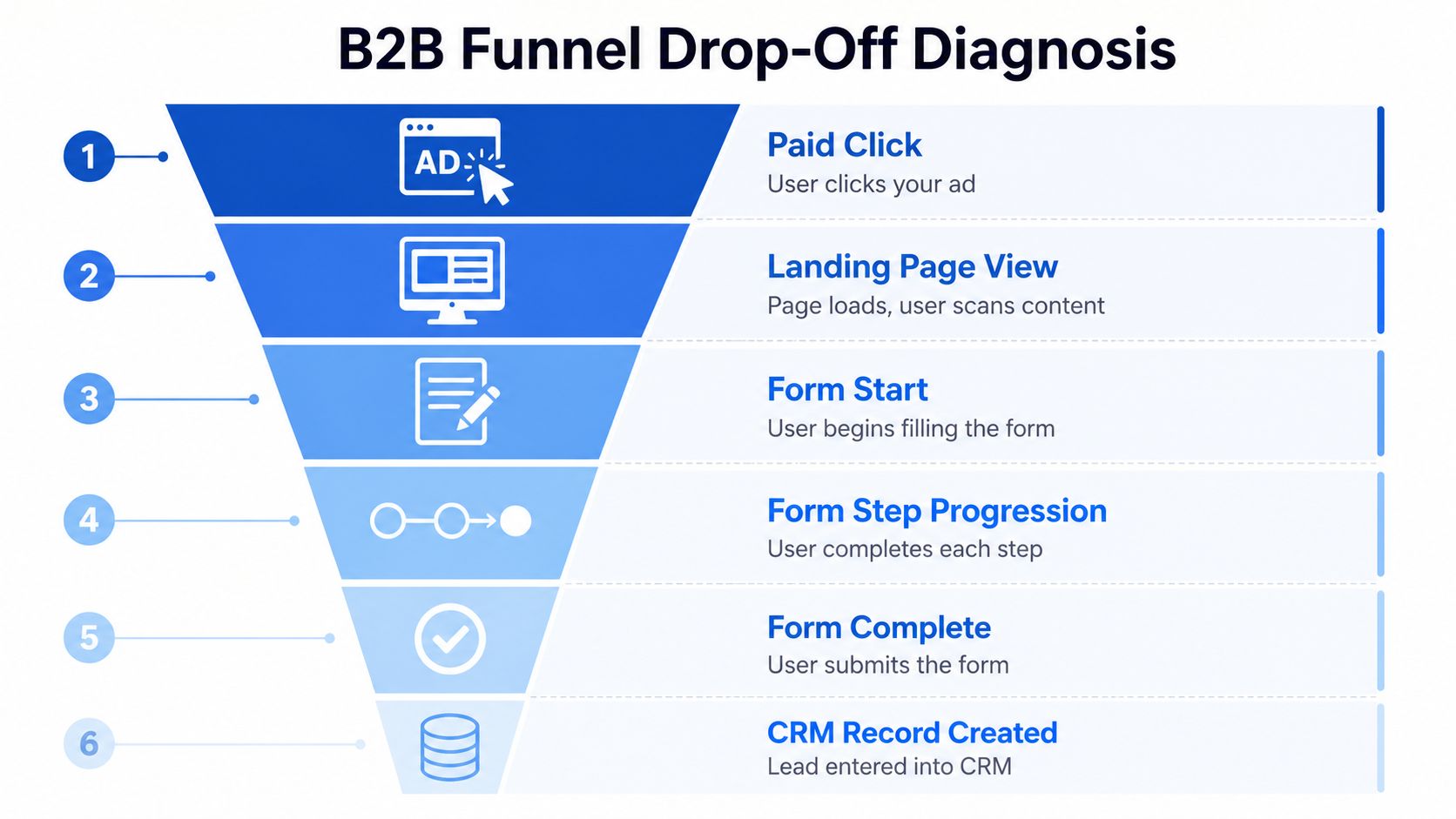
The reason to map it this way is straightforward. Unbounce's benchmark data shows that channel performance varies materially, with organic search around 2.4% to 2.6%, paid search around 1.2% to 1.5%, email around 2.0% to 2.4%, and LinkedIn ads around 2.0% to 3.5%. Those ranges tell you that a single site-wide average is almost always misleading. The same form can be underperforming on paid search and fine on email, which means the fix is different by channel.
Build reports that separate traffic, intent, and sales outcomes
The first report worth building is a channel-by-stage funnel view. Break the data out by paid social, paid search, email, and LinkedIn, then compare landing page view to form start, form start to completion, and completion to CRM creation. That's where you find whether the issue is message mismatch, form friction, or downstream tracking loss.
The second report is a cohort view. Long B2B sales cycles make calendar weeks noisy, so use cohorts by acquisition month or campaign start instead of pretending every week has the same purchase intent. The diagnostic guidance in data asset reliability validation is relevant here because broken event consistency can make a good funnel look weak, or a weak funnel look strong.
The third report is a revenue gap estimate. Multiply traffic by current conversion rate and compare it with the benchmark range that fits the channel or vertical. You're not looking for a perfect forecast, just a sane way to quantify opportunity before prioritizing tests.
If a report can't distinguish paid social from LinkedIn, or SMB from enterprise, it's too blunt to guide testing.
Segmenting by company size matters too. SMB and enterprise buyers behave differently, and mixing them hides the drop-off. The point is to isolate the stage and the audience where the largest gap sits, then attack that gap with a test, not a redesign.
Prioritizing Experiments That Actually Move Pipeline
Once the funnel is visible, the temptation is to fix everything at once. Don't. In B2B CRO, the fastest way to waste a quarter is to give every idea the same weight and let the loudest opinion win. A simple ICE or PXL score still works, but only if the “impact” part is tied to qualified pipeline, not raw form fills.
Score by pipeline opportunity, not vanity lift
A homepage headline test might be easy to ship, but it often has weaker downstream impact than a routing fix or a form simplification that reduces bad-fit submissions. The safer way to score ideas is to estimate the gap between the current conversion rate and the benchmark for that channel or stage, then ask how much of that gap could realistically close if the test worked.
Many teams get fooled. A test that raises submissions can still reduce pipeline if it attracts worse leads or slows sales follow-up. The operating rule from experienced CRO teams is to weight each experiment by the value of the downstream stage, not the surface metric.
A practical way to compare three common bets
If you're choosing between a homepage headline change, a multi-step form rebuild, and a speed-to-lead fix, they don't belong in the same bucket. The headline test affects message match and can be worthwhile on high-intent paid traffic. The form rebuild usually affects completion and qualification together. The speed-to-lead fix can touch acceptance and meeting rate, which often makes it more valuable than a cosmetic page tweak.
A good sequence is usually cheap wins first, structural work second. That means tightening message alignment, cleaning field logic, and fixing obvious routing problems before you invest in a larger rebuild. The reason is simple, the bottleneck shifts after every meaningful gain.
Rule of thumb: if an experiment can change who gets accepted by sales, it deserves a higher score than one that only changes how many people click submit.
Use dev-heavy projects sparingly until the data says they matter. Many teams can get meaningful lift from experiment ideas that don't require a rebuild, especially when the core problem is friction, qualification, or timing. The backlog should reward impact, not effort.
| B2B Conversion Benchmarks by Channel and Vertical | Reported conversion range | Source signal |
|---|---|---|
| B2B eCommerce | 1.8% | VWO statistics page |
| Median B2B website conversion rate | 2.9% | Ruler Analytics benchmark roundup |
| B2B SaaS | 1.1% | Lead Forensics vertical benchmark |
| IT and managed services | 1.5% | Lead Forensics vertical benchmark |
| Commercial insurance | 1.7% | Lead Forensics vertical benchmark |
| Legal services | 7.4% | Lead Forensics vertical benchmark |
| Organic search | 2.4% to 2.6% | Unbounce benchmark data |
| Paid search | 1.2% to 1.5% | Unbounce benchmark data |
| 2.0% to 2.4% | Unbounce benchmark data | |
| LinkedIn ads | 2.0% to 3.5% | Unbounce benchmark data |
Form and Landing Page Tactics That Hold Up on Mobile
Mobile is where a lot of B2B pages fail. Long forms, cramped layouts, and weak thumbs-optimized spacing kill completion long before a user reaches the final field. The fix is not just making the page smaller, it's designing the whole path so the user can keep moving with minimal effort.
The most reliable pattern is a multi-step flow with a clear progress indicator. That's easier to finish than a long static form because it reduces perceived effort and lets you place the harder questions later. Progressive profiling works for the same reason, ask for the minimum up front, then enrich later when the lead is already in motion.
A practical resource that covers mobile form structure well is 6 essential mobile form design. Use it as a design reference, but keep the logic tied to your own funnel, not a generic template.
What to change first on a live form
Start with field reduction. If a field doesn't change routing, compliance, or qualification, it probably doesn't belong in the first version of the form. Then move the strongest CTA above the fold so the promise matches the ad or search intent that brought the user in.
Conditional qualification helps too. Ask harder questions only after the lead has shown enough intent to justify them, which keeps momentum intact while still filtering poorly matched submissions. That's the same basic principle behind quiz-style forms and multi-step lead flows.
Another lever is mobile spacing. Stacked layouts, clear touch targets, and short labels matter more than clever visual treatment. If a user has to pinch or hunt for the next step, completion drops because the friction is physical, not psychological.
The best teams also keep the offer promise tight. If the ad promises a quote, the page should feel like a quote path. If the ad promises a demo, don't bury the booking CTA under a wall of explanation.
A form should feel like forward motion, not like a tax return.
In practice, I've seen teams preserve volume while improving qualified bookings by moving from a long single-step form to a shorter multi-step flow with conditional qualification. The exact field mix will change by vertical, but the pattern stays the same, reduce early friction, collect only what you need now, and make the next step obvious.
Later in the page, a video can do useful work without replacing the form. The point isn't to entertain, it's to answer the one objection that would otherwise stop the user from continuing.
If you're using a form builder, keep an eye on whether it supports conditional logic, pass-through fields, and real mobile-first rendering. Those features matter more than a polished dashboard when the goal is qualified leads, not generic submissions.
Attribution and Tracking Plumbing That Survives Real Traffic
A landing page can look right and still fail the funnel if the tracking breaks the moment real traffic hits it. If UTMs drop, click IDs vanish in a multi-step flow, or CRM records lose source detail, you cannot tell which test improved qualified pipeline. The dashboard turns into decoration.
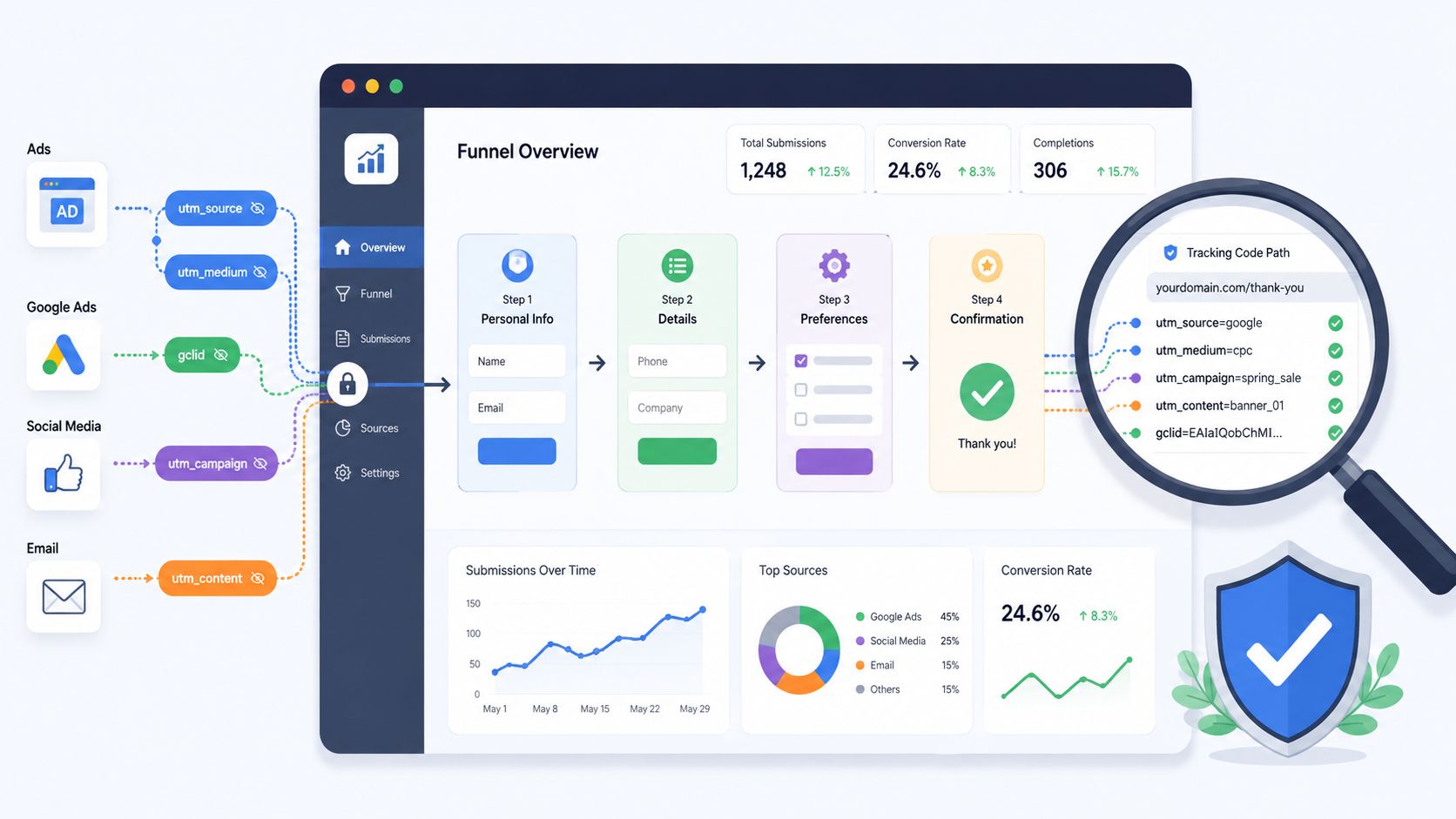
Good plumbing starts with hidden fields that survive the full journey. UTMs, gclid, fbclid, source, and sub-ID values need to carry through the form, then land intact in the CRM or lead buyer payload. If they disappear between click and submission, campaign quality gets separated from downstream pipeline, which makes every CRO readout less useful.
Audit the path from ad click to CRM record
Test the path in the same order traffic moves. Confirm the click arrives with the right parameters. Check that those values survive any multi-step or embedded form flow. Then verify they reach the CRM, the sales view, and any distribution platform or lead buyer.
Server-side tracking belongs in that same audit. Meta CAPI and Google conversion signals help recover some of the signal browser tracking no longer captures cleanly. GTM container support matters because teams need one place to keep event logic consistent instead of scattering tags across pages.
If you're comparing tools, the guide to marketing analytics platforms can help you judge whether the stack connects capture, attribution, and reporting without duct tape.
A practical standard is simple, every conversion should map back to a campaign source and a usable CRM record. If the sales team or lead buyer cannot see where the lead came from, the setup is not fully instrumented yet.
Delivery speed matters too. Real-time webhooks, instant alerts, and clean pass-through reduce the lag between form submit and follow-up. That matters because a strong conversion rate does not fix a slow handoff.
You can also use the guide to send conversions to Facebook via Conversion API as a reference for server-side signal plumbing, especially if your paid social team needs cleaner event recovery.
Practical rule: if the source data does not survive the handoff, your optimization results are not trustworthy.
This is one of the few places where the capture layer decides whether the rest of the funnel works. A tool that preserves source data, fires pixels reliably, and pushes records in real time earns its keep quickly.
Lead-Quality Safeguards That Protect the Pipeline You Build
A headline test that lifts submissions can still hurt the business if it invites junk. That's especially true in compliance-sensitive or buyer-sold lead environments, where acceptance rate matters more than raw volume. If quality drops, the apparent CRO win is really a pipeline loss.
I've seen this happen in legal and other high-intent funnels. A tighter headline and a lower-friction form can spike submissions, but if the new version attracts unverified, incomplete, or non-consenting leads, buyer acceptance falls and the team ends up undoing the change. The test looks good in one chart and bad in the one that pays the bills.
Build quality checks into the form itself
Verification should happen as close to submission as possible. Phone and email checks reduce fake or uncontactable leads before they hit sales or a buyer queue. For verticals where consent evidence matters, TrustedForm and Jornaya-style proof belongs in the capture flow, not as an afterthought.
Disqualification logic is equally important. If a lead clearly doesn't fit, filter it before it reaches the team that has to work it. That protects speed, keeps reps focused, and reduces downstream rejection.
The internal guide on verify leads in real time or bulk is relevant if your current stack still treats verification as a separate cleanup task. It shouldn't be separate. It should be part of the form strategy.
A better north star than form fill count is acceptance rate. If accepted pipeline goes up, the test earned its place. If submissions go up but accepted leads drop, the test needs another pass.
Quality gates and CRO aren't competing goals. In B2B, they usually protect the same revenue.
This is also where operational discipline matters. Sales and buyer feedback should feed back into experiment design, so you don't keep rewarding the same bad lead shape. The best teams don't just measure volume, they measure the quality of the volume they create.
Running A/B Tests That Hold Up in Long B2B Cycles
B2B tests fail most often because the measurement is sloppy, not because the idea was bad. If you don't define one primary conversion event, set a minimum sample threshold, and keep the metric tied to qualified leads, you'll end up making decisions on noise. Long sales cycles make this even trickier, because calendar-based analysis can hide the true story.
The safest approach is to pre-register the test. Write down the primary metric, the guardrails, the expected direction of change, and the segment you care about before launch. That keeps the team from peeking at early results and calling a win too soon.
Use the right unit of analysis
For SMB, user-level behavior may be enough to guide iteration. For enterprise, cohort analysis usually works better because multiple stakeholders can interact with the same opportunity over time. That's why a test should often be read by acquisition source, device, and company size, not just by total visitors.
Sequential or grouped testing is usually a better fit than casual checking in the middle of the week. If the event tracking is broken, pause the test and fix the instrumentation before drawing conclusions. A noisy event is worse than no event, because it creates false confidence.
A simple rules-of-thumb table helps teams decide how to treat common test types.
| Test pattern | Primary metric to watch | Common failure mode |
|---|---|---|
| Multi-step form | Qualified lead rate | More submissions, worse quality |
| Speed-to-lead change | Accepted lead rate | Faster contact, poorer routing |
| Message match update | Click to form start | Better click-through, weak downstream quality |
| Qualification logic change | Lead-to-opportunity rate | Fewer junk leads, but undercounted volume |
Turn wins into a repeatable operating rhythm
A useful 90-day cadence is diagnose, prioritize, ship, then graduate winners into evergreen templates. That means one team meeting dedicated to funnel analysis, one backlog review for scoring, one shipping window, and one rollout review focused on quality, not vanity metrics. Keep dev and IT out of routine iteration when you can, because the fastest CRO programs are the ones marketing can operate without opening a ticket for every field change.
The status review should cover qualified lead volume, acceptance rate, CPL, and pipeline created. If a win improves one metric but harms another, don't rush to scale it. If it improves both quality and throughput, it's ready to become the default.
That's the point where CRO stops being a series of experiments and starts becoming a system. The compounding effect comes from cleaner tracking, tighter qualification, faster follow-up, and a backlog that keeps scoring against pipeline instead of applause.
Growform gives teams a no-code way to build multi-step, quiz-style lead forms with conditional logic, lead verification, pass-through tracking, and real-time delivery into CRMs and distribution stacks. If your current funnel is leaking after the click, visit Growform and see how a cleaner capture layer can support better qualification, cleaner attribution, and faster handoff.
Related articles
10 Template Contact Form Resources for Better Leads
The prettiest template contact form isn't automatically the best one.
September 14, 2026
Quiz Lead Generation for Paid Media
Most advice about quiz lead generation starts with engagement.
September 13, 2026
A/B Testing for Landing Pages How to Lift Conversions
September 12, 2026