
A/B Testing for Landing Pages How to Lift Conversions
You're buying clicks from Meta or Google, watching people reach the landing page, and still seeing the same frustrating pattern: traffic costs money, the form gets attention, but completed leads don't move. The instinct is usually to change the button color, swap the hero image, or rewrite a few words. Those changes are easy to launch, but they rarely answer the commercial question that matters: will this page produce more accepted, revenue-generating leads at a sustainable CPL?
A/B testing for landing pages works when it's treated as a revenue discipline rather than a design exercise. You need a stable baseline, one clear hypothesis, controlled traffic, reliable attribution, and a decision rule that includes lead quality. The objective isn't to find a miraculous winner. It's to build a sequence of credible improvements that compounds across the funnel.
Table of Contents
Table of Contents
- Why A/B Testing Matters for Paid Landing Pages
- Planning Your Test Around One Clear Hypothesis and KPI
- Sample Size Significance and How Long to Run the Test
- High Impact Variants to Test on Lead Gen Funnels
- Setting Up Tracking So Attribution Survives the Funnel
- Interpreting Results and Iterating Without Losing Gains
Why A/B Testing Matters for Paid Landing Pages
Paid traffic gives you a clean reason to test. You control the source, campaign, audience, offer, and destination, so a landing page experiment can isolate what happens after the click. If the same campaign sends randomized visitors to a control and a variant, you can compare how each version handles the traffic you're already paying for instead of guessing from design preference.
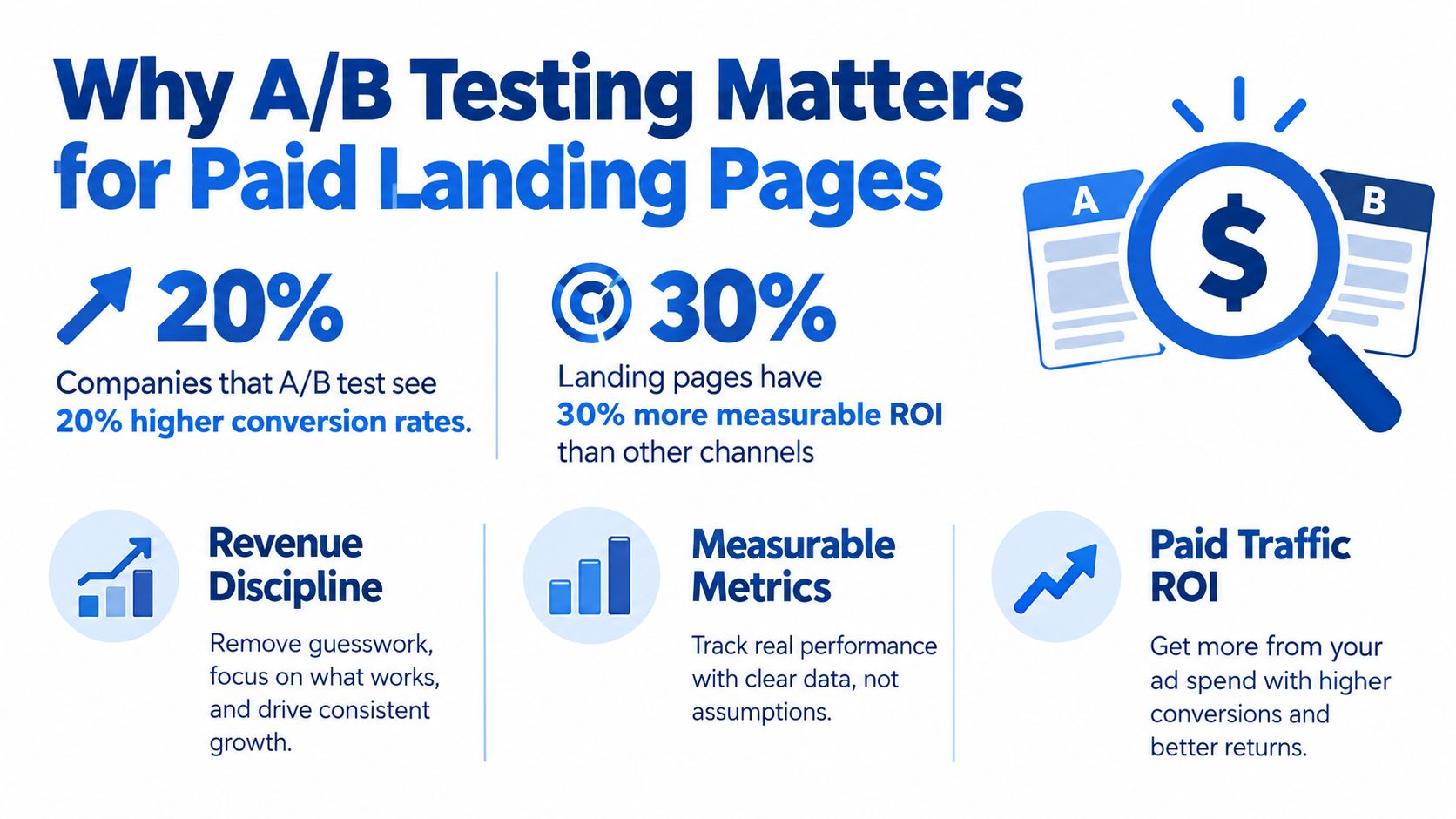
Landing pages are unusually measurable digital assets. Unbounce's benchmark, based on more than 41,000 landing pages and 464 million visits, places the median landing-page conversion rate at about 6.6%. That baseline doesn't tell you what your page should achieve, because conversion varies by offer, audience, device, and intent, but it gives you a useful reference point for distinguishing a meaningful result from ordinary fluctuation. The benchmark is summarized in landing-page conversion data from Unbounce and related sources.
Why most tests don't produce a winner
Only about one in eight landing-page A/B tests produces a statistically significant improvement, according to the same industry summary. That sounds discouraging until you understand the alternative. Without testing, teams often ship changes based on internal opinions, then attribute a later performance shift to the redesign, the ad platform, seasonality, or luck.
Most experiments fail to beat the control because the change is too small, the hypothesis is weak, the page has insufficient traffic, or the variation creates a trade-off between volume and quality. A failed test still gives you information if the audience, allocation, tracking, and stop rule were sound. It tells you that a particular change didn't justify its traffic cost under those conditions.
Practical rule: A test that protects you from shipping a bad change has commercial value, even when the variant loses.
The gains that do win are generally modest at the individual-test level. A CRO benchmark reports a median conversion uplift of 1.88% for winning A/B tests, while broader summaries describe 30% to 49% average improvement across sustained testing programs, not from one experiment. Those figures should change how you plan. Don't wait for one dramatic result. Build a backlog of hypotheses tied to friction, qualification, message fit, and sales outcomes.
For a useful perspective on connecting conversion work to broader commercial decisions, review these fractional CMO conversion insights. You can also use this landing-page optimization guide to audit the page before you spend traffic on a test.
The operating loop is simple:
- Audit the baseline: Find where users abandon, which devices underperform, and whether the offer matches the ad.
- Write the hypothesis: State the change, expected behavior, and commercial reason.
- Split traffic fairly: Keep allocation and traffic sources stable.
- Measure the funnel: Track conversion rate, CPL, acceptance, and downstream revenue.
- Document the result: Record what happened and use it to choose the next test.
Planning Your Test Around One Clear Hypothesis and KPI
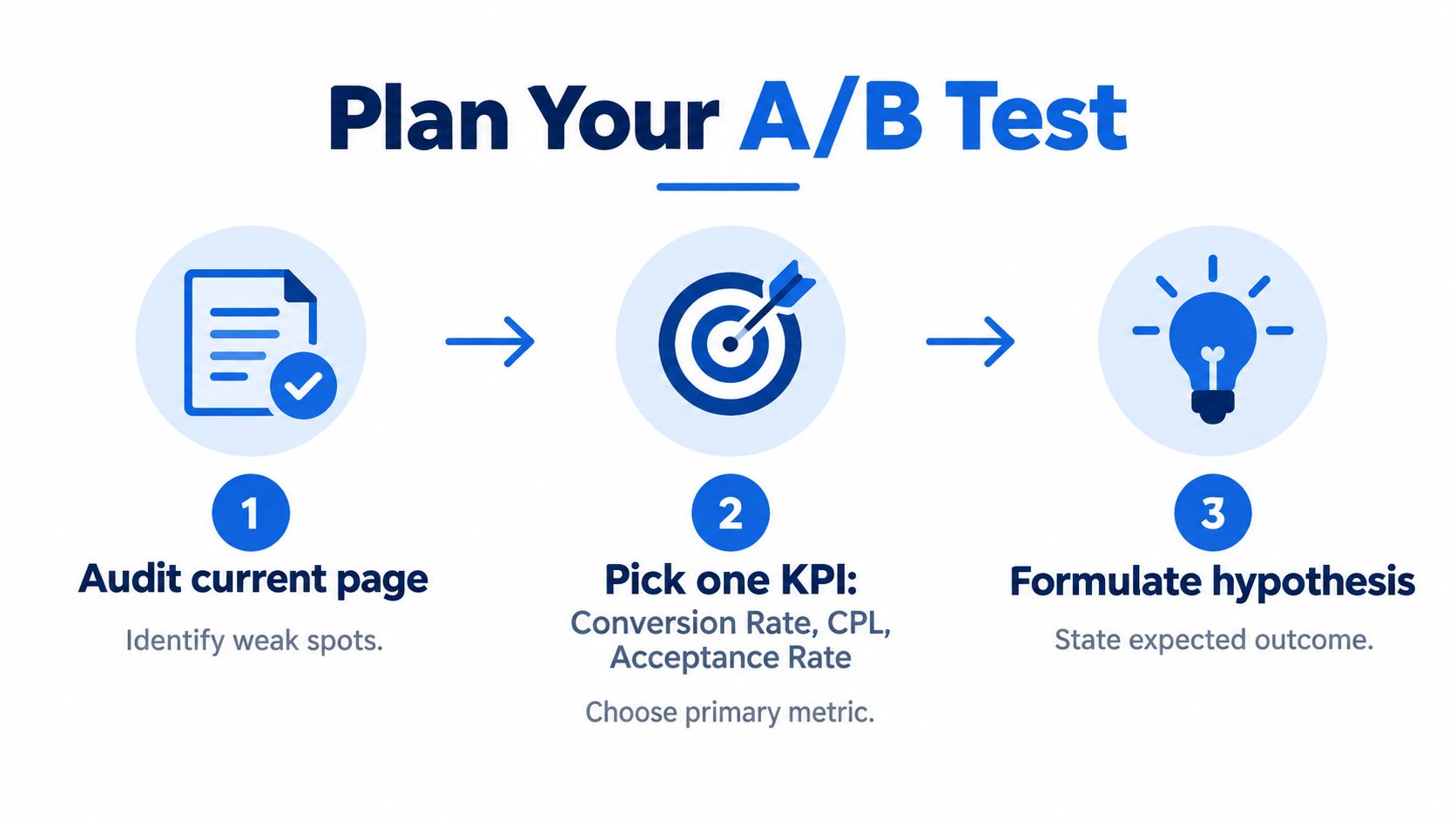
A test starts before you open an experimentation tool. First, audit the existing page and establish what problem you're trying to solve. Look at ad-to-page message match, load experience, mobile form behavior, field errors, abandonment by step, lead source, and the point where accepted leads disappear from the funnel.
Don't let the audit become a hunt for every possible defect. Pick the highest-cost problem that a page change could plausibly affect. If mobile users reach the form but abandon after a qualification question, a form-flow test is more relevant than a headline test. If leads complete the form but sales rejects them, reducing form friction may worsen the business even if the page conversion rate rises.
Choose one primary KPI
Your primary KPI should match the decision you're making. Conversion rate is appropriate when you're evaluating whether more visitors complete the intended action. CPL makes more sense when paid acquisition and spend are fixed enough for the business to judge efficiency. Acceptance rate, booked appointments, EPC, or revenue per lead may be the right primary measure when lead quality determines whether the campaign is viable.
Use guardrails for everything else. A lead-generation experiment might have:
- Primary KPI: Completed lead rate.
- Efficiency guardrail: CPL.
- Quality guardrail: Buyer acceptance or sales-qualified rate.
- Revenue guardrail: Downstream revenue per lead.
- Integrity check: UTM, click-ID, consent, and event completeness.
You can review the result on conversion rate first, but you shouldn't declare a commercial winner until the guardrails are stable and trustworthy. A page that generates more uncontactable leads can create a worse return while appearing successful in the front-end dashboard.
Write a falsifiable hypothesis
Use an if-then-because structure:
If we reduce perceived friction in the qualification flow, then completed leads will increase because visitors can answer the first questions without facing a long static form.
That sentence gives the team something to test and something to learn. It doesn't claim the result is guaranteed. A useful hypothesis also names the audience and context, such as mobile visitors from a specific paid campaign, rather than treating every visitor as interchangeable.
Document the control, variant, traffic source, audience, primary KPI, guardrails, launch date, planned end date, and decision rule before launch. Expert guidance on A/B testing landing pages and experiment design recommends random assignment, fixed traffic allocation, a predeclared stop rule, and a practical confidence benchmark of 95%. Treat that documentation as a preregistration for marketers. It prevents the team from changing the question after seeing the result.
A final planning test is worth asking: what decision will this result change? If a small improvement wouldn't alter budget, campaign structure, form logic, or sales routing, it may not deserve the traffic. Lead-gen teams rarely have unlimited volume, so the backlog should favor questions that can change CPL, acceptance, or revenue.
Sample Size Significance and How Long to Run the Test
A landing-page experiment becomes credible when the result reflects a controlled comparison rather than a temporary traffic pattern. Randomly assign visitors to the control and variant, keep the allocation fixed, and avoid changing the campaign mix while the test runs. If Meta, Google, or native traffic shifts materially between versions, you may be measuring audience composition instead of page performance.
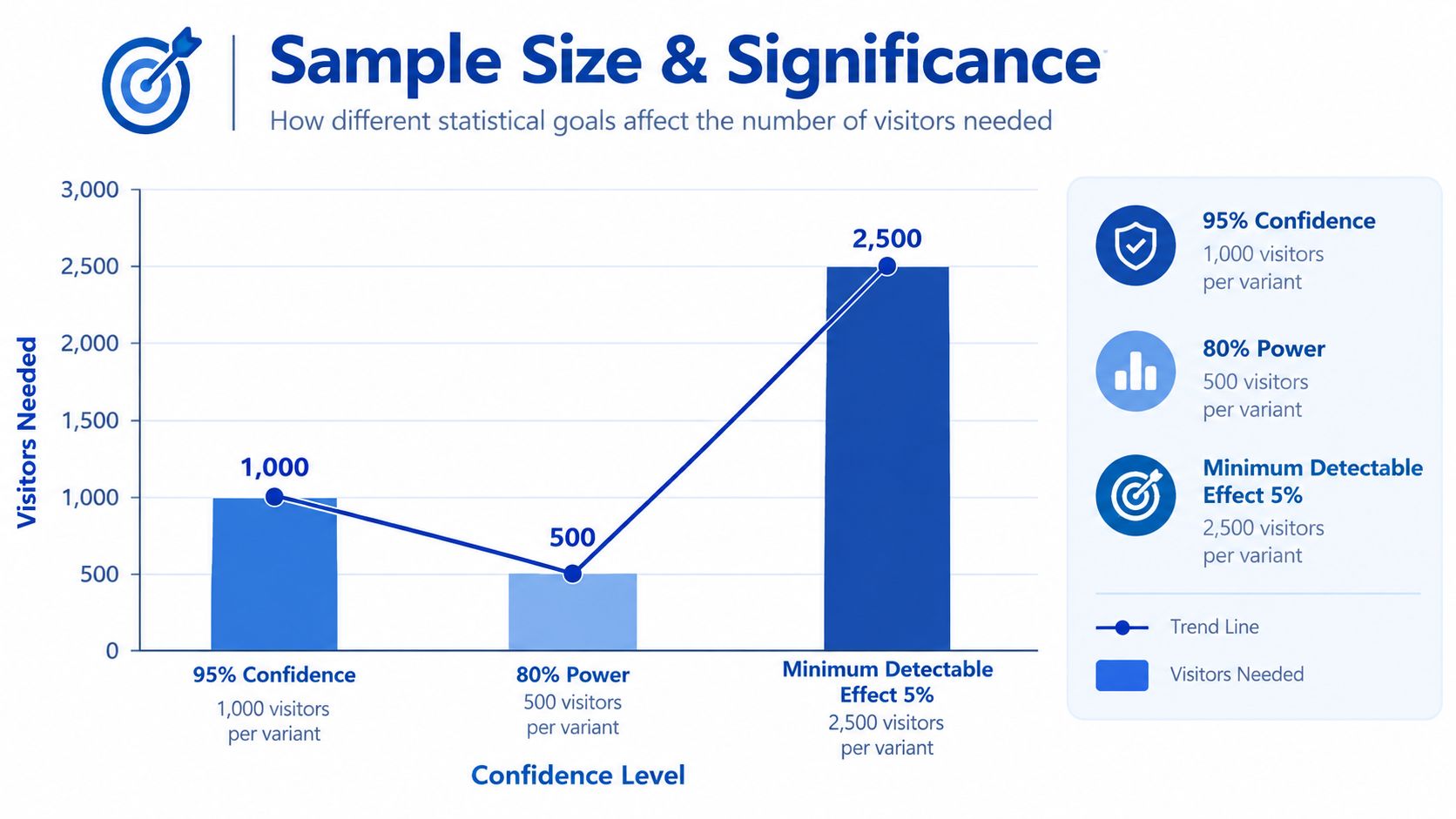
The practical benchmark is 95% statistical confidence, but confidence alone doesn't rescue an underpowered test. A few hundred visitors per variation may produce very few conversions, especially on a low-converting offer. A more reliable rule of thumb is to think in conversions per variation. One guide notes that a few hundred conversions per variation is more dependable than a few hundred visitors.
Why low conversion rates demand patience
At a 2% conversion rate, reaching 300 conversions per variant can require roughly 15,000 visitors per variant. The calculation is straightforward: expected conversions equal visitors multiplied by conversion rate. The business implication is more important than the arithmetic. If your page doesn't have the traffic to reach a useful conversion count, you may need to test a larger behavioral change, combine longer observation with qualitative research, or delay the experiment until the sample is viable.
This isn't an argument for waiting indefinitely. It's an argument for choosing a detectable effect that justifies the opportunity cost. A tiny visual change may require more traffic than the campaign can generate, while a substantial form-flow change may be more likely to produce a commercially relevant difference. The conversion-rate benchmark reference can help you frame the baseline, but your own audience and offer remain the deciding factors.
Stop rules prevent convenient conclusions
Peeking is one of the easiest ways to fool yourself. A marketer sees the variant ahead after a few days, pauses the test, and calls it a win. Early results are volatile, and repeated checking increases the chance that random movement looks like a real effect. Define the sample requirement and end date before launch, then evaluate the test after the planned run completes.
Run through at least one full business cycle so weekday and weekend behavior are represented. Keep ad creative, targeting, budgets, offer terms, and major page dependencies stable unless there's a genuine business reason to change them. If a campaign must change, document the timing and consider whether the experiment should be restarted.
The embedded explanation below provides additional context on experimental validity and significance.
Before launch, check that:
- Assignment is random: A visitor isn't consistently routed to a version because of an accidental rule.
- Allocation is fixed: The planned traffic split doesn't drift during the test.
- Events fire equally: Form starts, completions, calls, and qualified outcomes are recorded for both versions.
- The stop rule is written: Nobody can end the test because the chart looks favorable.
- The business cycle is covered: The run captures the normal rhythm of the campaign.
A statistically credible result still needs commercial interpretation. Significance tells you whether the observed difference is unlikely to be random under the model. It doesn't tell you whether the extra leads are accepted, contactable, compliant, or profitable.
High Impact Variants to Test on Lead Gen Funnels
The highest-value landing-page tests usually change how a visitor understands the offer or moves through the form. Cosmetic edits can be useful when they remove a real usability problem, but button color and styling rarely deserve priority over message, structure, qualification, and friction.
A 2026 analysis of landing-page experiments found that layout changes beat the control 14% of the time, CTA copy 10%, and styling 7%, as reported in landing-page test-type benchmarks. The lesson isn't that layout always wins. It's that test selection matters, and teams should stop treating every visible element as equally valuable.
Compare the flow, not just the form
A static form with every field visible asks visitors to make a large commitment immediately. A multi-step flow can introduce the task gradually, use a progress indicator, and apply conditional logic so people see only relevant questions. The trade-off is that a shorter first step can increase starts without improving completed leads if later questions reveal an unattractive offer or disqualify too many users.
Test form structure when the page has clear mobile abandonment or when qualification requires several questions. Test single-step against progressive disclosure, short form against quiz-style flow, and generic questions against questions that create useful segmentation. If a buyer only accepts leads in specific locations or circumstances, disqualification logic can protect downstream economics, but it may reduce headline lead volume. That's a feature if the rejected leads were never monetizable.
Prioritize tests by commercial risk
| Test Type | Win Rate vs Control | Best For |
|---|---|---|
| Layout | 14% | Reordering value, proof, form, and objection handling |
| CTA copy | 10% | Clarifying the action or aligning the CTA with intent |
| Styling | 7% | Fixing genuine visibility, contrast, or usability problems |
The win-rate figures above come from the same 2026 landing-page experiment analysis. They should guide prioritization, not become a promise about your campaign. A layout test can still lose when the current order is already strong. A styling test can win when poor contrast or cramped tap targets are suppressing mobile completion.
Strong candidates for lead-gen testing
Message and offer framing deserve attention when paid ads promise a specific outcome but the landing page opens with generic brand language. Test a direct continuation of the ad promise against a broader positioning statement. Measure whether the variant attracts the intended audience, not only whether more people submit.
Form length and field sequence matter when users encounter effort before trust. Test asking for low-friction information first, then introducing qualification. Keep fields that protect lead value, consent, routing, or buyer requirements, and challenge fields that exist only because someone might find them useful later.
Progress and reassurance can help longer flows. Test a clear progress bar, inline validation, address lookup, or short explanations beside sensitive fields. Each addition should have a reason. A progress bar that says a form is nearly complete may reassure users, while one that reveals a long process too early may increase abandonment.
Trust and objection handling should answer the concern blocking action. Test proof near the form, privacy language, call expectations, service-area clarity, or a concise explanation of what happens after submission. Don't add testimonials to fill space. Use evidence that matches the visitor's decision.
For each variant, predict the likely trade-off:
- More completions: Could increase total lead volume.
- More qualification: Could improve acceptance while reducing volume.
- Less friction: Could lower CPL but attract weaker intent.
- More transparency: Could reduce form starts but improve downstream conversion.
The best test is the one whose outcome changes your buying or routing decision. Button styling usually doesn't.
Setting Up Tracking So Attribution Survives the Funnel
A test can be statistically clean and commercially useless if attribution breaks after the first form step. Paid landing pages need a continuous record from ad click to submission, CRM status, buyer acceptance, and revenue. That record must survive redirects, multi-step interactions, embedded forms, and server-side events.
Capture identifiers at the first touch
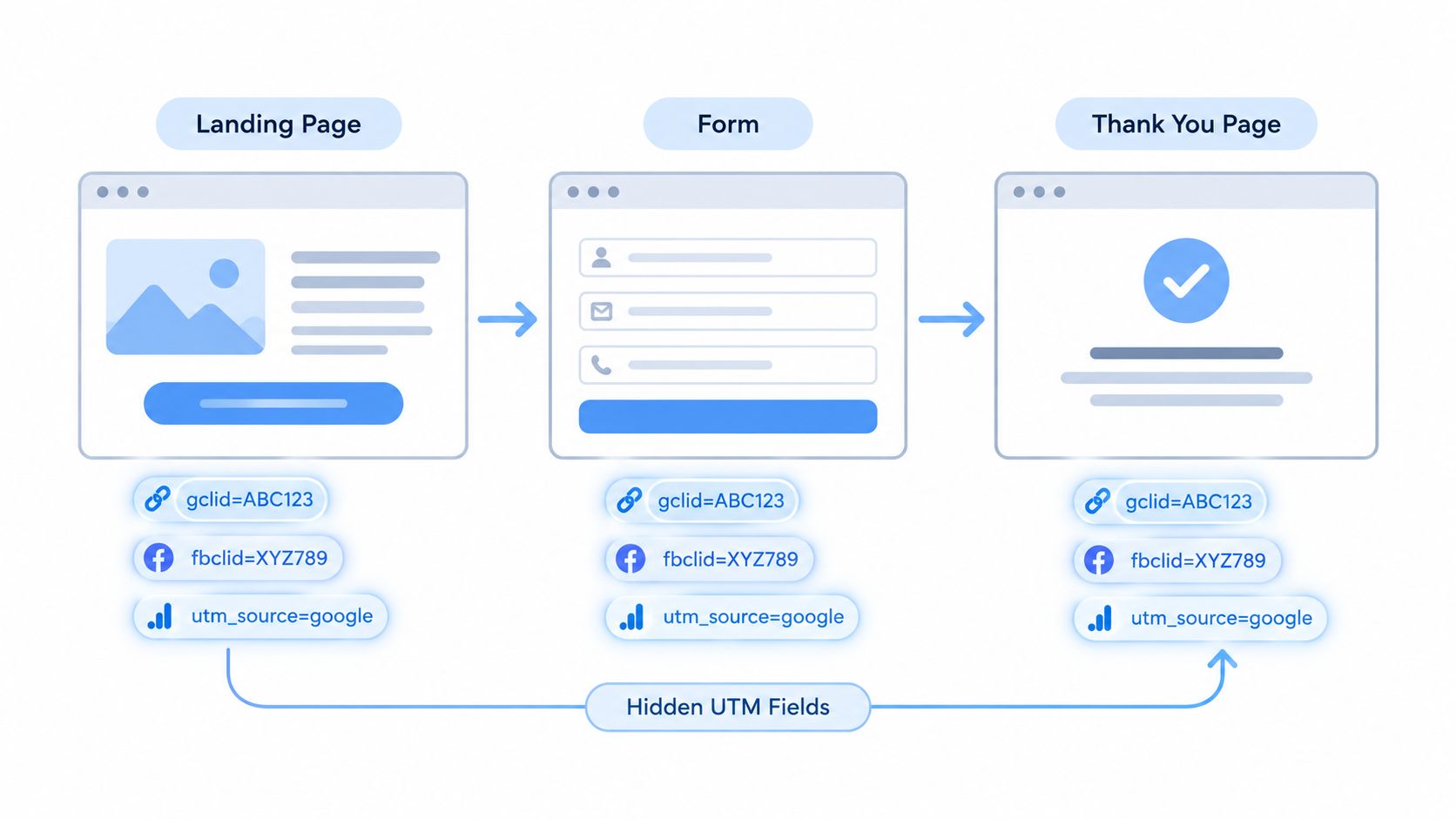
Persist UTMs and click IDs as soon as the visitor arrives. Common fields include source, medium, campaign, ad set, ad, keyword, placement, sub-ID, gclid, and fbclid. Store them in first-party cookies or session storage, then map them into hidden fields that travel with the submission.
The page variation should also be recorded. Add a control or variant identifier to the payload so downstream reports can compare outcomes after the lead leaves the landing-page platform. If the experiment tool assigns the version in the browser but the CRM never receives that assignment, the sales team can't connect page exposure to acceptance or revenue.
Validate events before buying more traffic
Use Google Tag Manager or the testing platform to fire browser events, then add server-side signals through Meta and Google conversion APIs where the stack supports them. Browser-only tracking can miss conversions because of consent settings, blockers, browser restrictions, or network failures. Server-side events won't fix bad field mapping, so validate both paths rather than assuming one compensates for the other.
Test the full path with controlled submissions:
- Landing arrival: Confirm UTMs and click IDs are captured.
- Step progression: Verify starts, advances, errors, and abandonment events.
- Completion: Check that the primary conversion fires once.
- CRM handoff: Confirm the correct source, campaign, variation, and consent fields arrive.
- Distribution: Verify routing to HubSpot, Salesforce, GoHighLevel, or the relevant buyer platform.
- Outcome reporting: Return acceptance, rejection, booked appointment, or revenue status to the experiment report.
Consent evidence deserves its own validation. If the campaign depends on TrustedForm or Jornaya, confirm the certificate or lead identifier is attached to the correct submission and remains available downstream. Phone and email verification should also be tested for both variants, because a change in field behavior can alter the quality of captured contact details.
Real-time delivery reduces the gap between submission and follow-up. Webhooks or Zapier can pass records into CRM and distribution systems, but monitor retries, duplicate events, field transformations, and failed responses. A campaign attribution framework offers a useful way to think about preserving source data across the funnel.
Growform can be used as a no-code capture layer for multi-step, quiz-style, and single-step lead forms, with hidden-field pass-through, conditional logic, real-time integrations, and consent integrations. It's one option for teams that need to test the form experience without separating form behavior from attribution and delivery plumbing.
Interpreting Results and Iterating Without Losing Gains
A winning variant is not the page with the higher completion rate. Start with the primary KPI you declared before launch, then inspect the guardrails. If the variant raises completed leads but lowers acceptance, contactability, booked appointments, or revenue per lead, it hasn't solved the business problem.
Segment carefully, but don't search every slice until something looks favorable. Review device, campaign, audience, geography, and step-level behavior when those segments were part of the original hypothesis or when the overall result looks contradictory. A mobile lift with a quality decline may point to a faster but less informative flow. That's a decision, not an automatic victory.
Protect the learning
Avoid running multiple material tests on the same page at the same time. Overlapping changes make attribution ambiguous, especially when one variant changes the headline while another changes the form. Novelty effects can also make a fresh experience look stronger during the first part of a test, so compare the planned run rather than the most exciting early window.
Document more than the winner:
- Question: What commercial problem did the test address?
- Change: What did visitors see differently?
- Result: How did the primary KPI and guardrails move?
- Interpretation: What behavior likely explains the outcome?
- Decision: Ship, reject, rerun, or test a related idea.
- Next hypothesis: What should the team learn next?
If the variant wins cleanly, roll it into the landing page and paid campaigns deliberately. Preserve the original result, annotate the deployment date, and monitor performance after the change. Keep the traffic source mix stable while you confirm that the improvement survives normal campaign conditions.
Your next week's testing checklist can be short:
- Audit the page and identify one expensive friction point.
- Choose one primary KPI and quality guardrails.
- Write the if-then-because hypothesis.
- Confirm split integrity, event tracking, and sample requirements.
- Build a meaningful flow, layout, message, or qualification variant.
- Launch without changing the traffic mix.
- Evaluate only after the planned stop rule.
- Feed the result into the next commercial hypothesis.
The compounding advantage comes from improving the decision process. Teams that connect landing-page conversion to CPL, acceptance, and downstream revenue stop celebrating cheap leads that buyers reject and start building funnels that perform across the whole acquisition system.
Use Growform to build and test multi-step or quiz-style lead forms with conditional qualification, hidden-field attribution, and real-time delivery into your CRM or distribution stack. Visit Growform to compare form variations around the metrics that matter, then launch your next paid-traffic experiment with lead quality and revenue included in the decision.