
Interactive Marketing Campaigns That Convert (2026 Guide)
 Harvey Carpenter Published 12 min read
You've got traffic coming in, the ad platform says the campaign is “working,” and the landing page still feels like a sieve. Meta clicks are getting more expensive, native traffic is noisier than ever, and your single-step form is asking strangers for too much, too soon. That's the moment interactive marketing campaigns stop looking like a creative experiment and start looking like the only sane way to turn paid attention into qualified demand.
The Funnel That Changed Everything
A paid media buyer stares at a dashboard that looks busy and feels broken. Meta is sending clicks, native tabs are filling with traffic, and the static form on the landing page is leaking leads before the first field is finished. The campaign isn't failing in the ad platform, it's failing at the point where a stranger has to decide whether your offer is worth their attention.
That's the pattern I see over and over. Static pages can still work, but they're blunt instruments when you're buying attention at scale and asking for more than a casual email opt-in. When the form is long, the offer is specific, or the traffic is cold, every extra bit of friction shows up as worse completion and worse lead quality downstream. A funnel like that can make your dashboard look active while the CRM fills with junk.
Interactive marketing campaigns changed that equation because they don't just present content, they collect signals while they sell. The experience becomes part of the conversion path, not a decorative layer on top of it. That's why teams keep moving from passive landing pages to multi-step flows, quizzes, calculators, and branching experiences that qualify before they ask for the handoff.
Practical rule: if the page can't tell you anything useful about the buyer, it's probably not doing enough work for paid traffic.
The shift matters even more now because the old attribution shortcuts are weaker and every click has to earn its keep. If you want a clean view of where the leak is happening, start by tightening the front end of the funnel and the handoff to the backend. A good place to look is the sales-funnel optimization guidance in this Growform resource, because the problem is rarely just “more traffic.” It's usually the structure between the click and the conversion.
What Interactive Marketing Campaigns Actually Are
Interactive marketing campaigns are campaigns that require an active user response before they deliver a personalized outcome. The simplest version is a quiz. The more operational version is a multi-step form that changes based on the answers. Calculators, polls, configurators, interactive video, AR try-ons, and shoppable content all fit the same pattern when they ask the user to participate instead of just consume.
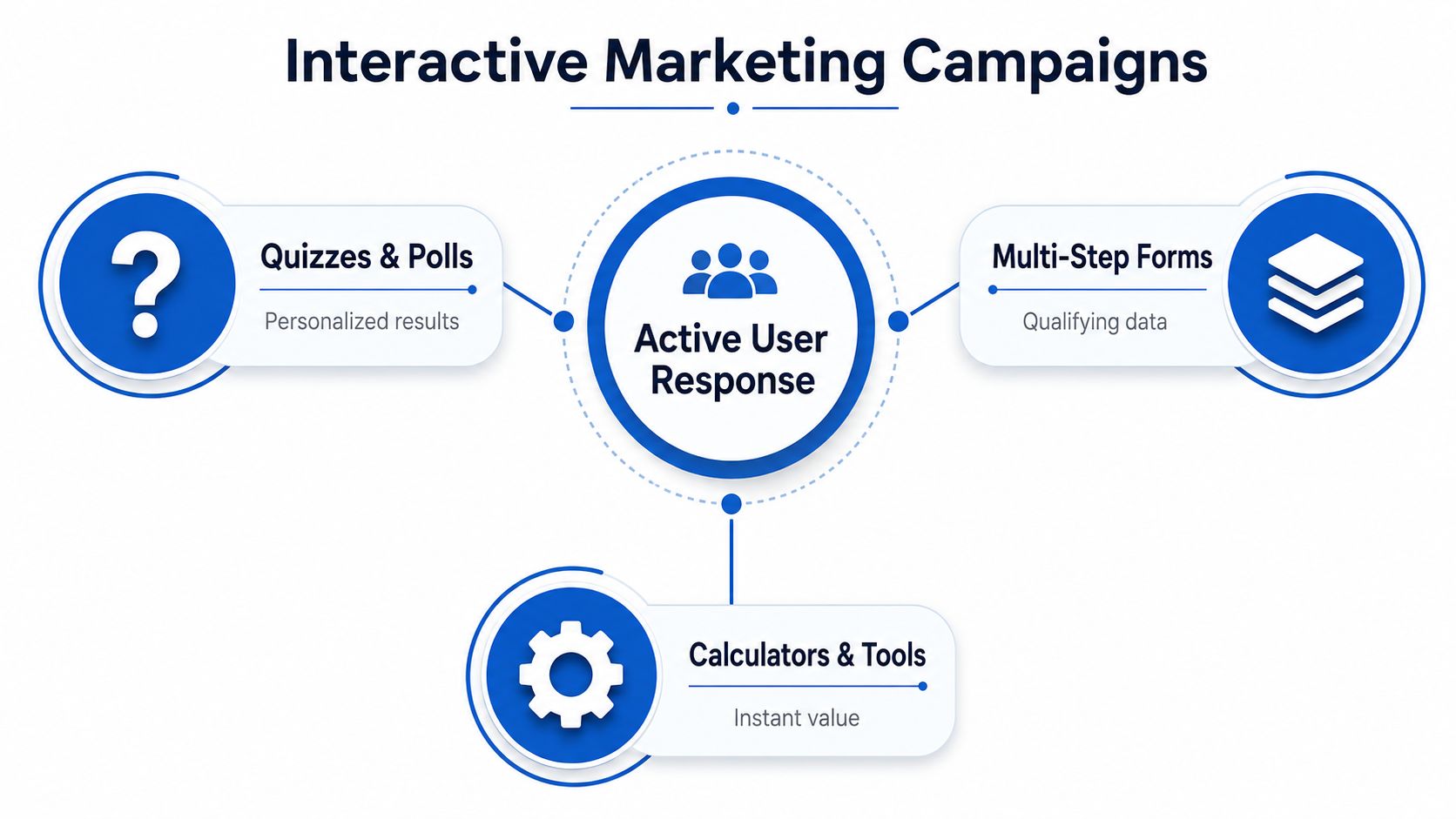
The difference from static content is bigger than format. Static pages broadcast. Interactive campaigns exchange value. The user gives answers, clicks, or preferences, and the campaign gives back a result, recommendation, quote, or next step. That exchange creates first-party data as a side effect, which is why acquisition teams care about it and why these campaigns have moved from novelty to standard practice in many paid funnels. Compiled stats in the Marketing Scoop review of interactive content marketing show that interactive content tends to generate about 2x more engagement than passive content, with engagement rates around 52% vs. 36% for static content and conversion rates in the 30% to 50% range versus 10% to 30% for static formats.
Identifying a true interactive campaign
A dressed-up static page often fails the test because it asks the user to scroll, then submit, with nothing personal in between. A true interactive campaign changes the path based on the response. The outcome gets sharper as the answers accumulate, and that is what makes the form feel useful rather than extractive.
You can usually tell the difference by asking three questions.
- Does the user change the outcome? If not, it's probably static content with decoration.
- Does the campaign capture usable data? If not, the interaction may be entertaining but useless for lead gen.
- Does the response shape the next step? If not, you're paying for clicks, not qualification.
The best interactive marketing campaigns do all three. They capture data, personalize the path, and make the user feel like the result was built for them. For a practical view of how teams measure that behavior, see landing page metrics for interactive funnels.
Why Interactive Formats Move the Needle
Interactive formats work because they line up with how people make small decisions before they make big ones. The first response is easy, the next one feels more natural, and by the time the final submit button appears, the user has already invested effort. That's the advantage, not novelty. A good funnel uses psychology to lower resistance and raise the value of the final action.
Reciprocity, commitment, and ownership
Reciprocity shows up when the user gives you data and gets something useful back. A calculator returns a price range. A quiz returns a recommendation. A branching form returns a more relevant offer. That exchange feels fair, which is why it's easier to complete than a cold ask for contact details.
Commitment and consistency matter because each early answer makes the next one feel like a continuation, not a new decision. Progress bars help here, but only if the steps are short and the sequence feels logical. If the first question is simple, the user is more likely to keep going than if you lead with high-friction qualification too early.
The IKEA effect is the last piece. People value outcomes they helped shape. That's why a personalized result page can outperform a generic thank-you page, and why a quote feels more tangible when the user has adjusted inputs along the way. The campaign stops feeling like a form and starts feeling like something they built.
The trap: more interaction isn't automatically better. Interaction only helps when it pushes the user toward qualification or conversion, not when it turns the journey into a game with no business outcome.
That's why the goal is segmentation and pipeline quality, not applause. A campaign can be lively and still be useless if it doesn't improve the lead that lands in CRM. The best operators treat the interaction as the mechanism, not the metric.
The Core Interactive Formats Worth Knowing
Different formats solve different problems, and paid acquisition teams usually don't need all of them. They need the one that matches the offer, the traffic source, and the level of information required before a lead is worth routing. For lead gen, quizzes and multi-step forms show up most often because they qualify without feeling like paperwork.
Format comparison at a glance
| Format | Build Effort | Lead Quality | Best Use Case |
|---|---|---|---|
| Quizzes and assessments | Moderate | High when the questions are tied to intent | Pre-qualifying buyers and segmenting by need |
| Multi-step forms with conditional logic | Moderate to high | High | Paid lead gen where routing depends on answers |
| Calculators and configurators | Moderate | High for purchase-intent traffic | Quotes, estimates, savings, and scenario-based offers |
| Polls and surveys | Low | Medium | Fast segmentation, audience research, retargeting angles |
| Interactive video and shoppable video | High | Medium to high | Product discovery and click-to-action funnels |
| AR try-on and product visualization | High | Medium to high | Retail, beauty, real estate, and visual-led offers |
Quizzes are strongest when the answer itself creates intent. They're useful for matching a user to the right offer, and they can turn a vague prospect into a clearer segment in a few questions. If you need a practical starting point, this Growform guide to lead-gen quizzes is useful because it focuses on qualification rather than entertainment.
Multi-step forms are different. They're the right choice when the lead has to be routed, sold, or scored before it reaches a human. That's where conditional logic matters, because the funnel can ask harder questions only after the user has already committed to the flow.
If you're in a visual category, property tours are another strong use case. A good example is how teams use virtual tours to sell properties faster with virtual tours, because the interaction helps the buyer self-select before a sales conversation even starts. The principle is the same across verticals, the user is not just watching, they're moving themselves closer to a decision.
Metrics That Actually Matter for Interactive Campaigns
The dashboard needs to tell you more than who clicked and who started. Those numbers are useful, but they don't tell you whether the funnel is creating usable demand. If a campaign produces lots of starts and weak submissions, the media buyer may celebrate the top of funnel while the sales team inherits a mess.
Engagement is not the finish line
The metrics that matter most sit in three layers. First, track completion rate, step-by-step drop-off, interaction rate, and hotspot CTR when the format supports it. Those numbers tell you whether the experience is usable. Benchmark material from Zigpoll says interactive experiences commonly land in the 60% to 95% completion range depending on format, while example campaigns report 40% interaction rates, 15% hotspot CTRs, and 10% CTA-driven purchase conversion versus 3% for traditional video ads, which shows how much the design itself can influence outcomes when the flow stays simple, according to the Zigpoll engagement metrics guide.
Next, track qualification metrics. That means completed leads, score thresholds, time to first qualified action, and rejection rate from buyers. These are the numbers that tell you whether the campaign is creating a pipeline worth paying for.
Finally, track pipeline metrics. Lead-to-opportunity rate, meeting booked, opportunity created, and revenue per click tell you whether the whole machine is working. If your first-party data is clean, these numbers should be visible in HubSpot, Salesforce, GoHighLevel, or a distribution platform through webhooks, hidden fields, and server-side conversion signals. Growform's landing-page metrics guidance is worth using here because it focuses on the handoff, not just the form start, and the landing page metrics resource is a good reference point for tying the front end to the backend.
Practical rule: if the form data doesn't land in CRM with source, step path, and consent evidence intact, the campaign is harder to optimize than it should be.
The biggest mistake I still see is teams treating every interaction as a win. A click is not a qualified lead. A start is not a sale. The only question that matters is whether the interaction improved the odds of revenue.
Design and Targeting Rules That Actually Move CPL
High-converting interactive funnels are usually boring in the best way. They start easy, they stay short, and they don't make the user solve a mystery. The design goal is to reduce perceived effort while increasing the amount of useful data you can capture before the handoff.
Build for momentum, not novelty
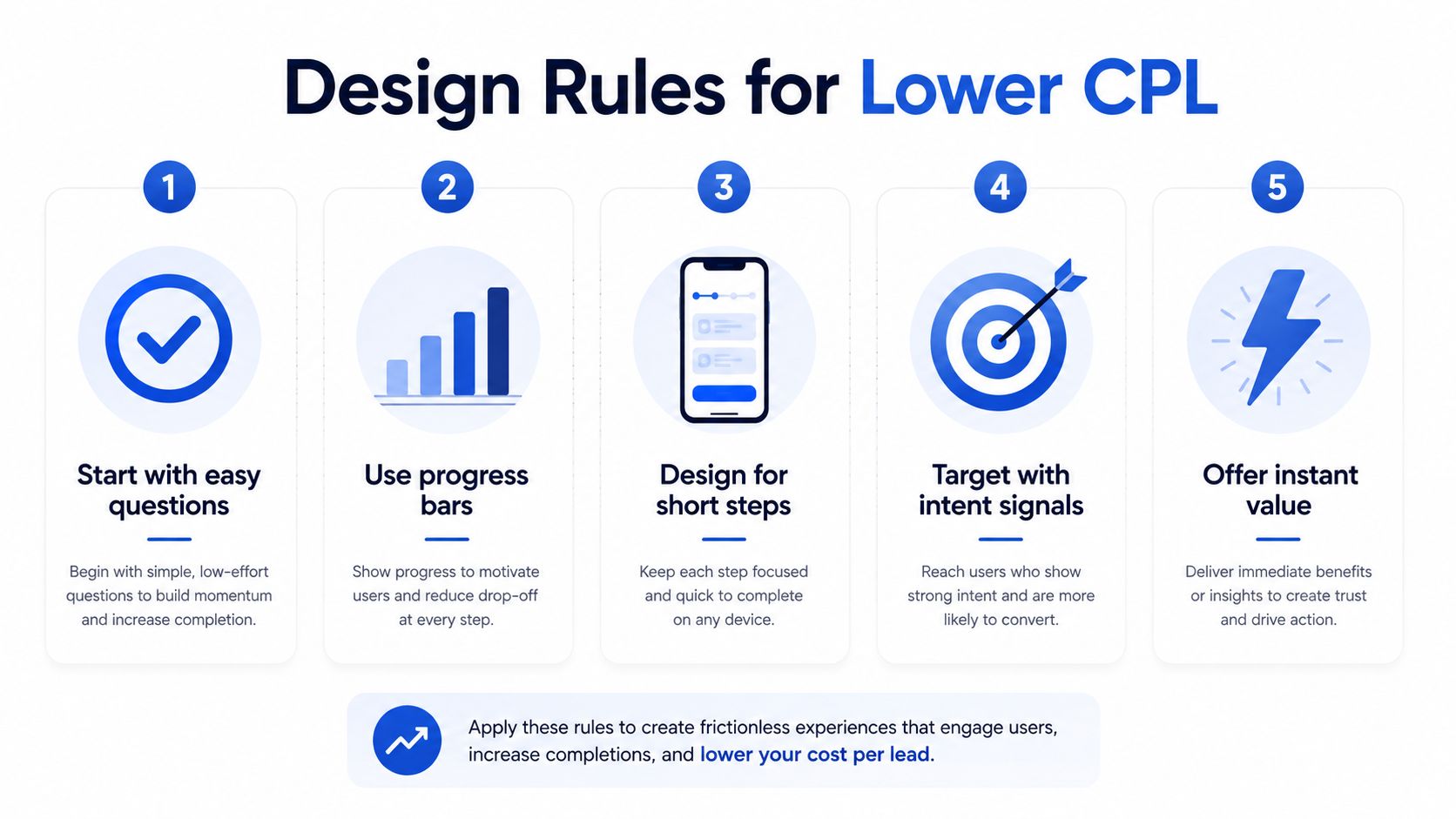
Start with the easiest questions. That keeps momentum alive and makes the next step feel earned rather than forced. Put the heavier qualification later, after the user has already invested a little attention.
Use progress bars, but don't overdo the visual drama. The point is to signal that the finish line exists. If the steps are clear and the path is short, the progress indicator does its job.
Conditional logic should disqualify junk early. If a visitor is outside your service area, not a homeowner, not in-market, or otherwise mismatched, don't wait until the last field to find out. Good funnels reduce waste before the CRM ever sees it.
Keep attribution intact
UTMs, click IDs, source, and sub-ID fields need to survive every step. If they disappear halfway through the flow, you lose the ability to reconcile media performance with actual pipeline outcomes. That's especially painful when the campaign is running across multiple channels and the buyers are judging you on lead quality, not clicks.
Mobile-first design matters because most of these journeys happen on small screens, and the experience has to feel native there. Short steps, large tap targets, and fast loads beat clever visual effects. Matching the format to the traffic source matters too, because a quiz that feels natural on one channel can underperform badly on another if the audience context is wrong.
A lot of teams also reach for Growform here because it's built for multi-step and quiz-style lead capture, conditional logic, pass-through of tracking data, and real-time delivery into CRMs and distribution systems. That makes it a practical option when the campaign needs routing and qualification, not just form submission.
A funnel that leaks before the CRM usually shows the same red flags.
- Questions feel hard too early: the user hasn't earned trust yet, so the flow stalls.
- The CTA arrives before value: the experience asks for a commitment before it gives one.
- Tracking breaks between steps: source data disappears and attribution becomes guesswork.
- The page is slow on mobile: the delay turns curiosity into abandonment.
- Disqualification happens too late: junk leads flow through and buyer rejection rises.
If those are happening, the funnel isn't just underperforming. It's sending the wrong signal to every downstream team that has to work the leads.
Three Growform Playbooks for High-Volume Lead Gen
The fastest way to make this practical is to map the funnel to a vertical that already depends on qualification. Insurance, solar, and mortgage all need cleaner routing than a one-field form can provide, and they're common places where paid traffic gets expensive fast. These playbooks are built around the same principle, ask enough to qualify, but don't ask in a way that kills momentum.
For insurance, the flow should start with policy type, then move into ownership, ZIP, and a small set of intent questions. TrustedForm and Jornaya evidence should be captured at submission, and the lead should route in real time via webhook to the buyer or distribution layer. The KPI to watch in the first 30 days is not just form completion, it's buyer acceptance.
For solar, the quiz should segment by roof type, home ownership, and energy usage before it presents the offer. That lets the campaign match the homeowner to the right solution instead of dumping every click into the same bucket. The first KPI is qualified completion, because the point is to sell a fit, not to harvest curiosity.
For mortgage, the calculator should turn a rate or payment estimate into a route toward appointment booking. Non-owners and out-of-area visitors should be removed early through conditional logic, not after the estimate is already calculated. The KPI to watch is meeting quality, because that's where a calculator proves it can do more than impress.
The easiest way to see the behavior in practice is to watch a live build and then reverse-engineer the flow.
Launch Checklist and the One Question Every Campaign Should Answer
A clean launch starts with the pipeline outcome, not the format. Define whether the campaign needs qualified leads, booked meetings, sold leads, or something else, then choose the interactive structure that supports that outcome. Build the question flow, wire the integrations, verify tracking, and make sure the submission reaches the CRM with the right source data intact.
The first 30 days should be a measurement sprint. Track completion rate, lead quality, reject rate, and revenue per click, then decide which layer needs attention first. If completion is weak, the experience is too hard. If completion is fine but lead quality is poor, the logic or targeting is off. If quality is good but revenue per click is weak, the offer or routing needs work.
The question every campaign should answer is simple. Did the interactive experience improve pipeline quality, or did it just increase activity? If you can't answer that cleanly, the campaign isn't finished yet.
If you're planning a new interactive funnel, build it around the qualification step instead of the vanity step. Growform gives performance teams a way to ship multi-step forms, quizzes, conditional logic, and real-time CRM handoff without waiting on engineering. Visit Growform if you want to turn paid clicks into cleaner leads and a more measurable pipeline.
Related articles
Digital Ad Campaigns That Convert: A 2026 Playbook
You've seen this campaign before. A prospect clicks a Meta ad, reaches a landing page, starts the form, and submits.
September 11, 2026
8 Ad Strategy Examples That Drive Better Leads
A winning ad isn't defined by its hook or click-through rate alone.
September 10, 2026
8 Lead Qualification Questions That Convert
The best qualification question isn't always the first one.
September 4, 2026