
Ping Post Software Guide Real-Time Lead Distribution
Ping post software exists because fixed pricing leaves money on the table. In competitive verticals, ping post software generates 20 to 40 percent more revenue per lead compared to fixed-rate routing, based on Boberdoo buyer benchmarks and 2026 industry analysis published by LeadDistro AI in its guide to what ping post is. The surprising bit is that the biggest failures usually don't happen in the auction logic. They happen earlier, in the form, the hidden fields, the consent record, or a timeout nobody logged.
Ping post is a method of selling leads in two steps: buyers receive a partial, anonymised version of the lead (the ping) and bid on it, and the winning buyer then receives the full contact details (the post).
That sounds simple. In practice, it only works when the capture layer, routing logic, compliance evidence and buyer endpoints all agree on the same payload, timing rules and acceptance criteria. Most guides skip that part. That's where real implementations break.
Table of Contents
Table of Contents
- Understanding Ping Post Software
- Comparing Ping Distribution Methods
- Prerequisites for Selling Leads in Real Time
- Building the Form for Ping Post Workflows
- Annotated Ping and Post Payloads
- Building a Reliable Architecture
- Consumer Fairness and Choosing the Right Delivery Model
- Frequently Asked Questions
Understanding Ping Post Software
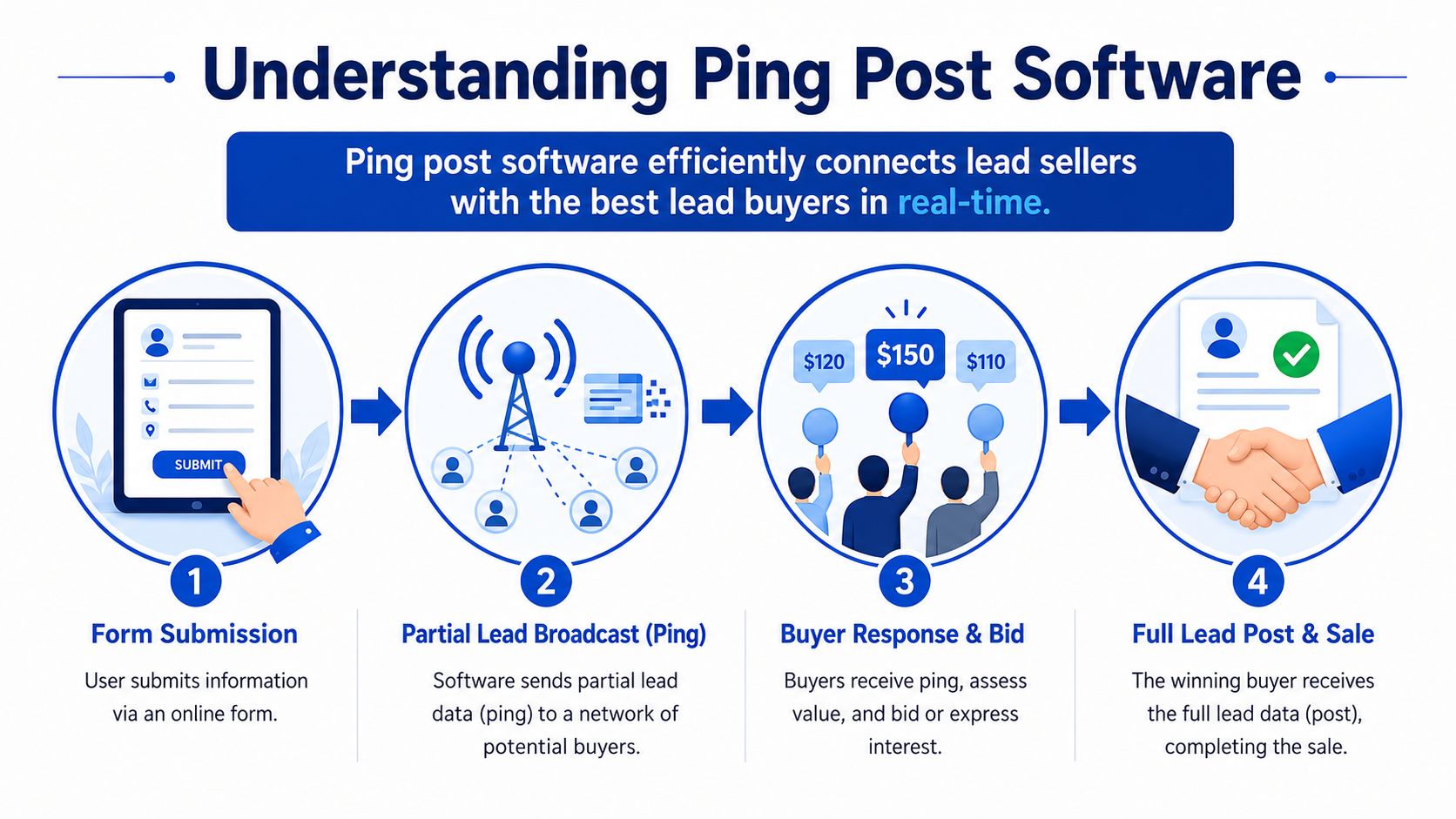
Ping post software sits between the form submit and the buyer. Its job is to take one incoming lead, decide who should see a partial version of it, collect bids or passes, then deliver the full record to the winning buyer fast enough that the lead is still worth calling.
The two-step handshake
The ping contains enough information for a buyer to price the lead without exposing the consumer's identity. That usually means the vertical, state, and qualifying answers such as homeowner status, coverage type, injury type or property details. It does not include name, phone number or full address. Holding back contact details protects the seller from being bypassed and stops buyers from calling leads they haven't won.
The buyer replies with a bid or a pass. In an auction setup, several buyers receive that ping at the same time. In a ping tree, the system moves through buyers in order until one accepts.
The post is the full lead record sent only to the winner. That payload carries the consumer data, the form answers that justified the bid, and the consent evidence that proves the lead can be contacted under the agreed rules.
Practical rule: If consent proof only exists in your form platform but never travels with the sold lead, the lead isn't really distribution-ready.
What happens under the hood
A typical journey looks like this:
- Form submission arrives with user-entered fields and hidden attribution fields.
- Distribution logic validates the lead, checks rules, and prepares the ping.
- Buyers respond with bids or passes.
- Winner receives the post and the transaction is logged.
That sounds familiar if you've worked in Boberdoo, Phonexa or LeadsPedia. The same principles also show up in buyer-side systems such as a carBoost lead management system, where routing quality depends on what arrives in the first payload and how quickly the recipient can decide.
The reason this model pays better than direct fixed routing is simple. Real-time bidding reflects current demand, not yesterday's negotiated rate.
Comparing Ping Distribution Methods
Not every lead distribution setup needs a full auction. Sometimes one trusted buyer is enough. Sometimes a ladder works better than a marketplace. The right choice depends on how many buyers are live, how much pricing variation exists in the vertical, and how much engineering patience the team has.
Distribution method comparison
| Model | Buyer Selection | Speed | Price Discovery | Integration Effort | Best For |
|---|---|---|---|---|---|
| Ping tree | Buyers are checked in priority order until one accepts | Fast when the top buyer is healthy, slower when several buyers pass | Limited, because the route follows order rather than open competition | Moderate | A few known buyers with clear ranking rules |
| Auction | Multiple buyers bid at the same time and the highest valid bid wins | Fast if endpoints are clean and timeouts are tight | Strong, because demand sets the value in real time | Higher | Open marketplaces and sellers trying to maximise yield |
| Direct post | One buyer receives the full lead immediately | Fastest to implement | None, because there is no bidding | Low | One trusted buyer or captive internal sales team |
A ping tree works well when buyer relationships are stable and the seller already knows who should get first look. An auction is better when value moves throughout the day and different buyers want different slices of inventory. Direct post is the least fiddly option, but it gives up the pricing benefit of competitive routing.
For a broader look at the category, Growform has a useful overview of lead distribution software that maps where form capture stops and routing infrastructure begins.
The trade-off is straightforward. The more open the market, the better the price discovery. The more moving parts, the more careful the implementation has to be.
Prerequisites for Selling Leads in Real Time
Real-time lead sales fail long before the first bid if the plumbing is wrong. The usual guides cover buyers and routing, but the breakpoints are often consent evidence, hidden attribution values, and timeout behavior between form submit and buyer response.
Buyer access and routing
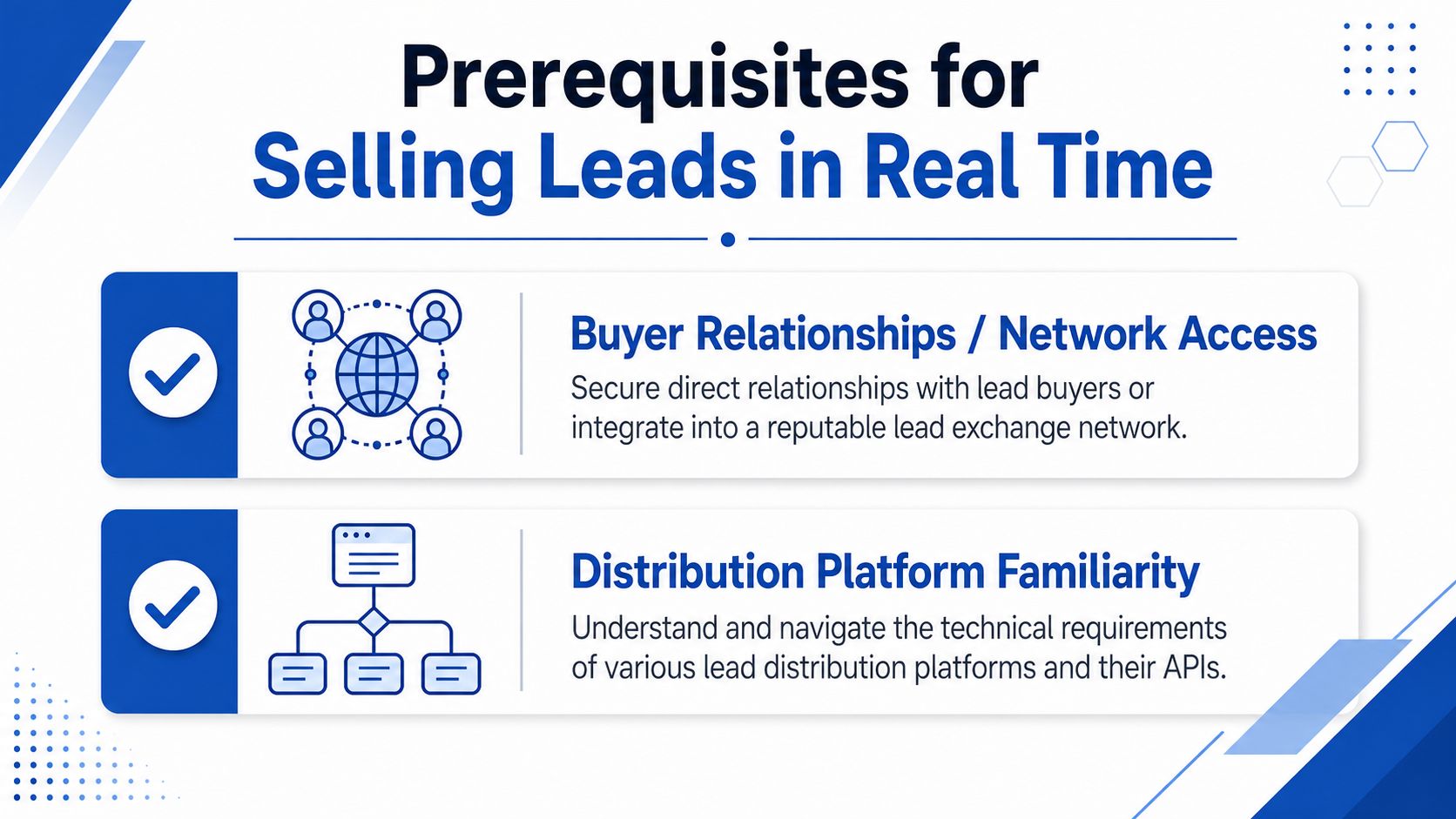
A lead needs a real destination before it needs software. That can be direct buyer contracts, a marketplace, or a network, but each path only works if the buyer has documented field requirements, response codes, payout terms, and a clear definition of what counts as accepted, rejected, or duplicate.
The distribution layer usually sits in Boberdoo, Phonexa, or LeadsPedia. Those platforms handle routing rules, buyer mappings, reporting, and billing. A smaller operation can post straight to buyer webhooks and save platform cost, but then the team has to own retries, request logs, duplicate suppression, and outage handling. That trade-off is fine at low volume. It gets painful once buyers have different schemas and inconsistent uptime.
Timeouts deserve attention early. If one buyer takes too long to answer a ping, the seller either waits and hurts user experience, or moves on and risks missing the best price. Good setups define hard response windows, log latency by buyer, and fail closed instead of letting one slow endpoint block the whole flow.
Compliance and capture
Consent has to survive the trip from form to buyer in a way that can be proven later. That means clear disclosure text, a timestamped submission record, page URL, IP address where appropriate, and the certificate or token from tools such as TrustedForm or Jornaya if the buyer requires it.
The operational mistake is treating consent proof as a document problem instead of a transport problem. If the form captures a session replay token but the ping omits it, the buyer may bid low or reject. If the post payload drops the same token, the lead can be accepted first and disputed later. Both failures are expensive.
Attribution data has the same issue. A lead without source, click ID, or sub-ID is harder to trace, harder to optimize, and harder to dispute. Verification belongs in this stage too, because bad phone numbers, malformed emails, and duplicate submissions waste ping volume and trigger avoidable rejects. Growform's guide to verifying leads in real time or in bulk covers the validation side well.
One practical rule helps here: test the full chain with raw payload logs. Check what the form captured, what the ping sent, what the buyer saw, and what the post delivered. That is usually where hidden-field loss, consent-token mismatches, and field-name errors show up.
Building the Form for Ping Post Workflows
Form design decides whether a ping post setup makes money or burns time in QA. The failures usually look like routing bugs, but they start earlier: missing qualification fields, dropped hidden values, consent tokens that never make it into the payload, or submit flows that wait too long before handing the lead off.
A ping can only price what the form captures and preserves. If the form collects weak qualification data, strips attribution on step two, or stores consent evidence in a field nobody mapped downstream, the auction runs on incomplete information.
Capture the fields buyers actually use
Every vertical has a working schema. Insurance buyers often price on state, age bracket, and coverage intent. Solar buyers care about ownership, roof profile, utility spend, and service area. Legal buyers may screen on incident type, injury severity, claim timing, or whether the consumer already has counsel.
The practical mistake is mixing conversion fields with pricing fields and hoping one set does both jobs. In production, it helps to separate them:
- Identity fields such as name, phone, and email
- Routing fields such as state, product, and qualification answers
- Commercial fields that increase bid value even when the buyer would accept the lead either way
That separation affects form order. Contact data usually belongs later than qualification, but not so late that the submit step becomes the first time you validate phone and email. Trade-off matters here. A shorter form can raise raw submit volume and still lower revenue if the ping lacks enough detail for buyers to bid confidently.
Buyers pay for clear, usable lead data.
Hidden fields carry the metadata that operations needs later
Attribution usually breaks in hidden-field handling, not in the ad platform. If source IDs, click IDs, sub-IDs, landing page variants, or publisher references fail to persist from page load to submit, the lead reaches the routing layer detached from the campaign that generated it. The result is that media buying, payout disputes and return analysis all get harder.
At minimum, preserve the fields needed to answer three operational questions:
- Source ID: Which campaign, publisher, or funnel produced the lead?
- Click ID: Which platform click should receive credit?
- Sub-ID: Which ad, ad set, placement, or affiliate variant produced it?
Use hidden fields deliberately, and test them across multi-step flows, prefills, and redirects. This guide on using hidden fields in Growform covers the basic mechanics, but the operational check is simpler: inspect the raw submit payload and confirm those values survive exactly as expected. A hidden field that renders in the builder but disappears in the webhook is a routing problem waiting to happen.
Consent evidence has to be mapped, not just captured
A lot of teams stop at "the form collected the certificate." That is not enough. Buyers and compliance teams care whether the consent proof travels with the lead in the fields their systems expect.
Store and map, at submit time:
- Certificate reference: TrustedForm or Jornaya ID, token, or URL
- Submission timestamp: In a standard format downstream systems can parse
- Consent text version: The disclosure version shown to the user
- Page context: Landing page URL or funnel identifier if required by the buyer
The hidden technical step many guides miss is field plumbing between systems. A form may capture the consent token correctly, but the ping omits it because the outbound mapping uses the wrong field name. Or the ping includes it, but the post payload does not. That creates an ugly failure mode. The buyer can bid on the lead, receive the full record, then return it later because the evidence trail is incomplete in their CRM.
Use conditional logic to qualify before the auction
Conditional logic is not just a UX feature. It is pre-routing.
Use it to ask harder questions only when they affect eligibility or price, and to stop collecting full contact data for leads that can never be sold. That keeps low-fit traffic from consuming ping volume and gives qualified leads richer payloads.
A simple example makes the point. If a home services buyer only wants owner-occupied properties in a short list of states, ask ownership and geography before collecting the full identity block. If a legal buyer only accepts a narrow claim type, branch on that first and keep out-of-scope submissions from reaching the post stage at all.
That improves bid quality, but it also reduces downstream noise. Return reviews get easier when the qualification path is visible in the submission record.
Build the submit handoff for real-time delivery
The submit step needs to hand off immediately to your webhook, router, or lead platform. Thank-you-page success does not mean delivery success. I have seen forms report a clean submit while the actual handoff timed out, dropped a hidden field, or sent an outdated payload schema to the endpoint.
Three checks catch a lot of production issues:
- Verify the outbound payload against the buyer and router field map.
- Log timeout behavior at submit, not just API success after retries.
- Confirm required hidden fields and consent fields exist in both ping and post mappings.
Timeouts are easy to underestimate here. If the form waits too long on a downstream call, users refresh, double-submit, or bounce before the router finishes. If the handoff fires asynchronously without good logging, operations sees accepted form submissions and missing leads with no obvious cause. Reliable ping post setups handle both cases with explicit payload logs, idempotency checks, and a fast handoff path from form to routing layer.
Annotated Ping and Post Payloads
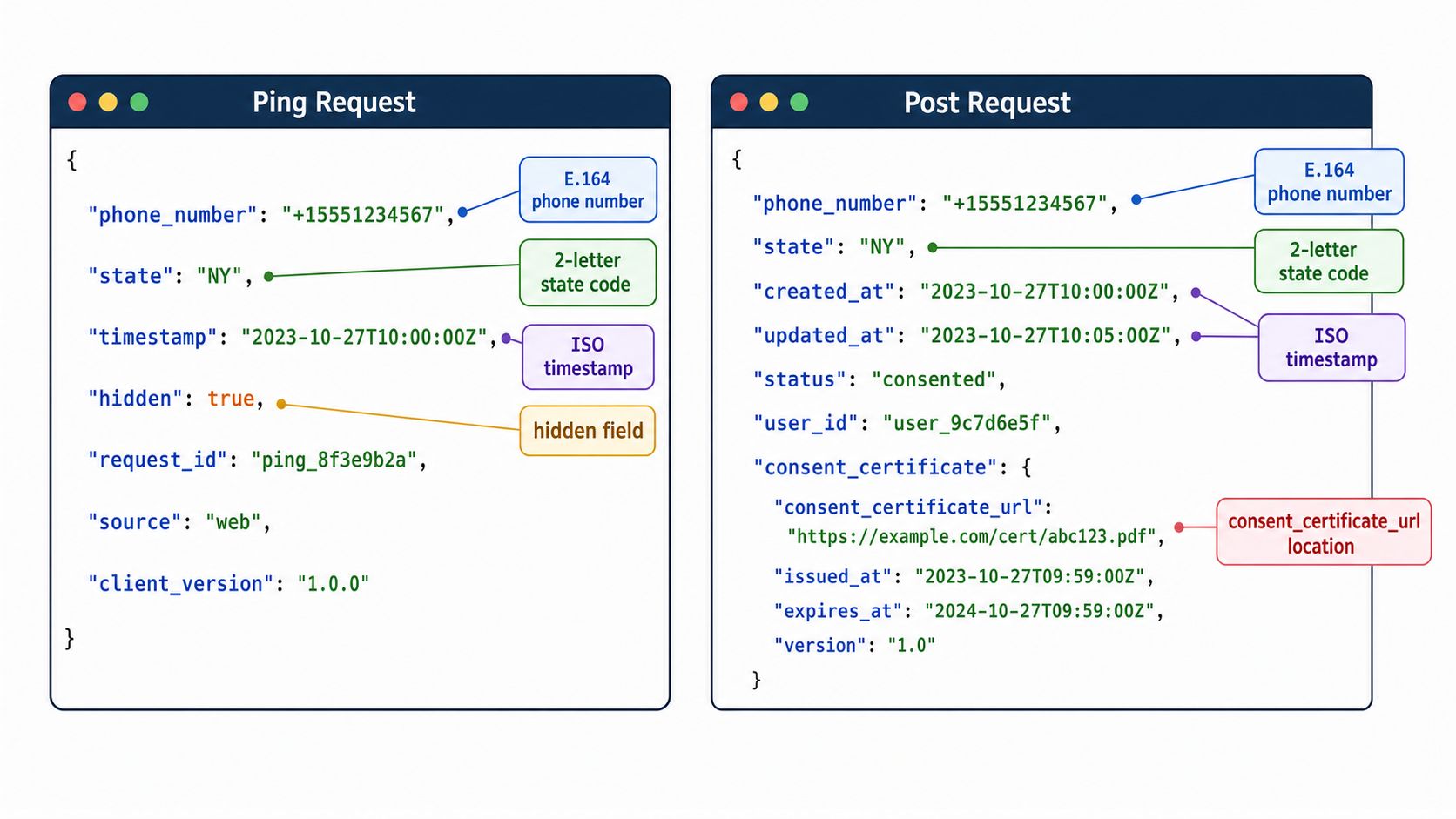
Most production setups use REST and JSON for ping post lead distribution. LeadDistro AI's API guide notes that expert-level systems run as a REST+JSON interface and that the 2026 industry standard sets a 200-millisecond p99 latency for post delivery from auction close to buyer acknowledgement in its ping post API integration guide. That target matters because tiny formatting mistakes often waste more time than the network does.
Example payloads
| Ping | Post |
|---|---|
| “`json | |
| { | |
| "lead_id": "abc123", | |
| "vertical": "home_services", | |
| "state": "TX", | |
| "postal_code": "77002", | |
| "service_type": "hvac", | |
| "homeowner": true, | |
| "submitted_at": "2026-07-14T10:15:22Z", | |
| "source_id": "meta_campaign_7", | |
| "click_id": "fbclid_example", | |
| "sub_id": "adset_b" | |
| } | |
| “` | “`json |
| { | |
| "lead_id": "abc123", | |
| "vertical": "home_services", | |
| "first_name": "Alex", | |
| "last_name": "Taylor", | |
| "email": "[email protected]", | |
| "phone": "+15551234567", | |
| "address_1": "12 Example Street", | |
| "city": "Houston", | |
| "state": "TX", | |
| "postal_code": "77002", | |
| "service_type": "hvac", | |
| "homeowner": true, | |
| "submitted_at": "2026-07-14T10:15:22Z", | |
| "source_id": "meta_campaign_7", | |
| "click_id": "fbclid_example", | |
| "sub_id": "adset_b", | |
| "trustedform_url": "https://example.com/cert/abc123", | |
| "consent_timestamp": "2026-07-14T10:15:22Z" | |
| } |
<a id="what-matters-in-the-schema"></a>
### What matters in the schema
- **Phone format:** Use **E.164** in the post payload. Buyers often reject local formatting because validation and dialling logic expect a standard.
- **State code:** Use the two-letter code. Full state names create needless mapping problems.
- **Timestamps:** Use ISO format. It keeps sorting, auditing and downstream parsing sane.
- **Consent field:** Put the certificate URL or token in the post where the buyer expects it. If it's buried in a notes field, it may as well not exist.
- **Hidden fields:** Keep source and click identifiers in both records if the buyer or platform uses them for reporting, dedupe or dispute handling.
> Small schema errors don't look dramatic in logs. They look like normal buyer rejects, which is why they survive for weeks.
<a id="building-a-reliable-architecture"></a>
## Building a Reliable Architecture
In legal, a dropped lead isn't a minor ops bug. From Growform's experience working with lead generation companies, cost per lead can reach **$150–$300** in legal verticals. If a buyer endpoint hangs, a webhook dies, or a lead vanishes between form submit and post delivery, that's real money gone.

LeadDistro AI describes the full flow as a **7-layer architecture** consisting of intake, compliance, dedupe, scrub, buyer matching, parallel bid auction and post delivery, with **1.8 to 2.5 seconds** end to end and the auction phase consuming **70% to 80%** of the total budget in its breakdown of [how a ping post system works](https://www.leaddistro.ai/blog/how-ping-post-system-works). That's a useful frame because it shows where delay really lives. Not just at the buyer edge, but across the whole chain.
<a id="timeouts-and-fallbacks"></a>
### Timeouts and fallbacks
A reliable setup treats every buyer request as disposable. The system should expect some endpoints to be slow, some to fail, and some to accept the ping then reject the post.
What works in practice:
- **Short buyer timeouts:** Don't let one slow buyer hold the whole auction hostage.
- **Fallback routes:** If the first path fails, send the lead to backup buyers or a lower-priority route.
- **Clear abandon rules:** Retrying forever is worse than failing fast when the lead's value depends on speed.
- **Per-attempt logging:** Every ping, response, timeout, post and reject needs its own record.
What doesn't work is silent failure. If the only evidence is a lower sold count in the end, the team will blame traffic quality when the actual issue is transport.
Later in the stack, speed still matters. A separate benchmark summary notes that effective operations need a ping response time under **1.0 second**, with delays above **2 seconds** risking missed bids, and that healthy programmes target a **30% to 60%** bid rate and **90% or higher** sell-through, as outlined in these [ping post lead distribution benchmarks](https://standardinformation.com/company/resources/ping-post-lead-distribution-benchmarks-what-s-good-in-2025). Those figures aren't a universal promise, but they are a useful health check when diagnosing whether the bottleneck is buyer appetite or system latency.
This walkthrough is also worth a watch if the team is mapping retries and buyer handoff behaviour into its own lead stack:
<iframe width="100%" style="aspect-ratio: 16 / 9;" src="https://www.youtube.com/embed/R09dnjzhc_g" frameborder="0" allow="autoplay; encrypted-media" allowfullscreen></iframe>
<a id="duplicate-suppression"></a>
### Duplicate suppression
Duplicates are not just a quality issue. They're a pricing issue. If the same consumer arrives from multiple sources, the seller needs a rule for when the second submission is blocked, when it is updated, and when it can still be sold.
A practical duplicate layer usually checks some combination of:
- **Identity overlap:** Phone, email, and address signals
- **Time window:** How long a prior lead should block a new one
- **Source logic:** Whether the same lead from a better source should overwrite or coexist
- **Buyer contracts:** Some buyers accept a recent duplicate from the same seller, others won't
<a id="returns-are-a-reputation-metric"></a>
### Returns are a reputation metric
Buyers return leads for predictable reasons. Bad contact data. Lead already sold elsewhere. Out-of-criteria answers. Missing consent evidence. Stale response time. The important part isn't that returns happen. It's whether the seller can explain each one.
> A return rate tells buyers how much cleanup work they'll need to do after buying from a seller.
That feeds back into payouts and trust. A seller with clean logs, clear consent records and disciplined duplicate rules can usually defend more inventory. A seller who can't explain why a lead was returned gets marked as expensive to work with.
<a id="monitoring-the-whole-chain"></a>
### Monitoring the whole chain
A good monitoring view doesn't stop at uptime. It should answer, lead by lead:
1. Did the form submit complete?
2. Did the routing layer receive the payload?
3. Which buyers were pinged?
4. Who bid, who passed, and who timed out?
5. Was the post accepted?
6. Was the lead later returned?
If any of those answers is missing, the stack is guessing.
<a id="consumer-fairness-and-choosing-the-right-delivery-model"></a>
## Consumer Fairness and Choosing the Right Delivery Model
The delivery model shapes the consumer outcome more than the routing label does.
A bad auction can send a lead to the highest bidder even if that buyer is slow, loosely matched, or relying on broad filters. A well-configured ping post setup does the opposite. It screens for current capacity, geography, product fit, and acceptance rules before the full record moves. If consent evidence is attached correctly and the buyer can act on the lead inside the response window, the consumer usually gets a faster and more relevant handoff.
The failure points are usually technical, not philosophical. A buyer wins the ping but never receives the right consent string. Hidden fields carrying campaign context drop between the form and the router. A timeout is set so aggressively that the best buyer never gets a fair chance to answer, so the lead falls through to a weaker destination. Those are setup problems, and they have direct fairness consequences.
<a id="choosing-the-model"></a>
### Choosing the model
Use **direct post** when one buyer is already the right destination and the commercial terms are stable. That model gives the seller tighter control and fewer moving parts, which matters in verticals where returns, audits, or compliance reviews are common.
Use a **ping tree** when buyer priorities are known in advance and response behavior is predictable. It is easier to reason about than a live auction, but it needs disciplined timeout settings and a clear fallback order. If Buyer 1 gets 1200 ms and Buyer 2 gets 400 ms, that is not a neutral routing policy. It is a business decision.
Use an **auction** when demand changes throughout the day and pricing really does vary by lead attributes. Auctions can improve yield, but only if the ping payload is honest, buyer filters are enforced, and the post step is reliable. Otherwise the system rewards buyers who bid high on the ping and fail on the post.
In practice, good operators choose by vertical and compliance burden. Legal and regulated categories usually need tighter buyer control, stronger consent logging, and stricter delivery rules. Home services often benefit from speed and live capacity checks. Insurance can support either model, depending on buyer filters, licensing rules, and how much variation there is in call-center availability.
Consumer fairness is not about pretending every buyer should see every lead. It is about making sure the lead reaches a buyer who matches the submitted criteria, can prove the right to contact the person, and can respond while the enquiry is still fresh. If the plumbing cannot preserve those conditions, the model is wrong no matter how good the bid looks.
<a id="frequently-asked-questions"></a>
## Frequently Asked Questions
<a id="what-is-ping-post-in-lead-generation"></a>
### What is ping post in lead generation
Ping post sells a lead in two steps. The ping sends a partial record so buyers can check fit, price, and acceptance rules. The post sends the full lead, including contact details and any required consent evidence, only after a buyer accepts.
<a id="how-does-a-ping-tree-work"></a>
### How does a ping tree work
A ping tree routes the lead through buyers in a fixed order. The system pings Buyer 1 first, then falls through to the next buyer if the response is a reject, a timeout, or a technical failure. That sounds simple, but the timeout policy does much of the work. If one buyer gets more time to respond than the rest, routing is being shaped by configuration, not just demand.
<a id="what-is-the-difference-between-the-ping-and-the-post"></a>
### What is the difference between the ping and the post
The **ping** is the preview used for matching, filtering, and pricing. The **post** is the full payload delivered after acceptance. In a working setup, the post also carries the fields guides often skip over: consent text version, timestamp, page URL, IP, user agent, trusted form inputs, and the hidden-field values needed for attribution and downstream routing.
<a id="how-do-i-sell-leads-from-my-website"></a>
### How do I sell leads from my website
A sellable lead form needs more than visible input fields. It has to capture the exact fields buyers require, store attribution in hidden fields, record consent in a way you can prove later, and pass everything into a routing layer fast enough to meet buyer SLAs.
Miss any of those steps and the failure usually shows up after the form submit. The ping gets accepted, then the post fails because a required hidden field is blank, the consent record is incomplete, or the buyer endpoint times out.
<a id="what-is-a-lead-auction"></a>
### What is a lead auction
A lead auction sends the same partial lead to multiple buyers at the same time and compares responses. It can raise revenue when buyer demand changes throughout the day, but only if your filters are accurate and your post delivery is dependable. High bids do not help if the winning buyer cannot take the full record cleanly.
If you're rebuilding the front end of a lead stack, use a form layer that can pass hidden fields reliably, preserve consent evidence, and post to webhooks without brittle custom work. Those details decide whether a ping post setup clears in production or burns time in retries, rejects, and buyer disputes.