
What Is TCPA: Your 2026 Guide to Lead Gen Compliance
A lot of marketers only start asking what is TCPA when a buyer pauses volume, compliance asks for consent proof, or a lead batch gets rejected because nobody can show exactly what the user saw before submitting the form.
That's usually the moment the law stops feeling abstract.
If you run paid lead gen, TCPA isn't a legal footnote. It sits right in the middle of campaign economics. It affects whether a buyer accepts your leads, whether your CRM follow-up is safe, whether your SMS flows can go live, and whether your team can defend itself months later when someone asks for proof of consent. The painful part is that most breakage happens at the front of the funnel, not in the dialer. It starts with a disclosure tucked below the fold, a checkbox that means nothing, a form that passes the wrong fields downstream, or a missing consent record when the lead changes hands.
Marketers tend to think in CPL, acceptance rate, and speed-to-lead. TCPA belongs in that same conversation. A lead with weak consent data isn't just a compliance problem. It's a lower quality asset.
Table of Contents
Table of Contents
- Introduction Why the TCPA Matters More Than Ever for Marketers
- What Is the TCPA A Plain English Primer
- Decoding TCPA Consent Rules ATDS PEC and PEWC
- The High Cost of Non-Compliance TCPA Damages and Enforcement
- Navigating the Modern Compliance Maze State Mini-TCPAs and FCC Rules
- Building Bulletproof Lead Capture Forms Actionable TCPA Compliance
- TCPA Compliance FAQs for Marketers
Introduction Why the TCPA Matters More Than Ever for Marketers
You launch a campaign. The CPL looks fine. The form converts. Traffic quality seems solid. Then the buyer asks for proof of consent on a sample of leads, and your team realizes the form only stored a generic “yes” flag.
No disclosure text. No timestamp tied to the exact version of the page. No independent evidence. No clean chain between the form submission and the downstream outreach.
That's where TCPA becomes operational.
For marketers, the biggest mistake is treating compliance as something that happens after the lead enters the CRM. In reality, most TCPA risk gets created at the point of capture. The form, the checkbox behavior, the disclosure copy, the way buyer names are shown, and the evidence stored with the submission all matter more than many expect. If those pieces are weak, every call or text that follows sits on shaky ground.
Practical rule: If you can't prove what the user agreed to at submission time, don't assume you have defensible consent.
This matters more in paid lead gen because leads move. They get sold, routed, enriched, called, texted, and scored by multiple systems. Each handoff adds friction. Each missing field creates ambiguity. Buyers know this, which is why many of them now scrutinize consent evidence before they care about volume.
The marketers who handle TCPA well usually do one thing differently. They design forms and data flows as if every lead might someday need to be defended.
What Is the TCPA A Plain English Primer
The simplest answer to what is TCPA is this: it's the federal rulebook that tells businesses when they can and can't contact people by phone using automated technology or prerecorded voice.
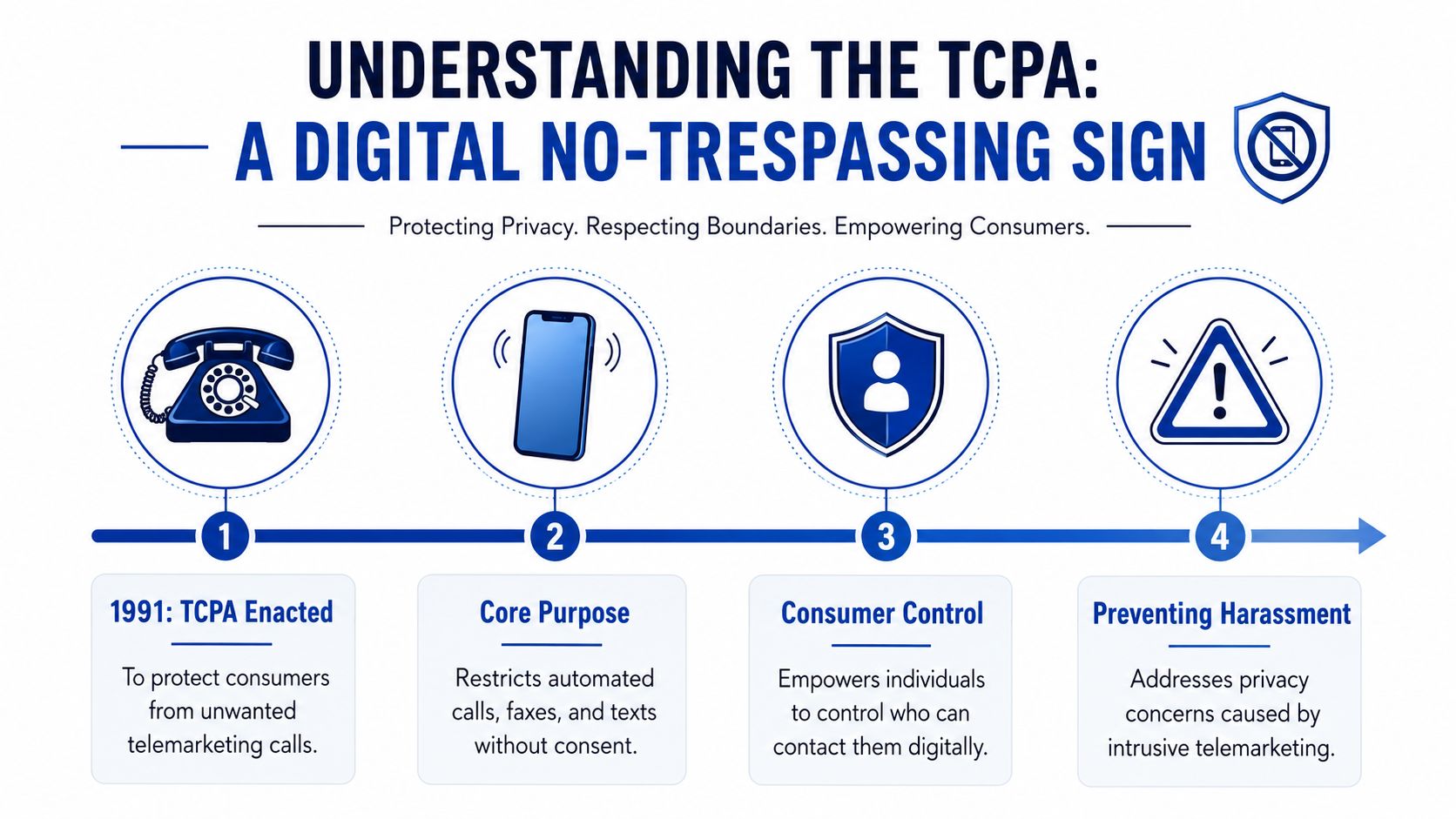
A practical way to think about it is as a digital No Trespassing sign for someone's phone. A consumer's number is not an open invitation for automated marketing. If a business wants to call or text in a way the law covers, it needs the right kind of permission first.
The law's roots go back to an older telemarketing problem, but its effect is still very current. The TCPA was signed into law by President George H.W. Bush in 1991, amending the Communications Act of 1934 to address growing telemarketing activity and restricting the use of autodialers and prerecorded voices to contact cell phones without prior express consent, as outlined in the FDIC's TCPA compliance manual.
What the law covers in plain language
The TCPA started with telemarketing calls, but marketers need to think more broadly now. It reaches into modern outreach channels and workflows that many growth teams use every day.
A workable marketer's definition looks like this:
- Calls to cell phones: Automated or prerecorded outreach to wireless numbers is where many teams first run into TCPA rules.
- Text messaging: SMS campaigns often get built like regular lifecycle marketing, but TCPA can apply just as directly.
- VoIP and related workflows: If your outreach stack routes calls through modern platforms, the age of the law doesn't make it irrelevant.
- Lead generation funnels: The form isn't outside the law. It's where the consent record starts.
Why marketers should care about the original purpose
The TCPA wasn't written to make lead gen harder. It was written to give consumers control over who can contact them and how. That matters because many of the mistakes marketers make come from trying to stretch a broad opt-in into permission for every downstream action.
That approach usually fails under scrutiny.
The safest mindset is simple. Consent should match the actual outreach that follows.
If a form says the user is requesting information, but the downstream action is promotional calling or texting from one or more sellers, the form needs to support that reality. Good compliance starts when the capture experience accurately reflects what happens next.
Decoding TCPA Consent Rules ATDS PEC and PEWC
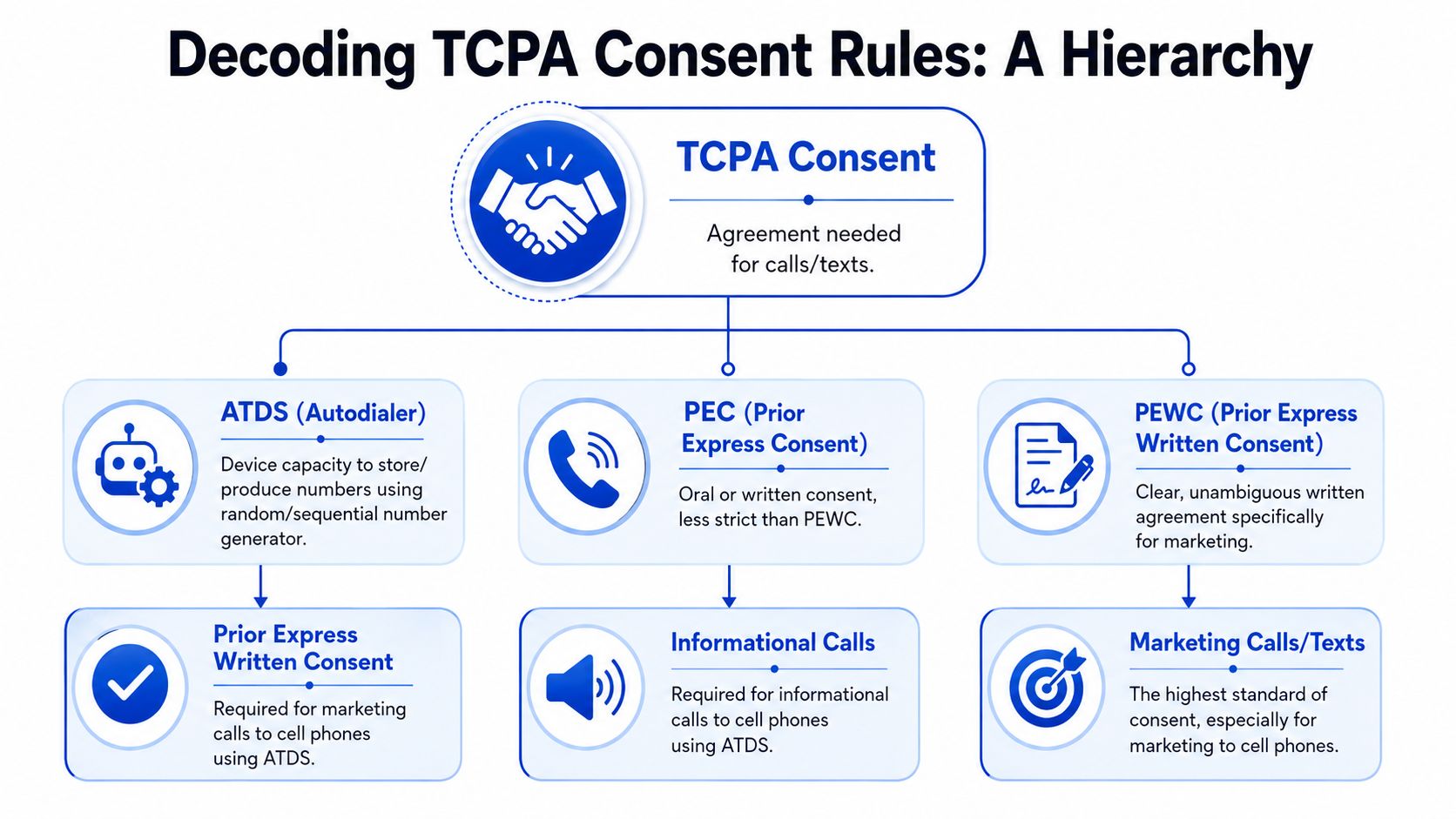
Most TCPA confusion comes from three terms: ATDS, Prior Express Consent (PEC), and Prior Express Written Consent (PEWC). If you get these wrong, you'll either slow conversion by overbuilding the form or create exposure by collecting the wrong kind of consent.
The core rule is straightforward. The TCPA requires Prior Express Written Consent for telemarketing calls or texts to wireless numbers using an ATDS or prerecorded voice, while non-telemarketing informational messages sent that way can rely on Prior Express Consent, which may be oral or written, according to this TCPA consent FAQ from MSLaw Group.
The real split is informational versus marketing
A lot of teams use one consent template for everything. That's where bad assumptions start.
Here's the practical split:
| Message type | Typical consent standard | What marketers should assume |
|---|---|---|
| Informational outreach | PEC | Lower threshold, but still needs clear logic and documentation |
| Sales or promotional outreach | PEWC | Highest standard. Your form should be built for this if the lead will be marketed to |
The trouble is that many funnels aren't purely one or the other. A quiz may begin as educational, then turn into a sales handoff. A comparison form may look neutral, then trigger outreach from sellers. A “check your options” flow may feel informational to the user but function as telemarketing in practice.
That's why the message classification should happen before you finalize the form, not after launch.
If the lead will enter a promotional calling or texting workflow, build the capture experience as a telemarketing consent flow from the start.
How to think about ATDS without getting lost
ATDS stands for Automatic Telephone Dialing System. Marketers often hear extreme interpretations here. One side says every modern CRM workflow counts. The other says almost nothing does. Neither shortcut is useful when you're building actual campaigns.
For operators, the better question is not “Can I argue this tool isn't an autodialer?” It's “What technology are we using, what messages are we sending, and can our consent record survive buyer or legal review?”
A few practical checks help:
- Map the dialing path: Know whether the follow-up comes from a CRM, dialer, SMS platform, call center tool, or a buyer's system.
- Review the message purpose: Informational and promotional outreach should not share the same assumptions.
- Audit the handoff: If your form posts into multiple systems, make sure the consent fields travel with the lead.
- Document the stack: Teams that can name each tool and what it does make better compliance decisions.
If you're implementing buyer-side compliance fields, this guide on setting up a Jornaya form with Growform is useful because it shows how consent evidence can be captured as part of the form workflow rather than bolted on later.
A good, better, best way to think about consent collection looks like this:
- Good: You collect the phone number and show a disclosure.
- Better: You tie the disclosure, timestamp, and affirmative action to the exact submission.
- Best: You keep an auditable record that can be passed downstream with the lead and matched to the version of the form the user saw.
That last step is what separates a lead that merely exists from a lead you can defend.
The High Cost of Non-Compliance TCPA Damages and Enforcement
Most marketers don't need a lecture on compliance. They need to know what a bad form can cost.
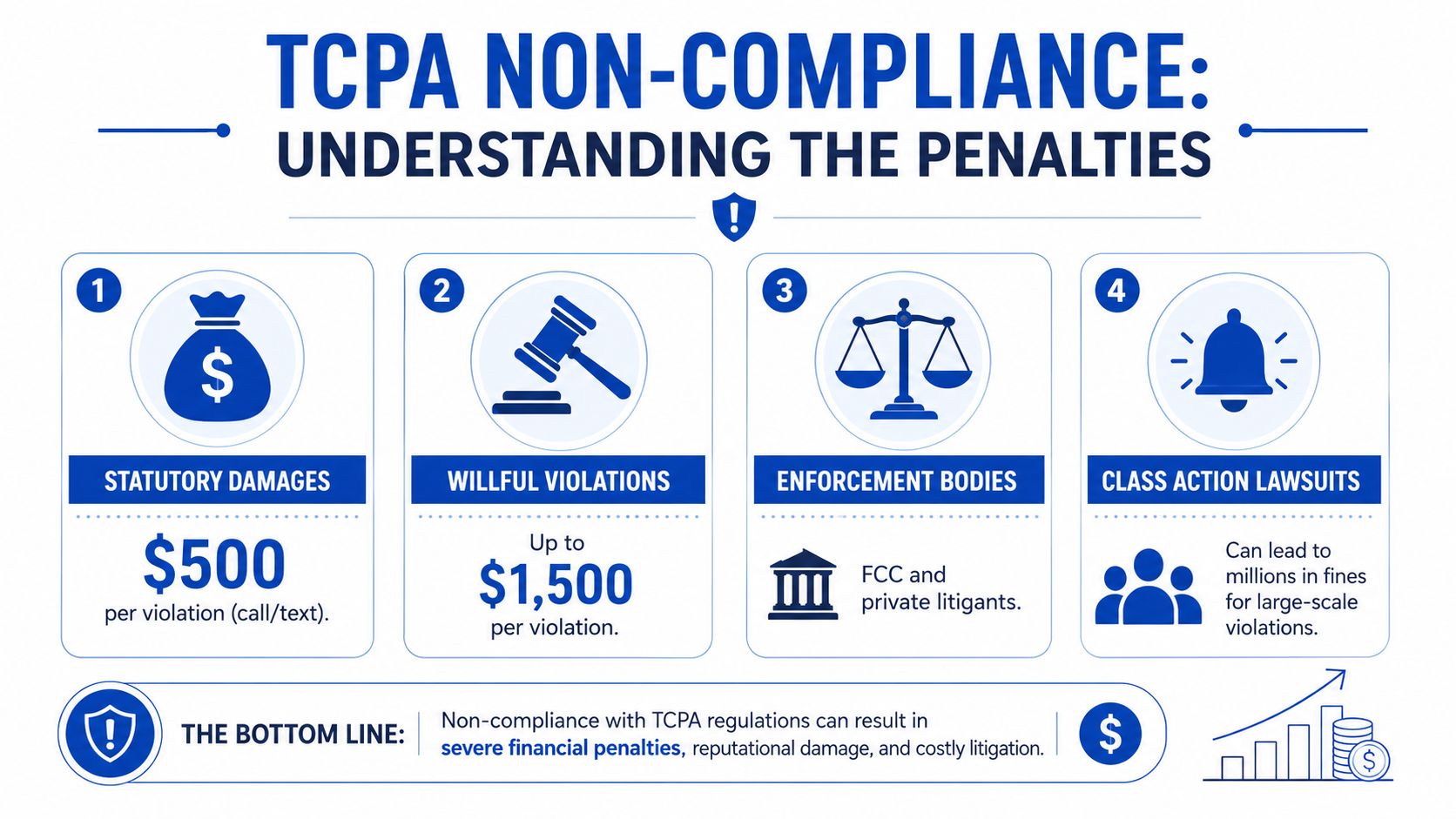
The TCPA carries $500 per violation, which can rise to $1,500 for willful or knowing violations, and because there's no cap on total damages, large-volume campaigns can create exposure that reaches into the millions, as described in these 2025 TCPA litigation statistics. The same source notes that approximately 3,200 annual federal cases were filed in 2025.
Why lead gen businesses get exposed fast
Lead gen teams work at a volume where small mistakes don't stay small.
One broken disclosure can affect every submission on a page. One routing bug can strip consent data from every lead sent to a buyer. One checkbox preselected by default can undermine a whole campaign's defensibility. Because liability is tied to each call or text, the cost doesn't sit at the form level. It can multiply downstream.
That's why “we probably had consent” is a dangerous position. In a low-volume environment, weak documentation is bad. In a paid lead funnel, it can become a business event.
What enforcement looks like in practice
Marketers often focus on the FCC, but private lawsuits are usually the more immediate operational threat. The same litigation source states that average settlements ranged from $5,000 to $12,000 per case in 2025, and it also notes a four-year statute of limitations plus an implementation delay for one-to-one consent rules until April 11, 2026.
A few takeaways matter more than legal theory:
- Private plaintiffs matter: You don't need a regulator to feel the consequences.
- Documentation offers an advantage: Teams with clean evidence are in a different position from teams with screenshots and guesswork.
- Old leads can still matter: If your recordkeeping is messy, historical gaps stay risky.
Weak consent collection doesn't just increase legal exposure. It lowers the resale value and usability of your leads long before anyone files a claim.
Navigating the Modern Compliance Maze State Mini-TCPAs and FCC Rules
Federal TCPA compliance is only part of the job now. Marketers also deal with state-level rules, buyer-specific standards, and changing FCC expectations around how consent must be collected and tied to sellers.
That means a form can look acceptable at a glance and still fail under a stricter interpretation somewhere else in the chain. This is why teams that only ask “Are we TCPA compliant?” usually miss the bigger problem. The better question is “Will this capture flow hold up across the states, buyers, and follow-up methods we use?”
Federal compliance is only the floor
In practice, many lead gen operators already live under a stricter regime than the bare federal baseline. Buyers add their own requirements. Networks ask for proof artifacts. Internal teams want fields normalized in specific ways. State laws can create another layer on top.
The result is that checkbox compliance rarely works. A form has to be designed for the whole motion:
- Traffic source to form: The promise in the ad should match the disclosure on the page.
- Form to buyer list: If multiple parties may contact the lead, the consent language has to reflect that structure.
- Buyer to outreach channel: Calling and texting workflows shouldn't rely on assumptions that were never captured at submission.
One-to-one consent changes form architecture
The FCC's one-to-one consent direction has pushed lead gen teams to rethink how they name buyers and how broad they let consent language become. The implementation was delayed until April 11, 2026, according to the earlier litigation source, but the operational lesson is already clear. The old “by clicking submit, you agree to be contacted by our partners” style is getting harder to defend.
That creates real trade-offs.
If you list specific sellers clearly, the flow may feel heavier. If you keep the disclosure vague, the form may convert better in the short term but create rejection risk later. Most serious operators now accept that cleaner consent usually beats artificial conversion gains from ambiguity.
If you want a practical breakdown of this shift, this guide to FCC lead generation rules and 1:1 consent is a useful operational reference for how consent collection has to map to the actual seller relationship.
A sound approach is to build forms as if broad bundled consent won't save you. In most lead gen businesses, that assumption leads to better architecture anyway.
Building Bulletproof Lead Capture Forms Actionable TCPA Compliance
TCPA compliance gets real at the form level. At this stage, abstract rules turn into screen elements, field logic, hidden values, and evidence capture. Most failures are not dramatic. They're ordinary build mistakes.
A disclosure sits too far from the submit button. The language is broad enough to be meaningless. The form stores a yes/no value but not the actual text shown to the user. The lead posts into the CRM, but the consent record doesn't travel with it.
What a defensible form actually includes
At minimum, your form should make the user's agreement obvious and provable.
A practical build checklist looks like this:
- Visible disclosure: Put the consent language close to the action button. Don't bury it in a footer or behind a collapsed panel.
- Specific parties: If named sellers may contact the lead, identify them clearly instead of hiding behind “marketing partners.”
- Affirmative action: Use an unchecked checkbox when your workflow calls for a clearer opt-in signal.
- Linked terms: Terms and privacy links should be accessible and relevant to the capture event.
- Stored evidence: Save the exact disclosure version, timestamp, page URL, and lead identifiers with the submission.
- Downstream continuity: Make sure your CRM, dialer, and buyer export all receive the same consent-related fields.
This is also where tooling matters. Some teams use custom forms and build their own audit trail. Others use compliance products and lead capture platforms that support consent evidence natively. One practical option is TrustedForm documentation for Growform, which shows how form builders can attach independent consent evidence at the point of capture.
Consent language that works better than vague disclosure
Most weak TCPA forms fail because the copy tries to do too much with too little clarity.
These examples are stronger than generic “I agree to receive communications” wording:
By checking this box and clicking Submit, I agree to receive marketing calls and texts at the number I provided, including calls using automated technology or prerecorded messages, from [Named Seller or Sellers]. Consent is not a condition of purchase.
That works better because it tells the user what kind of contact may happen, at what number, and from whom.
For a non-promotional informational flow, the language should match that narrower purpose instead of borrowing telemarketing language blindly. The mistake many teams make is mixing both standards into one muddy disclosure and hoping it covers all use cases.
If your lead gen motion also includes outbound motions after capture, it helps to compare form-driven consent with broader B2B outbound strategies so your team doesn't treat every contact path as if it carries the same permission model.
Special caution for healthcare and adjacent funnels
Healthcare, debt relief, legal intake, and related verticals create extra confusion because the form often starts with questions that look diagnostic, educational, or service-oriented before turning into a monetized handoff.
That's risky. The healthcare guidance gap is real. Existing material often misses the impact of the 2025 clarification around treatment, payment, and operations messages, and it leaves marketers uncertain about when pre-qualifying health questions in a lead form shift the interaction into telemarketing territory, as discussed in this healthcare TCPA analysis from mPulse.
A practical rule helps here:
- If the form is collecting data to route or sell a lead, treat it as a commercial capture event.
- If the follow-up could include promotional outreach, don't rely on a service-style tone to save the form.
- If one question changes the purpose of the interaction, rewrite the disclosure before launch.
Later in the build, review your evidence path again.
The teams that do this well usually keep a versioned library of disclosures, map each form to its downstream outreach type, and test whether the full consent payload survives every handoff. That work isn't glamorous, but it's what keeps a form defensible.
TCPA Compliance FAQs for Marketers
Does an established business relationship cover a lead form
Sometimes, but marketers overextend this constantly.
The key nuance is that existing guidance often ignores the established business relationship (EBR) issue for non-telemarketing calls to wireless numbers, where consent may be implied if the number was provided for the same account or transaction, as noted in this health care TCPA discussion from SKN Law. In lead gen, that usually means you shouldn't assume a quiz or calculator creates broad permission for later promotional outreach.
If the user gave a number for one limited purpose, treat that permission as narrow unless your form clearly captured more.
Who owns compliance when a lead is sold
Both sides have exposure, even if they argue about responsibility later.
The seller controls the capture experience and the evidence created at submission. The buyer controls what outreach happens next and whether it matches the permission that was collected. In practice, blame gets shared when the record is weak. That's why astute buyers ask for the actual consent artifact, not just a vendor promise that “the leads are opted in.”
Do healthcare-style messages get an automatic pass
No. That's where many teams get sloppy.
A service or treatment-related communication may be treated differently from telemarketing, but a lead capture form can cross the line if it qualifies a prospect for a commercial offer or seller follow-up. If your intake flow asks pre-qualifying questions and routes the lead into promotional outreach, the safer assumption is that your form needs to support that commercial use clearly.
If you're rebuilding lead capture with compliance in mind, Growform is one option to evaluate for multi-step lead forms that pass data into downstream systems and support consent evidence workflows like TrustedForm and Jornaya. The main thing that matters isn't the brand. It's whether your form stack can show exactly what the user agreed to, preserve that record, and send it wherever the lead goes next.