
Social Media Recruiting: The Complete 2026 Playbook
According to CareerArc, social recruiting has become standard practice for employers, and passive talent is a large part of the target pool. That changes the economics of hiring. Strong candidates are rarely sitting on job boards waiting to apply. They are already employed, spending time in feeds, and making fast judgments about credibility, role fit, and effort.
That shift forces recruiting teams to operate more like acquisition teams. Social media recruiting works best when it is managed as a conversion funnel with audience targeting, creative, click-through rate, landing page performance, form completion rate, qualification logic, and cost per qualified applicant. Posting jobs is only the top of funnel. The core objective is turning attention into completed applications at an efficient cost.
For high-volume hiring engines, the form is the decisive battleground.
A polished post can earn the click. A strong employer brand can hold attention for a few more seconds. The application form determines whether intent becomes a candidate record or leaks out through abandonment. In practice, that is where recruiting ROI gets won or lost, especially for roles with large applicant volumes and narrow qualification criteria. Teams hiring SDRs already see this dynamic clearly, which is why hireSDR.io's guide to SDR hiring focuses so heavily on screening discipline and candidate quality.
Table of Contents
Table of Contents
- Why Your Old Recruiting Playbook Is Broken
- Choosing Your Channels and Building Your Brand
- Architecting Your High-Conversion Candidate Funnel
- Designing Application Forms That Convert Not Deter
- Qualifying and Routing Candidates on Autopilot
- Measuring Success from Social Click to Hire
Why Your Old Recruiting Playbook Is Broken
92% of employers use social media to recruit, according to the Society for Human Resource Management. The problem is that many of them still run social like a distribution channel, not a conversion system. They post openings, send traffic to a careers page, and hope enough candidates tolerate the friction to finish the application.
That approach wastes intent.
The old recruiting playbook was built for a different buying environment, and recruiting is a buying environment. Candidate attention is fragmented, platform feeds control discovery, and comparison happens before a recruiter ever speaks to the applicant. By the time someone clicks, they have already made a fast judgment on role relevance, employer credibility, and whether the next step looks worth the effort.
The teams that win on social do not treat recruiting as an HR posting task. They run it like performance marketing. The candidate is the lead. The application is the conversion event. Cost per qualified applicant, completion rate, and time to first response matter more than post impressions.
That shift changes what gets prioritized:
- Audience quality beats reach. More clicks from the wrong segment only raise screening costs.
- Message match affects conversion. A post for an SDR opening should sell the work, the quota reality, and the upside, not read like a generic employer brand caption.
- The landing step decides whether paid and organic traffic pays off. A specific landing experience converts better than dumping every visitor onto the same careers hub.
- Form friction shows up as lost applicants. If the apply flow is slow, repetitive, or mobile-hostile, candidate volume drops before screening even starts.
- Speed after submission affects hire rate. Strong applicants disappear fast, especially in competitive markets.
I have seen the same pattern repeatedly. Teams blame platform quality when the actual issue sits after the click. Social can generate attention at scale, but it only becomes a hiring channel when the path from ad or post to completed application is tight, fast, and measurable. A simple social media application form template is often a better starting point than sending candidates straight into a heavy ATS workflow.
Role design matters too. If the job requires prospecting discipline, written communication, and consistency under pressure, the application flow should test for those traits early instead of relying on resume filters. hireSDR.io's guide to SDR hiring is a useful example of how stronger screening logic improves applicant quality before the recruiter spends time on outreach.
Posting jobs alone does not create a recruiting engine. A working system captures demand, qualifies it, and routes it efficiently.
| Stage | Old approach | Better approach |
|---|---|---|
| Discovery | Job boards | Role-specific social distribution |
| Engagement | Generic careers page | Customized landing experience |
| Conversion | Long ATS form | Shorter, structured application flow |
| Screening | Manual inbox sorting | Qualification logic before handoff |
| Reporting | Last-click guesswork | Source-level attribution |
The practical takeaway is simple. Social recruiting performs best when it is managed like paid acquisition with hiring as the revenue event. If the form, routing logic, and attribution are weak, the channel looks worse than it is. If those pieces are built properly, social becomes a predictable source of qualified applicants instead of a stream of low-intent clicks.
Choosing Your Channels and Building Your Brand
The first mistake teams make is trying to be everywhere. The second is making every post feel like an ad. Both kill consistency.
A working system is narrower and more disciplined. Use one primary platform aligned to your hardest-to-fill roles, keep a 70/30 content ratio, and use unique tracking links by platform for source-of-hire attribution, as recommended in HireLab's social media recruitment guide.

Pick one platform first
The right channel depends on the job, not your brand preference.
If you're hiring senior operators, recruiters, account executives, or technical talent, LinkedIn is usually the cleanest starting point because professional identity is already established there. If you're hiring local service staff, shift workers, or community-based roles, Facebook can still outperform slicker channels because local groups and regional targeting do real work. If the role depends on brand affinity, lifestyle cues, or younger audiences, Instagram and TikTok can create better top-of-funnel engagement than formal job ads.
That's also why broad “omnichannel” recruiting plans often fail in practice. One strong channel with repeatable creative beats five neglected accounts.
For teams thinking at a media-buying level, LatoJobs' guide to programmatic recruiting in LATAM is a useful complement because it pushes the same discipline: match channel strategy to hiring economics and market realities.
Build content that earns the click
The 70/30 rule is practical because it forces balance. Most recruiting feeds fail in one of two ways. They either become a dead wall of openings, or they drift so far into culture content that nobody knows what jobs are available.
Use the split like this:
- 70% role and company-operating content. Open roles, hiring manager clips, day-in-the-life breakdowns, team updates, compensation context where appropriate, and clear expectations.
- 30% trust-building content. Team moments, employee stories, onboarding snapshots, workspace footage, and human details that reduce skepticism.
Practical rule: A candidate should be able to understand both the work and the people from your feed.
If you need a starting point for role-promotion layouts, a social media recruiting form template can help you think through the capture flow that sits behind the post, especially when you're turning campaigns into consistent lead intake rather than one-off announcements.
Track every platform separately
Never send every post to the same generic application URL. That destroys attribution. Use distinct tracking links for LinkedIn, Instagram, Facebook, TikTok, or any paid variant of those channels. If the same role is running across multiple placements, each needs its own source label and campaign identifiers.
That lets you answer the questions that matter:
- Which platform creates completed applications, not just clicks?
- Which channel sends candidates who pass screening?
- Which posts attract volume but low fit?
- Which audience deserves more budget next week?
Brand matters in social media recruiting. But brand without attribution turns into guesswork fast.
Architecting Your High-Conversion Candidate Funnel
A recruiting funnel lives or dies in the handoff between interest and action. Social can generate attention at scale, but the economics break fast if that traffic hits a dead end.
The usual failure pattern is easy to spot. A candidate clicks from a strong post, lands on a careers page built around internal process, waits for the page to load, gets pushed into account creation, uploads a resume, fixes parsing errors, then retypes the same information into required fields. Every extra step cuts completion rate.
That loss is expensive. Paid clicks still cost money. Organic distribution still costs time, creative, and team attention. If the candidate never completes the application, the channel did its job and the funnel still failed.
The funnel should be built like paid acquisition
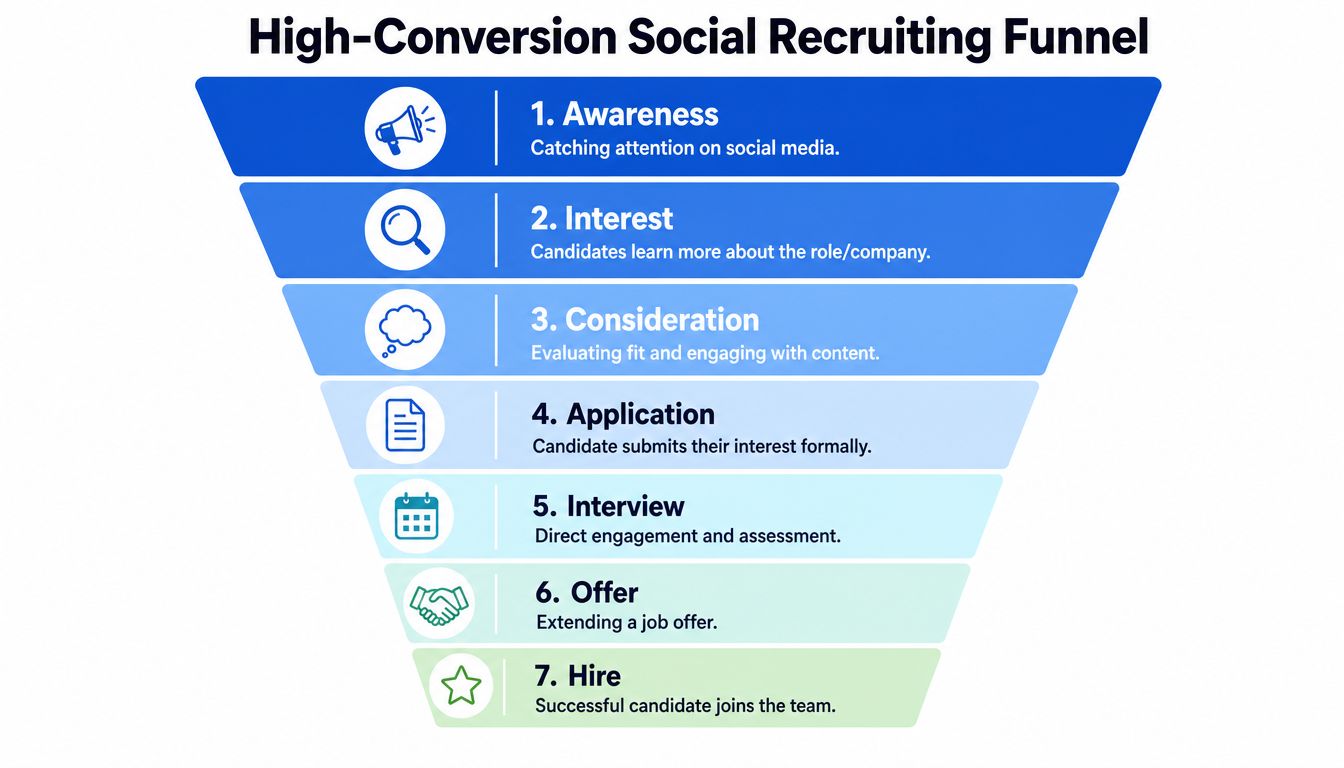
High-volume recruiting works better when it is treated like lead generation with qualification layered in. Each stage has one job. Each job has a metric. Each metric should tell you whether to fix traffic quality, message match, form friction, or routing speed.
| Funnel stage | What the candidate needs | What the team should optimize |
|---|---|---|
| Awareness | A reason to stop scrolling | Relevance and creative clarity |
| Interest | A reason to click | Message match between post and page |
| Consideration | Confidence the role is worth pursuing | Role details, trust signals, mobile experience |
| Application | Low effort to submit | Form flow, field order, completion rate |
| Interview | Fast follow-up | Routing and response speed |
| Offer | Clarity and momentum | Process coordination |
| Hire | Smooth handoff into employment | Data quality and tracking |
The operational change that matters is simple. Put a conversion-focused intake layer between social traffic and the ATS.
That intake layer should do three things well. It should preserve message match from the ad or post. It should capture core candidate data with minimal friction. It should screen for must-have criteria early enough to protect recruiter time without crushing completion rate.
For many teams, that means sending traffic to a short, mobile-first application flow instead of dropping candidates straight into the ATS. A structured job application form template for recruiting campaigns gives you a better starting point than a generic careers portal because it is built around completion, not system compliance.
Map each step to a measurable conversion point
Treat the funnel the same way a performance marketer treats a paid lead campaign. The click is not the win. The completed form is not the final win either. You need visibility across the full path from social click to qualified applicant to interview booked.
Track points like these:
- Click-through rate from post to landing experience
- Landing-page view to application start rate
- Application start to completion rate
- Completion to qualified rate
- Qualified rate by channel, campaign, and creative
- Time from submission to first recruiter response
- Interview-set rate from completed applications
Those metrics change how teams diagnose problems. If click-through is strong but starts are weak, the post and landing page are out of sync. If starts are high but completions are weak, the form is doing damage. If completions are healthy but qualification is poor, targeting or pre-screening needs work. If qualified candidates are not converting to interviews, response speed or routing is the issue.
As noted earlier, social recruiting can reduce sourcing time and speed up hiring. Those gains only show up when the middle of the funnel is built to convert.
Build for intent, then pass data downstream
The ATS still matters. It is the system of record, the compliance layer, and the place where hiring workflow gets managed. It should not be the first touch for cold or warm social traffic in many campaigns.
A better setup captures intent first, qualifies second, and sends clean data into the ATS after the candidate has committed enough to continue. That lowers abandonment, improves source attribution, and gives recruiting teams cleaner inputs to work from.
The goal is not more clicks. The goal is more qualified applicants per dollar, per post, and per recruiter hour.
Designing Application Forms That Convert Not Deter
The form is the most impactful part of the recruiting funnel because it's where intent gets tested. Teams obsess over ad copy, employer branding, and targeting, then hand candidates a form that feels punitive.
That's backwards.
Most application forms fail before screening begins
A bad form usually has the same symptoms. Too many fields on one screen. Hard questions up front. Poor mobile spacing. No progress signal. Vague error messages. Resume upload before basic qualification. It feels like work before the candidate has enough emotional commitment to finish.
That design punishes serious applicants and rewards only the most persistent. In a competitive market, persistence is not the trait you should be filtering for at the top of the funnel.
A better form behaves like a strong lead-gen flow. It uses momentum. It asks easy questions first. It breaks effort into smaller steps and shows visible progress. It reduces uncertainty so the candidate always knows what comes next.
What high-converting application UX looks like
Good recruiting forms are structured, not just shortened. The order matters as much as the number of questions.
Use a pattern like this:
- Start with low-friction identity fields. Name, email, phone, location. These are easy wins that build momentum.
- Move into role-fit questions. Eligibility, experience bracket, shift preference, notice period, certification, or role-specific criteria.
- Ask for heavier inputs later. Resume upload, portfolio links, or free-text answers belong after commitment has increased.
- Show progress. A simple progress bar reduces uncertainty and makes the task feel finite.
- Validate inline. Don't wait until the final click to reveal five preventable errors.
For recruiting teams evaluating structure, a job application form template is a useful benchmark for how to break a long intake into smaller, more manageable steps without losing the data recruiters need.
When candidates know they're making progress, they tolerate more qualification than you think.
This walkthrough shows the same principle in action from a form-building perspective:
The mobile experience decides the outcome
A lot of social traffic is mobile by default. That means spacing, tap targets, keyboard behavior, dropdown friction, and file upload usability aren't minor UX details. They are conversion variables.
A practical checklist helps:
- Keep one question or a tight cluster per step. Dense screens create perceived effort.
- Use plain labels. Candidates shouldn't decode internal HR terminology.
- Avoid forcing account creation before submission. Save that for later stages if it's necessary.
- Use disqualification sparingly and politely. If someone isn't eligible, tell them quickly and clearly.
- Preserve partial intent when possible. Even if a candidate doesn't finish, basic captured data can inform retargeting or recruiter follow-up where appropriate.
The goal isn't to make applying effortless. The goal is to remove pointless friction so only real qualification remains.
Qualifying and Routing Candidates on Autopilot
A recruiting funnel doesn't break only when it captures too few applicants. It also breaks when it captures the wrong ones and dumps them all into the same queue.
That's why qualification belongs inside the form, not only after it. If you wait until submission to screen every applicant manually, your recruiters become human middleware.
Put screening logic inside the form
Conditional logic lets the application respond to the candidate in real time. A warehouse role can ask about shift availability. A field sales role can ask about territory. A licensed role can request certification details only if the candidate indicates they hold them. An SDR flow can branch into outbound-writing or objection-handling prompts.
That does two things at once. It keeps the experience shorter for qualified candidates, and it prevents irrelevant applicants from completing a generic form that wastes everyone's time.
A useful implementation pattern looks like this:
- Minimum criteria first. Work authorization, geography, schedule fit, required license, or language needs.
- Branch by role family. Different openings need different follow-up questions.
- Screen out clearly unqualified applicants early. Do it politely, with a concise explanation where appropriate.
- Collect richer detail only from viable candidates. That protects both volume and recruiter time.
Route candidates by fit, role, and urgency
Once the form has qualified the candidate, routing should happen automatically. Candidates for engineering shouldn't land in the same workflow as local field hires. Urgent openings shouldn't wait behind low-priority reqs. High-intent applicants shouldn't sit in a spreadsheet until someone checks it.
Effective integrations are essential. A recruiting form should pass structured data directly into the ATS or recruiting stack so the right owner gets the right candidate fast. If your team uses Greenhouse, Growform's Greenhouse integration page shows the kind of handoff model modern teams now expect between capture and downstream hiring operations.
Fast routing is a quality filter. Good candidates don't stay available for long.
Protect the funnel from algorithmic narrowing
There's also a strategic risk in social media recruiting that performance-minded teams can't ignore. Social algorithms tend to optimize toward engagement patterns, and that can potentially narrow who sees your roles and who enters the funnel.
Forbes Tech Council recommends a “social-blind lane” where 20% to 30% of candidates come from non-social channels to counter algorithmic narrowing and bias, according to its guidance on keeping social recruiting from shrinking your talent pool. In practice, that means reserving a portion of pipeline creation for channels like open-source communities, alumni networks, returnships, referrals, field sourcing, or direct outreach that isn't driven by social delivery systems.
This isn't a philosophical add-on. It's a funnel safeguard.
Measuring Success from Social Click to Hire
A social recruiting program lives or dies on one number set. How many clicks turned into qualified applicants, interviews, and hires at an acceptable cost.
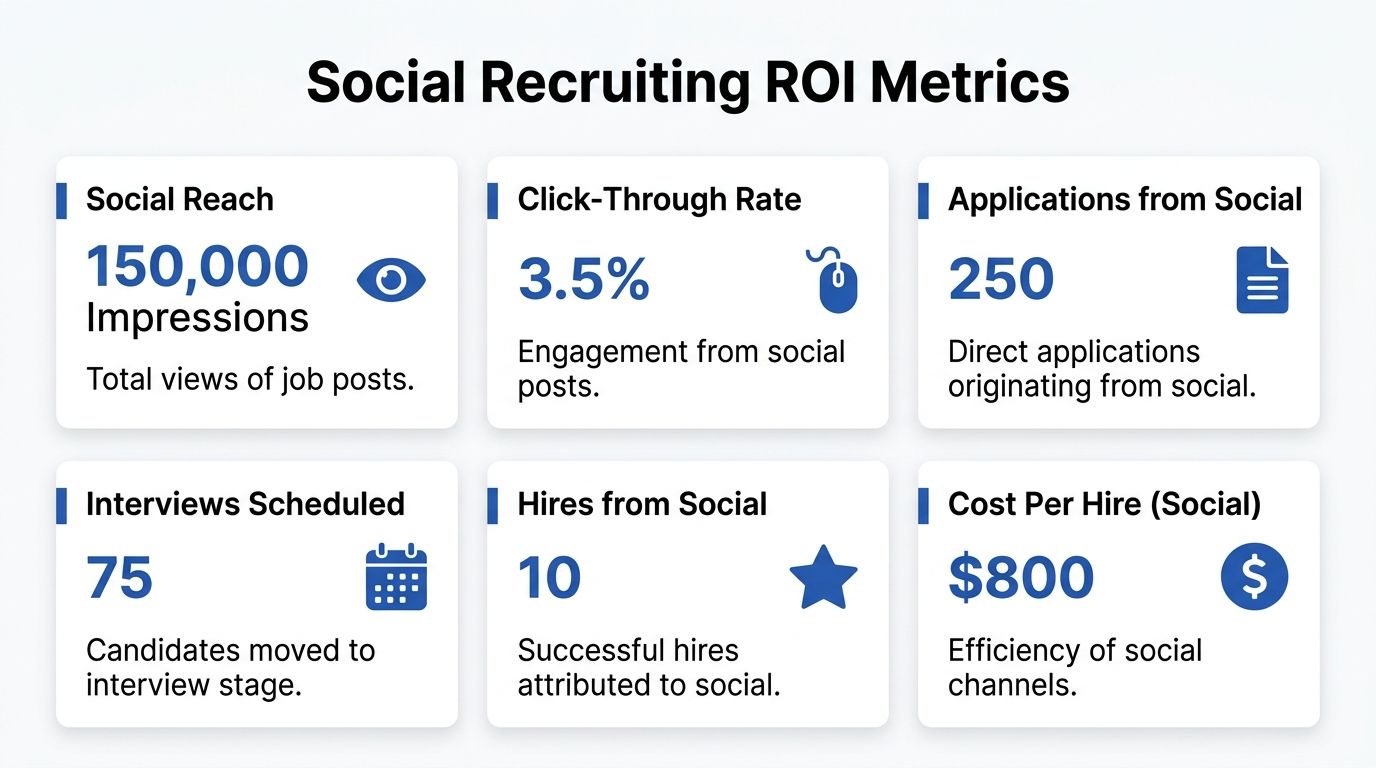
Recruiting teams often default to the metrics sitting on the native platform dashboard. Impressions, likes, comments, shares. Those numbers describe attention. They do not explain whether the funnel produced hireable candidates or whether paid and organic effort lowered cost per hire.
A better scorecard starts at the click, treats the application form as the primary conversion point, and follows the candidate all the way to an accepted offer. That shift changes social recruiting from a posting activity into a measurable acquisition channel.
Track the funnel in layers
Good reporting separates audience response from candidate intent and candidate quality. Each layer answers a different operating question.
Track at least these metrics:
- Traffic quality. Click-through rate from the post or ad to the landing page or form.
- Form conversion. Form start rate, completion rate, and drop-off point by field or step.
- Lead quality. Qualified application rate and interview-ready candidates by source.
- Hiring outcome. Offers, hires, and time-to-fill by channel or campaign.
- Efficiency. Cost per click, cost per completed application, cost per qualified applicant, and cost per hire.
That level of visibility makes budget decisions easier. A campaign with cheap clicks and weak completion rates usually has a conversion problem. A campaign with strong completions but poor screening yield usually has a targeting problem. A channel that produces fewer applicants but more hires may deserve more budget than the channel driving volume alone.
Set up closed-loop attribution
Attribution breaks fast in recruiting because the handoff crosses systems. The click happens in a social platform. The conversion happens in a form. Screening happens in the ATS. Hiring outcomes often live in a different reporting workflow entirely.
The fix is operational. Capture UTM parameters, campaign IDs, and click IDs such as fbclid or gclid in hidden form fields, then pass them into the ATS or reporting layer with the rest of the candidate record. If those values disappear during submission, reporting gets distorted and channel decisions get worse.
A working attribution setup should answer practical questions like these:
| Question | Data required |
|---|---|
| Which platform generated the hire? | Source and medium |
| Which campaign drove the best applicants? | Campaign ID and form completions |
| Which creative angle brought qualified candidates? | Ad-level identifiers |
| Which landing page version converted better? | Variant tracking |
| Which recruiter processed the lead fastest? | Routing and timestamp data |
Without that structure, the same hire gets credited three different ways. Paid social claims the click. Recruiting logs the applicant as direct. Finance sees spend with no reliable outcome mapping. Once trust in attribution drops, optimization slows down because every budget conversation turns into an argument.
Judge channels by economics
The useful question is simple. Which source produces qualified candidates and hires at the lowest acceptable cost, with the least delay, and with enough volume to matter?
As noted earlier, social recruiting can outperform older channels on both cost and hiring efficiency. That only matters if the numbers hold inside your own funnel. In practice, channel economics usually come down to four comparisons:
- Cost per completed application
- Cost per qualified application
- Cost per interview
- Cost per hire
Weak forms become apparent. A channel can look efficient at the click level and still fail financially if the application flow bleeds candidates halfway through. I have seen teams cut promising traffic sources when the underlying issue was a long form, poor mobile usability, or avoidable screening friction.
Once measurement is set up correctly, the next actions become obvious. Cut campaigns that generate clicks but not starts. Rework pages that get starts but weak completion. Change creative that drives low-fit applicants. Increase spend on sources that consistently produce interview-ready candidates and hires. Shorten time-to-review where strong applicants are waiting too long.
If social recruiting is being run like a real acquisition funnel, reporting should show where money goes in, where candidates drop, where quality improves, and what each hire costs.
If you're rebuilding the conversion layer between social traffic and your ATS, Growform is built for exactly that kind of high-intent, qualification-heavy flow. It lets teams create multi-step application forms, screen candidates with conditional logic, capture attribution data cleanly, and route submissions into downstream systems without turning every change into a developer project.
Enhanced by Outrank