


Lead acceptance rate is often treated as a lead quality score. In paid consumer lead generation, that is only half the story.
A lead can have the right intent, a valid phone number, matching geo, and clean routing data, yet still get rejected or discounted if the buyer cannot verify how consent was captured. That is where consent proof shifts from a compliance file to an operational input.
This article is for lead generation operators and marketers, not legal advice.
Lead acceptance rate depends on buyer confidence, not just buyer demand
For lead sellers, lead acceptance rate is the percentage of submitted leads that a buyer actually accepts into billing, routing, or downstream sales activity. In verticals like solar, final expense, home services, and mass tort, that rate is tied to margin just as tightly as raw CPL.
When buyers raise scrutiny, they usually do not ask only whether the consumer looked real. They ask whether the lead can be worked, whether the buyer can defend the outreach, and whether the submission includes the evidence needed for audits, disputes, and return reviews.
That changes the job of the form layer. It is no longer enough to collect contact details and pass them downstream. The form has to capture the lead and the proof at the same moment.
A buyer does not need to accuse a seller of noncompliance to lower acceptance. They only need enough uncertainty to tighten filters.
TCPA burden of proof changes buyer acceptance rules
This is why consent proof affects lead acceptance rate so directly. The FCC has stated that the burden of proving valid consent sits with the caller or texter. The same order also says callers cannot rely on comparison sites or other lead generators to retain proof of consent on their behalf.
That point matters more than many operators admit. If the buyer is the party carrying the burden, the buyer has every reason to make proof of consent part of acceptance logic before the lead is worked, not after a complaint arrives.
Buyers increasingly treat missing consent proof the same way they treat a bad phone number, failed duplicate check, or out-of-geo ZIP. It becomes a filter condition.
After enough disputes, complaints, or compliance reviews, buyer behavior usually shifts in predictable ways:
- tighter source-level thresholds
- more real-time rejection rules
- lower accepted volumes
- slower onboarding for new sellers
And the commercial impact shows up quickly:
- Acceptance policy: buyers ask for certificate URLs or trusted consent signals on every lead
- Routing logic: leads missing proof get diverted, paused, or priced down
- Dispute handling: sellers without attached evidence lose more return conversations
- Source testing: new traffic sources face harder scrutiny before scaling
This is why “we have the consent language on the page” is no longer enough. The buyer needs proof tied to the exact submission event.
TrustedForm and Jornaya affect real-time lead filtering
In many lead buying stacks, TrustedForm and Jornaya are not stored as passive records. They are active inputs in acceptance, verification, and routing.
That is the big operational shift. Consent certificates now sit next to phone verification, email validation, duplicate checks, and geo filters in the buyer’s decision process. Buyers can use them to verify that the lead included clear disclosure, that the capture event happened when claimed, and that the evidence was passed with the lead rather than reconstructed later.
TrustedForm publicly describes its verify workflow as a way for buyers to confirm clear and conspicuous consent and improve the speed of lead acceptance, prioritization, and distribution. That matches what experienced lead sellers see in practice.
A certificate-driven workflow often looks like this:
- Certificate URL: attached to the lead payload and checked before acceptance
- Timestamp data: compared with the submit event and traffic source metadata
- Session evidence: reviewed when returns or complaints hit
- Real-time filtering: used to decide whether the lead can route to a higher-value buyer
For high-volume operators using ping/post or direct-post flows, this matters at the plumbing layer. If a ping contains enough data for the buyer to score consent confidence before the full post, the seller has a better shot at routing the lead to the best-paying endpoint. If proof is missing until later, the lead may never reach that buyer tier.
That is a routing issue, not just a legal issue.
Consent proof changes CPL math for lead sellers
Most teams focus on front-end CPL and forget that acceptance rate changes the true cost of every billable lead. Consent proof can improve economics even if it does not lower media costs by a dollar.
Here is a simple example for a paid traffic lead seller.
| Metric | Weak consent proof | Consent proof attached at capture |
|---|---|---|
| Submitted leads | 1,000 | 1,000 |
| Media CPL | $25 | $25 |
| Media spend | $25,000 | $25,000 |
| Buyer price per net accepted lead | $40 | $40 |
| Initial acceptance rate | 62% | 80% |
| Post-sale return rate | 8% | 3% |
| Net billable leads | 570 | 776 |
| Revenue | $22,800 | $31,040 |
| Gross margin | -$2,200 | $6,040 |
The traffic did not change. The ad account did not get cheaper. The form’s value came from protecting acceptance and reducing downstream returns.
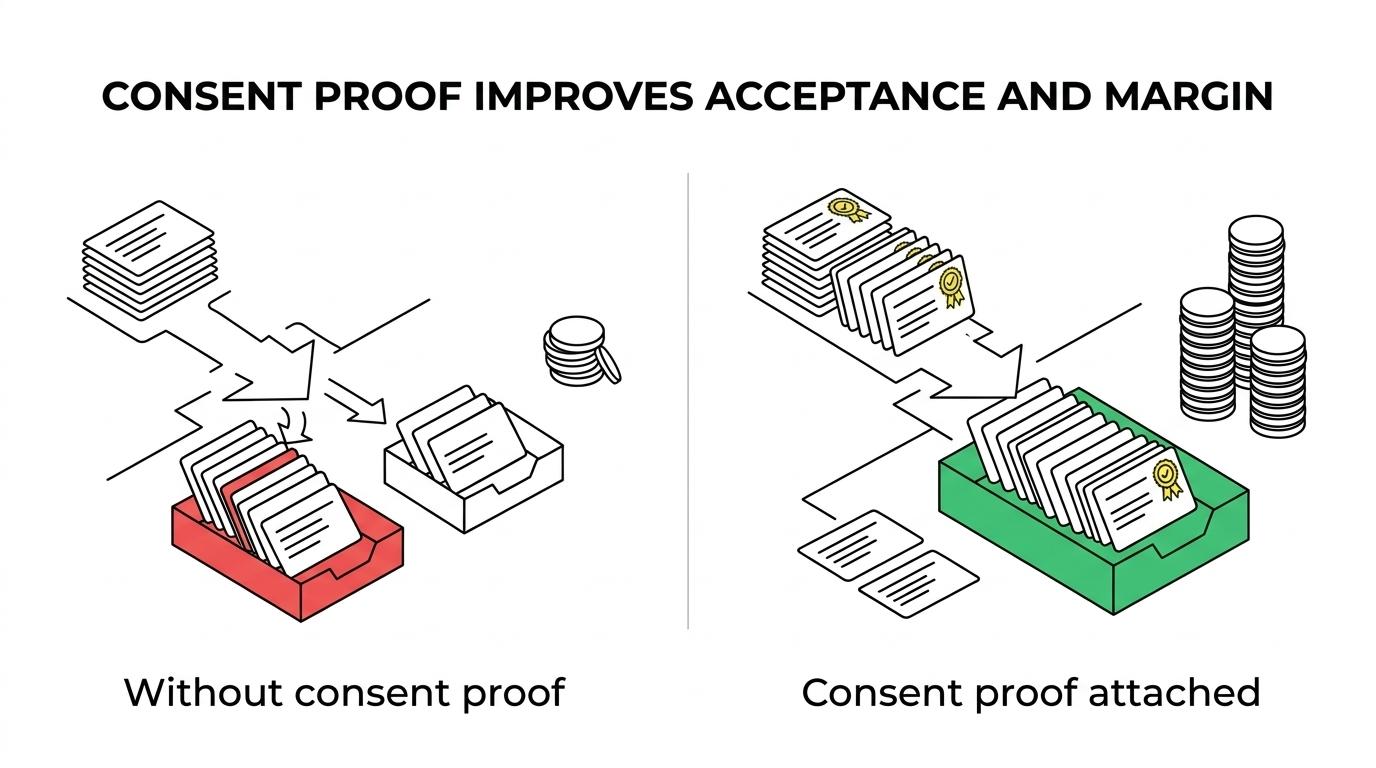
That is why sophisticated lead sellers care about consent proof early in the funnel. A buyer-side rule that rejects missing certificates can wipe out margin faster than a modest change in landing page conversion rate. A higher submit rate is not very useful if a growing share of leads fail acceptance.
This also explains why operators sometimes see a confusing pattern: raw form conversion goes up, but effective CPL gets worse. The missing link is usually what happens after submit. If acceptance falls, your real CPL rises even when the platform-reported CPL looks stable.
For teams selling into strict verticals, the working formula is closer to this:
Effective CPL = media spend / net billable accepted leads
Once you use that denominator, consent proof stops looking optional.
Form design patterns that capture consent proof at submission
The best setup is boring in a good way. The form asks the right questions, verifies core contact data, presents consent clearly, and sends the proof with the lead in one flow.
A fragmented setup causes problems. If the landing page contains one disclosure, the form tool stores another version, and the certificate is attached later by a separate script or vendor handoff, disputes get messy fast. Buyers do not want a story about how consent “should have been” captured. They want the record attached to the lead.
Tools built for lead generation forms, including Growform, let you put the consent checkbox on the contact details step and support attaching TrustedForm or Jornaya evidence to the same submission. That is the right model because it treats proof as part of lead capture, not as an afterthought.
When building the flow, focus on a short set of rules:
- One capture event: lead data and consent evidence should be created in the same submission flow
- Required action: checkbox or equivalent consent mechanism should not be optional when the campaign requires it
- Payload integrity: certificate data, UTMs, click IDs, and source IDs should pass through together
Phone and email verification also matter here. A valid certificate attached to a fake phone number still creates buyer friction. The strongest setups combine consent proof with contact verification so the lead can pass both compliance review and contactability review before the buyer sees it.
That combination is what protects lead acceptance rate at scale.
Lead distribution software should receive consent fields as first-class data
If you use Boberdoo, Phonexa, LeadsPedia, Databowl, or a custom webhook stack, consent proof should be mapped like any other critical acceptance field. It should not live in a notes box or an email receipt.
The buyer or routing platform may want the certificate URL, consent text version, timestamp, page URL, IP, user agent, and source metadata. Exact field names vary by stack, but the principle stays the same: if the buyer scores or filters on consent, the payload must make that easy.
A simple payload pattern might look like this:
{
  "first_name": "Jane",
  "last_name": "Doe",
  "phone": "5551234567",
  "email": "jane@example.com",
  "zip": "33101",
  "trustedform_cert_url": "https://cert.trustedform.com/...",
  "jornaya_leadid": "abc123",
  "consent_text_version": "2026-10-solar-v3",
  "consent_timestamp": "2026-10-11T14:03:22Z",
  "landing_page_url": "https://example.com/solar-save",
  "ip_address": "203.0.113.10",
  "user_agent": "Mozilla/5.0",
  "gclid": "EAIaIQob...",
  "fbclid": "fb.1.123...",
  "source_id": "meta_prospecting_a1"
}
That payload becomes even more useful in ping/post environments. The ping can expose enough metadata for a buyer to decide whether the lead is worth bidding on, and the post can deliver the full certificate and audit fields for retention and verification.
If your current form stack captures the lead but drops the proof, your acceptance problem may not be a buyer problem at all. It may be a capture-layer problem.
The operators who protect margin in paid lead generation tend to think this way: every field that affects acceptance deserves the same care as the phone number, ZIP, and campaign source. UTMs, click IDs, and source IDs belong in that group, because buyers already treat it that way.
Related articles

Jornaya LeadID Explained for Lead Generation Teams
September 30, 2026
Growform Solar Lead Forms With CAPI and Jornaya Proof
Growform builds solar lead forms for teams that buy traffic and need more than a basic contact form.
September 30, 2026

Jornaya vs TrustedForm for Lead Generation in 2026
Lead sellers and in-house paid media teams keep asking the same 2026 question: should you use Jornaya LeadiD, TrustedForm, or both?
September 30, 2026