
Medicare Leads: A Guide for Performance Marketers

You're probably staring at three tabs right now. One shows live spend on Meta, one shows a spreadsheet of leads that your team can't contact, and one has a compliance note asking for a form rewrite because the consent language was too loose. That's the Medicare leads business in practice, a market where volume looks good until the rejection rate, callback lag, and consent trail start eating the margin.
Medicare isn't a side niche. As of February 2024, about 66.4 million people were enrolled in Medicare Parts A and/or B, which equals 19.7% of the U.S. population according to ConsumerAffairs Medicare statistics. That scale makes Medicare a core insurance vertical, but it also makes the economics unforgiving. Fresh leads, aged leads, paid social, search, inbound calls, shared distribution, every one of them has to be judged by cost per acquisition, contact rate, and rejection rate, not by the vanity number on the lead report.
If you buy, route, or resell Medicare leads, the question isn't whether the channel can generate activity. It's whether the lead can survive buyer review, get contacted fast enough, and close at a price that still leaves room for profit. For a simple framework to calculate your baseline, find your customer acquisition cost before you scale another dollar of spend.
Table of Contents
Table of Contents
- The Real Economics of a Medicare Lead
- What Counts as a Medicare Lead
- Lead Types Compared Exclusive, Shared, Aged, and Inbound Calls
- Channels That Produce Medicare Leads
- Capture and Qualification Plumbing That Keeps Leads Clean
- Compliance and Consent Evidence in a Post-iOS World
- Measuring What Matters: EPC, Acceptance, and Return Rates
- An Operator Playbook for Building a Medicare Lead Program
The Real Economics of a Medicare Lead
The first mistake I see is treating Medicare like a cheap lead market that just needs more traffic. It isn't. One industry guide says fresh Medicare leads typically run $75 to $150 per lead, with a 50% to 60% contact rate and a 10% to 15% close rate, which puts implied cost per sale around $750 to $1,500. That same guide puts aged Medicare leads at $50 to $100 per lead, with a 40% to 50% contact rate and a 12% to 20% close rate, while another Medicare marketing source says optimized Facebook campaigns can produce Medicare supplement leads at $18 to $35 in many markets and Google Search leads at $45 to $90. Those numbers come from Qualfon's Medicare lead generation quality guide.
Why the margin math matters first
A marketer can look brilliant on CPL and still lose money. If the buyer rejects the lead, the campaign never had a real sale opportunity, and if the contact rate is weak, the cost per actual conversation climbs fast. In Medicare, the spread between a lead that looks cheap and a lead that converts cleanly is usually the difference between a program that scales and one that gets paused.
Practical rule: if you can't defend a lead's economics after returns, bad data, and uncontactables, the CPL is a distraction.
The buyer side and the media-buying side often optimize against different truths. Buyers care about appointments, enrollments, and auditability. Media buyers care about feed volume and short-term ROAS. If those two groups aren't looking at the same acceptance and rejection patterns, the program drifts until someone kills the source.
The operator lens
Medicare lead generation is a mature market with a lot of intermediaries, from aggregators to ping trees to call centers. That makes small process improvements matter more than splashy claims. Faster follow-up, tighter qualification, and clearer source tracking can change the economics more than a new ad angle ever will.
The right operating question is simple. What source produces a lead that can be reached, accepted, and sold at a margin you can repeat? If the answer changes by channel, then the channel is not “good” or “bad.” It's only right or wrong for your capacity and compliance posture.
What Counts as a Medicare Lead
A real Medicare lead is not just someone who clicked an ad or filled out a general insurance form. It's a person who has explicitly expressed interest in Medicare coverage, shared enough information to be contacted and qualified, and given consent that covers Medicare outreach. The consent standard matters here, because a CMS-compliant Medicare lead must be the result of explicit, Medicare-specific opt-in consent that is documented and time-stamped. Generic health-insurance permission doesn't clear that bar.
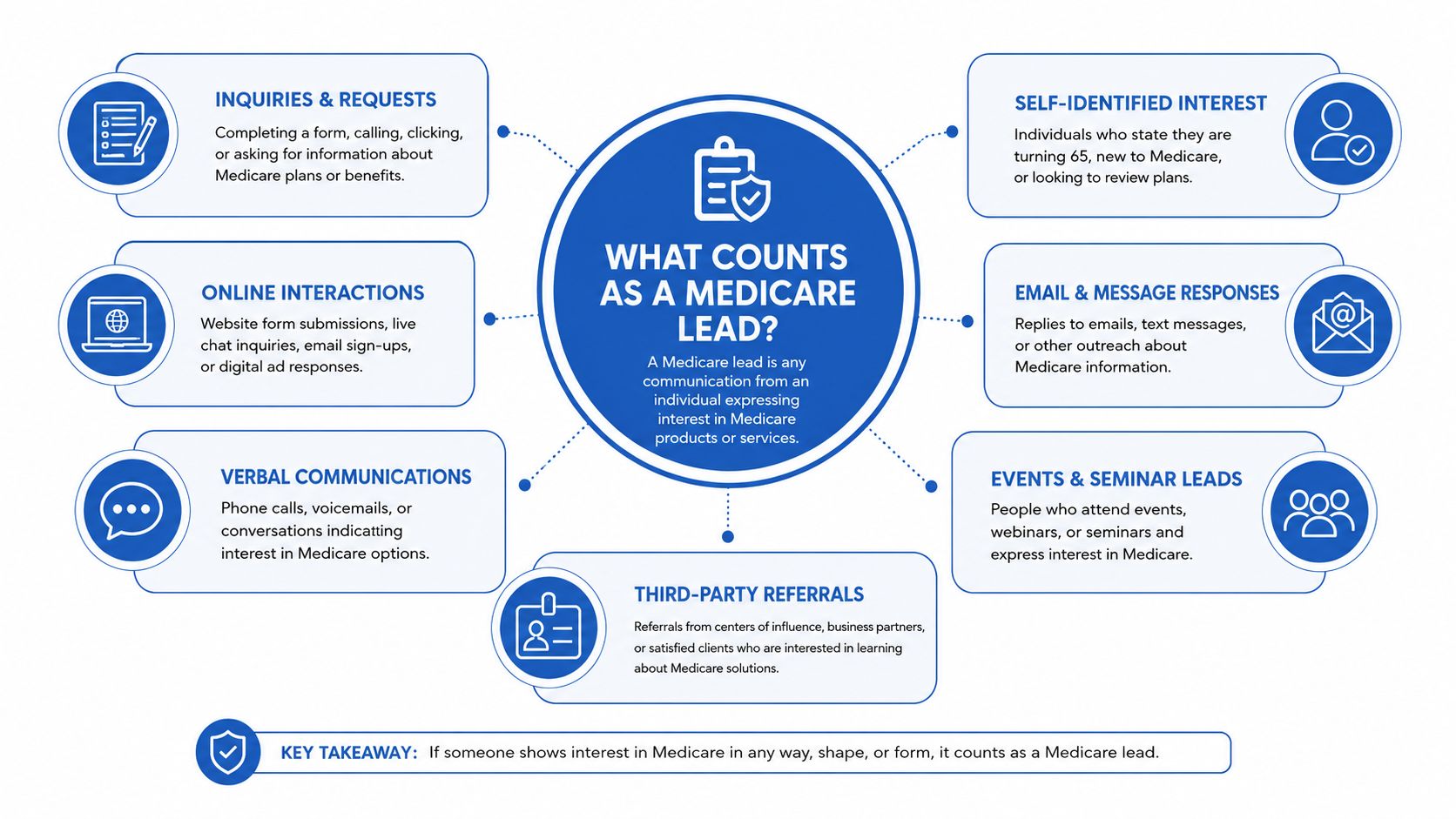
Buyer intent and originator intent are not the same
An agent or carrier wants prospects who can be sold, retained, and audited. An aggregator or media buyer wants traffic that can be qualified, routed, and monetized. Those goals overlap, but not perfectly. A source can look attractive to the seller because it's cheap and abundant, then fall apart in the hands of the buyer because the lead doesn't meet the plan, age, or consent requirements.
That's why scraped records, appended records, and broad health-interest lists create trouble. They might increase apparent reach, but they usually lower buyer confidence. In this vertical, buyer confidence is part of the product.
Medicare Advantage, Supplement, and Part D leads
Not every Medicare lead is sold the same way. Medicare Advantage, Medicare Supplement, and Part D each come with different buyer expectations and different qualification checkpoints. A lead for one product line isn't automatically usable for another, especially if the consent language was too broad or the lead record doesn't preserve enough context.
A good litmus test is whether the lead record can answer three questions without interpretation. Did the person ask about Medicare, did they authorize Medicare contact, and can the evidence travel with the record? If the answer to any of those is shaky, the record may still be traffic, but it isn't a clean Medicare lead.
A lead is only as valuable as the proof that travels with it.
Lead Types Compared Exclusive, Shared, Aged, and Inbound Calls
The biggest margin swings in Medicare usually come from lead type, not headline traffic source. Exclusive, shared, aged, and inbound-call leads are different acquisition models with different economics, and they need to be judged that way. A buyer who needs live appointments tomorrow shouldn't price leads like a long-tail nurture shop, and a team with slow follow-up can't pretend aged inventory will behave like a live inbound call.
| Lead Type | Typical CPL | Contact Rate | Close Rate | Best For |
|---|---|---|---|---|
| Exclusive | Higher than shared, because the buyer gets the record alone | Usually stronger than shared when follow-up is fast | Better when the lead is well qualified | Buyers who want less competition and cleaner ownership |
| Shared | Lower upfront, but more competition for the same person | Can fall fast once multiple buyers call | Often weaker because contact fatigue sets in | Teams with very fast speed-to-lead and strong scripts |
| Aged | Lower than fresh inventory | Lower than fresh, but workable with disciplined follow-up | Can improve when the buyer knows how to re-engage | Teams with patience, cadence, and low-cost outreach |
| Inbound calls | Usually the highest intent and often the most expensive | Stronger because the caller initiated contact | Strong when call handling is tight | Call centers and buyers with live answering capacity |
Why exclusive and shared aren't just price points
Exclusive leads cost more because the buyer isn't fighting other callers for the same person. That usually helps acceptance and reduces the weird race-to-the-phone dynamic that shared inventory creates. Shared leads can still work, but they reward operational discipline more than budget shopping.
Aged leads are a different animal. They're cheaper, but they're not cheaper in a vacuum. They need better cadence, faster re-contact, and a team that knows how to work older interest without sounding robotic.
Inbound calls need actual infrastructure
Inbound calls are the cleanest signal you can buy because the prospect raised a hand first. That doesn't mean they're easy. If your call center can't answer quickly, route cleanly, and document consent, the value leaks out before the sales conversation starts.
For a practical benchmarking lens on lead sourcing, the Pipecorn sourcing benchmark is a useful reference point when you're comparing source quality against operational capacity. And if you're building the demand side as well as the buying side, the internal guide on top health insurance lead generation ideas shows how differently the acquisition models can behave in practice.
Channels That Produce Medicare Leads
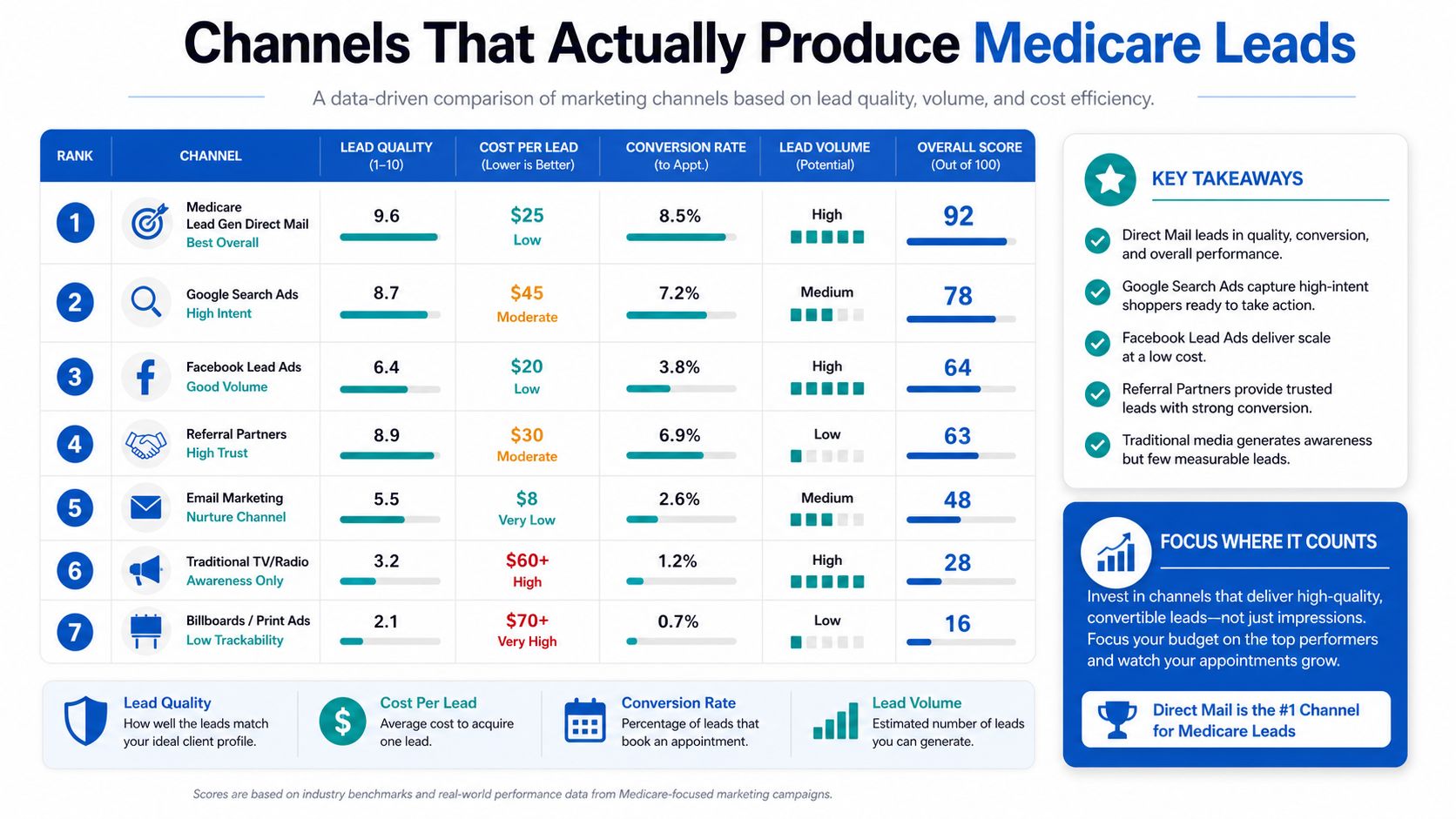
The channels that keep producing Medicare leads at scale are paid search, paid social, native advertising, and inbound or transferred calls. Each one creates a different kind of buyer, and each one changes the economics in a different way. A channel can look efficient in the ad platform and still be expensive once you count junk records, slow response, and low acceptance in the CRM.
Paid search and paid social
Google Search usually captures stronger intent because the prospect is already looking for a Medicare solution. The trade-off is cost. Paid social can produce lower-cost Medicare supplement leads, and search leads often sit higher on the spend curve, but that gap only matters if the paid social traffic still converts after filtering and follow-up. The point is not that one channel is cheap and the other is expensive. The point is whether the lower-cost source survives contact with the sales process.
Paid social works best when the creative is plain, the offer is specific, and the form qualifies early. Medicare audiences do not need clever copy. They need a clear reason to raise their hand and a fast path into the right queue. Search usually earns its higher cost through stronger intent, not through better ad polish.
Native and calls
Native can scale fast when the headline and pre-lander match the kind of educational content seniors will read. It also turns noisy quickly if the message gets too broad, because cheap clicks tend to pull in weaker-fit submissions. Inbound or transferred calls stay the highest-intent format because the prospect has already crossed the hardest line, agreeing to talk to someone.
For a practical comparison of source quality against operating capacity, the Pipecorn sourcing benchmark is useful when you are deciding where to place budget. If you are also building the demand side, the top health insurance lead generation ideas guide shows how differently acquisition models can behave once they hit real buyers.
Video can help you pressure-test the channel mix and the call flow.
The question is fit. A paid social funnel with weak handoff still loses money, and an expensive call source can outperform if the team answers fast, routes cleanly, and follows through. That is the economics of Medicare leads. Volume matters, but only after the channel can produce records the team can contact and close.
Capture and Qualification Plumbing That Keeps Leads Clean
Most Medicare lead problems start before the lead ever hits the CRM. The form was too long, the qualification was too loose, or the tracking broke between click and submission. Once that happens, every downstream report gets contaminated, and the team starts blaming the wrong source.
Build the form to disqualify early
Multi-step forms usually perform better than a single wall of questions because they reduce perceived friction on mobile and let you qualify in stages. Conditional logic matters even more. If the prospect is outside your service area, not in the right age band, or not looking for a Medicare product you sell, the form should disqualify them before they ever reach the buyer queue.
That isn't about being harsh. It's about protecting the economics. Every unqualified record that enters the CRM steals follow-up time from the leads that can close.
Keep the tracking intact
UTMs, gclid, fbclid, source IDs, and sub-IDs need to survive the full journey from click to lead record. If they drop out midway, attribution becomes a guessing game. Server-side signals like Meta and Google CAPI help too, because the platform still needs conversion feedback even when browser tracking is degraded.
For a practical build guide on this part of the stack, the real-time and bulk verification playbook is relevant because verification isn't just about cleaning lists, it's about protecting the handoff from bad records and bad routing.
Operational rule: if the source, qualification status, and consent proof don't survive the handoff, the lead wasn't production-ready.
Phone and email verification should happen before the lead gets sold or routed, not after the team has already spent time on it. Twilio and Zerobounce are common parts of that plumbing because they help cut bot traffic, fake submissions, and records nobody can reach. The cleanest Medicare stacks also pass the submission in real time to the CRM or distribution platform, so speed-to-lead doesn't die in a batch export.
Compliance and Consent Evidence in a Post-iOS World
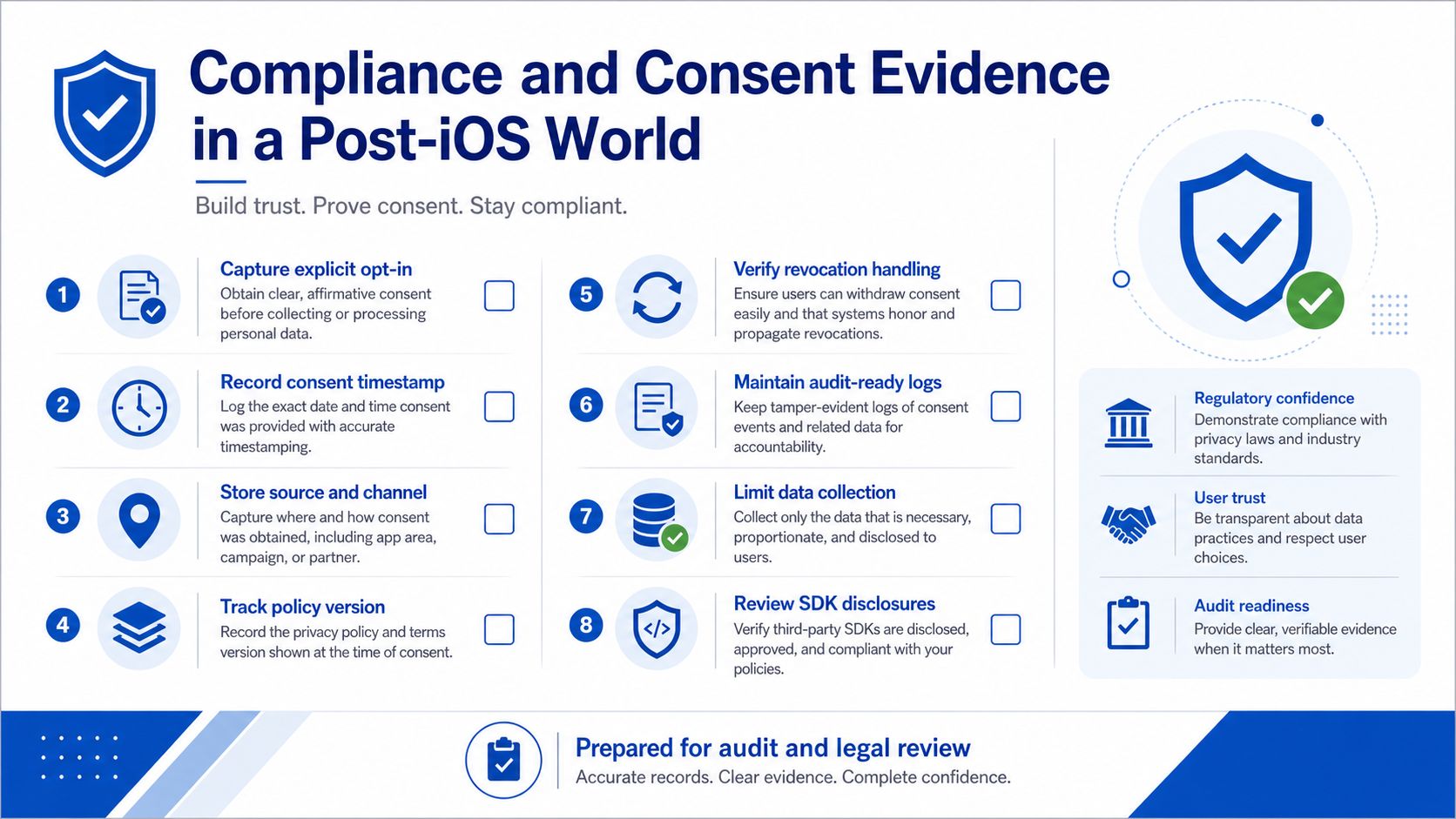
Medicare compliance isn't a footnote. It's part of the product. A CMS-compliant lead needs explicit, Medicare-specific consent that's documented, time-stamped, and auditable, because generic permission to talk about health insurance won't save a lead in a review.
Consent evidence has to travel with the lead
A lead without proof is increasingly hard to sell. Serious buyers expect consent evidence to stay attached through distribution, especially when forms, SMS, and cross-channel follow-up are involved. That's why tools like TrustedForm and Jornaya became de facto standards in the market, not because they're fashionable, but because buyers need something auditable when they review the source.
The operational standard is simple. Capture the consent, store it with the record, and make sure it survives every transfer. If the proof sits somewhere disconnected from the lead file, the buyer has to trust your memory instead of your process.
SMS and call handling need the same discipline
Text permission should not be an afterthought, and neither should permission-to-contact timing. If your team uses SMS for follow-up, the consent trail needs to show that text outreach was authorized, not implied. That becomes even more important when the call path is outsourced or routed through multiple vendors.
For teams that rely on live call handling, Eden's insurance call handling is a useful example of how the front end of the call flow can affect compliance and response quality. The internal guide on TCPA basics for lead gen operators is also worth keeping close, because the compliance question is usually a workflow question before it becomes a legal one.
Buyers and sellers both need an audit trail that answers the same question. Where did the lead come from, what exactly did the person consent to, and can that evidence be produced without a scramble? If the answer is yes, the lead has a market. If it's no, the lead has a problem.
Measuring What Matters: EPC, Acceptance, and Return Rates
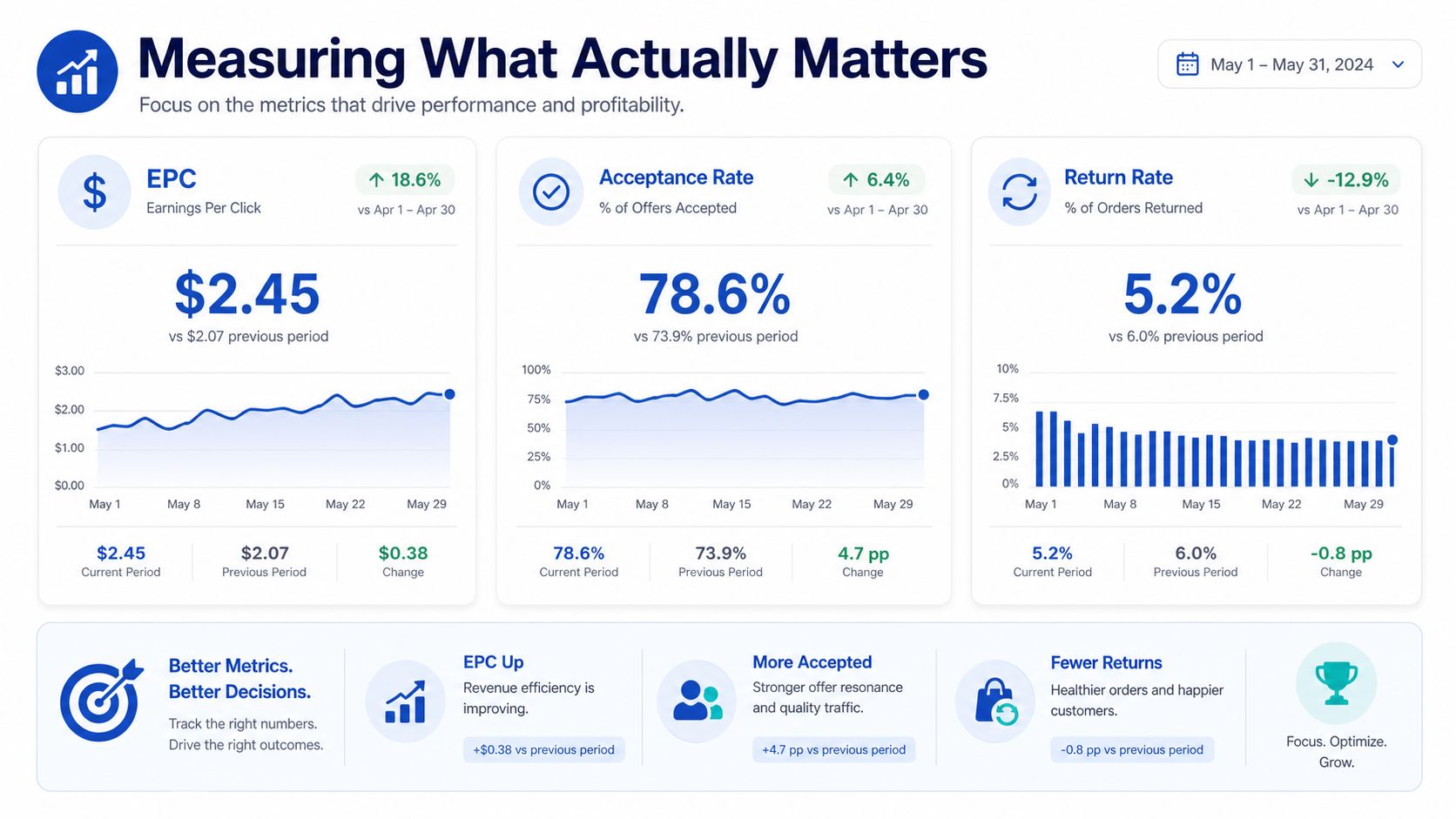
Cost per lead gets too much credit in Medicare. It is a top-of-funnel number, and top-of-funnel numbers can flatter a weak source or a sloppy compliance trail. The metrics that decide whether a program makes money are earnings per click, buyer acceptance rate, return rate, and contact rate.
Read the numbers in the right order
EPC tells you whether the traffic monetizes after the friction is applied. Acceptance rate tells you whether the buyer thinks the lead is usable. Return rate tells you how much of your sold volume comes back as bad. Contact rate tells you whether the team can reach the person before the opportunity cools.
Each metric points to a different failure point. Low EPC with decent acceptance usually means the traffic is not monetizing well enough, while high returns usually point to bad qualification, bad consent, or bad data quality. A weak contact rate often comes from stale records, slow response, or poor verification.
Speed changes the outcome
In Medicare, response speed is not a cosmetic advantage. A lead that sits too long often turns into a lower-contact asset, especially in older or shared inventory. Fast follow-up protects the value you already paid for, and verified phone and email records tend to clear faster because the buyer does not have to spend time on junk.
A buyer will forgive a higher CPL faster than they'll forgive a weak contact rate.
That is the logic behind strong verification and clean handoff. If your reporting only tracks CPL, you end up optimizing for cheap inputs instead of profitable outcomes. Once the dashboard shifts toward acceptance, returns, EPC, and contact, the program starts telling the truth.
An Operator Playbook for Building a Medicare Lead Program
Start with one channel and one lead type, then measure EPC, acceptance, returns, and contact rate from day one. Build the capture stack with multi-step forms, conditional disqualification, real-time verification, and consent evidence attached to every lead, then wire your tracking before you add more spend. If acceptance is stable, expand one variable at a time. If returns rise, cut the source before you scale the budget.
The fastest way to break a Medicare program is to buy the cheapest shared leads, skip verification, and treat compliance like a footer. The fastest way to build one is to make the economics visible early and refuse to sell anything you can't defend with proof.
If you're building Medicare funnels and want cleaner qualification before the lead ever hits sales, Growform gives you the multi-step capture and conditional logic stack to do that without waiting on a developer. It's built for lead quality, tracking, and clean handoff, which is exactly what Medicare programs need when margins depend on acceptance and returns.