


Growform helps mass tort marketers and intake teams turn paid traffic into better-screened claimant leads. We’re a no-code multi-step form builder built specifically for lead generation and qualification, not a generic survey tool, so your intake flow is designed around completion rate, lead quality, consent capture, and clean handoff into legal workflows.
If you are running Meta, Google, or native traffic into mass tort campaigns, Growform gives you a better front end than a long static form. You can screen for matter type, jurisdiction, and basic disqualifiers, preserve consent evidence, and send submissions instantly to your CRM, GoHighLevel, or lead distribution stack without waiting on a developer.
Growform mass tort intake forms screen case fit before attorney or call center review
Mass tort intake gets expensive when every click lands on the same bloated form and every submission needs manual cleanup. Growform lets you break intake into a mobile-first, step-by-step flow that asks only the questions needed to determine whether a claimant fits the case criteria you actually care about.
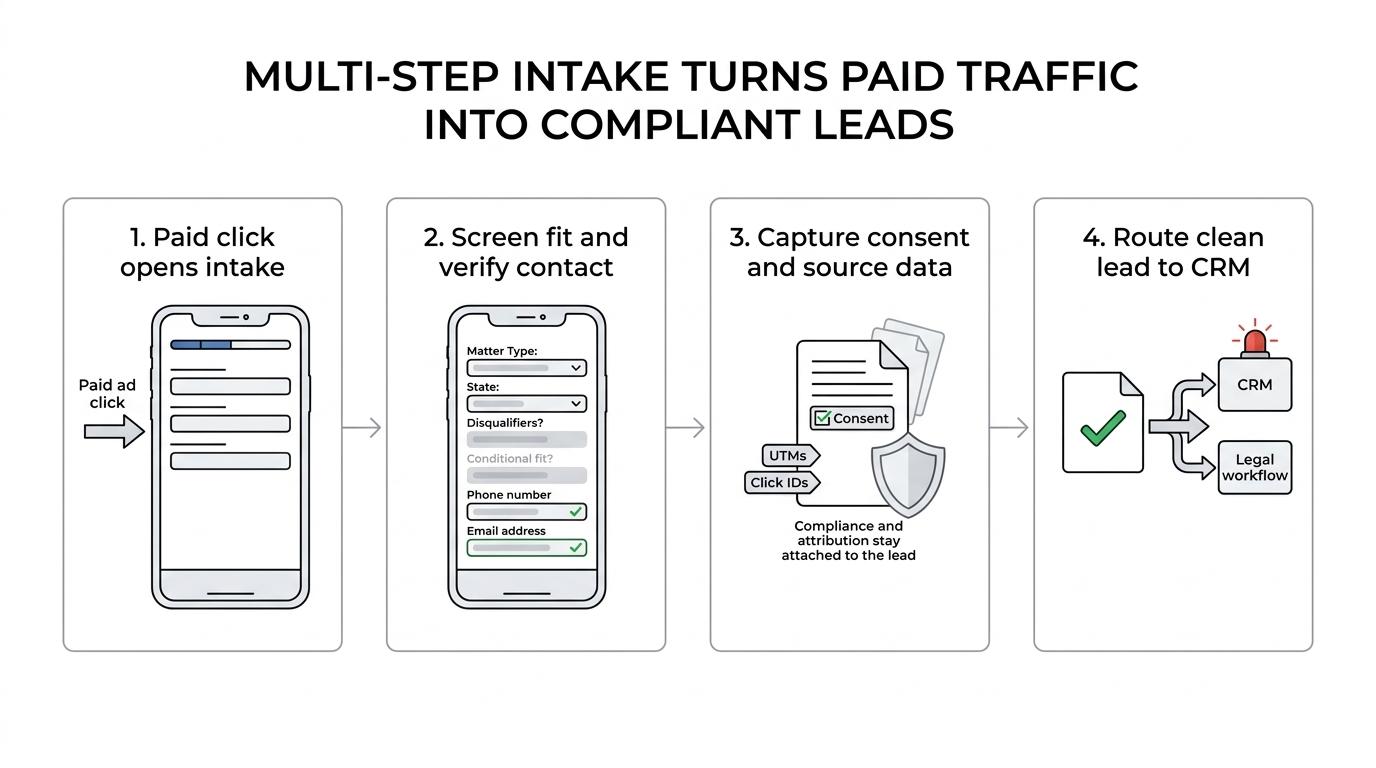
Growform’s conditional logic is what makes this useful in mass tort, not just prettier. You can show or hide fields, skip irrelevant steps, reveal follow-up questions only when a claimant qualifies, and send different respondents to different thank-you pages based on their answers.
That means your form can screen for the matter type, the state or jurisdiction involved, and obvious disqualifiers before the lead ever reaches attorney review, retainer paperwork, or a consultation booking step.
A typical Growform mass tort intake flow can help you capture and qualify:
- claimant contact details with inline validation
- case-type-specific answers based on conditional logic
- jurisdiction and fit signals before handoff
- phone and email verification to reduce fake or unreachable leads
- source data such as UTMs, click IDs, and sub-IDs for attribution and buyer payloads
Tort-specific screening questions that stay out of medical territory
The questions that decide whether a mass tort claimant is worth a call are mostly about the case, not the person’s health. A good intake form asks those and leaves injury and medical detail to the firm’s intake call, where the firm’s own confidentiality obligations apply. Growform’s mass tort intake form template follows that pattern and asks nothing about health or medical history.
- The case. Which product or litigation the inquiry belongs to, in the claimant’s own words or from a list of the torts you are running.
- Exposure or use dates. When the claimant first used the product or was exposed, and roughly for how long. Most dockets have a qualifying window, and a date question removes the claimants who fall outside it before anyone dials.
- State. Where the claimant lives and where the use or exposure happened. The statute of limitations differs by state and by claim type, so the form collects the state and the dates, and the firm’s counsel sets the cutoffs that the intake team applies.
- Prior representation. Whether the claimant has already signed with another firm or filed a claim for the same matter. A claimant who is already represented is a rejected lead for most buyers, and the question costs one tap.
Each answer can drive the next step. A claimant outside the date window or already represented can skip straight to a polite thank-you page, while one who fits moves on to contact details and consent.
Matter-type screening for broader legal intake
The same approach works when one form serves more than one practice area. Legal intake is screening as much as information collection, and a form that shows the right follow-up questions for each matter type behaves more like an intake specialist than a generic contact page.
If someone selects a vehicle accident, Growform can show a different set of follow-up questions than someone asking about a defective product or a mass tort, keeping the form relevant while collecting the detail your team needs. Conditional logic is included on all plans, including the ability to show or hide both fields and entire steps.
Growform also helps you control what happens after submission. You can send people to different thank-you pages based on their answers, which is useful when one inquiry should be prompted to call now, another should wait for review, and a third should be told the matter is outside scope. For firms that take personal injury inquiries alongside mass tort, the personal injury claim form and law firm templates are starting points for those paths.
Mobile-friendly mass tort intake forms for higher completion on paid traffic
Legal intake guidance increasingly favors logic-based, mobile-friendly forms that adjust by case type instead of forcing every prospect through the same page. That matters when your traffic is coming from mobile devices and your CPL rises every time a claimant abandons halfway through.
Growform builds that mobile experience into the form layer itself. Multi-step layouts, progress bars, address lookup, inline validation, and subtle animations reduce perceived friction on longer qualification flows, and Growform’s UX-driven templates are built for lead capture rather than general data collection.
For operators buying traffic at volume, Growform also protects the data behind the submission. Hidden fields persist UTMs, gclid, fbclid, source tags, and sub-IDs across the full multi-step flow so attribution does not silently break between the ad click and the lead record.
Growform also supports 1-click pixel firing and Google Tag Manager, with server-side conversion events for the Meta Conversions API and Google launching soon. If you are trying to understand which campaigns are producing accepted mass tort leads instead of just cheap form fills, that tracking matters as much as the form design.
Mass tort intake compliance workflows reviewed for 2026 consent standards
This section was reviewed on 30 September 2026. The FCC’s January 2024 order would have required prior express written consent for robocalls and robotexts to be one-to-one and logically and topically related to the page where consent is collected. The Eleventh Circuit vacated those requirements on 24 January 2025 in Insurance Marketing Coalition v. FCC, before they took effect, so the one-to-one rule is not in force. Our TCPA guide for lead generation operators covers what that means in practice.
Buyers and firms still ask for clear, case-specific disclosures and proof of consent, and Growform helps you build intake flows that meet those expectations. You can keep case-specific disclosures close to the form experience, keep the intake page aligned with the outreach being authorized, and capture consent evidence at the point of submission instead of trying to reconstruct it later.
The FTC has also emphasized that written permission requests cannot be buried in unrelated text and must include affirmative assent and the consumer’s number and signature in an E-SIGN-compliant format. Growform gives you the capture layer and the evidence layer, while your legal team or compliance counsel can approve the disclosure language, seller naming, and campaign-specific setup.
For mass tort operators, Growform’s compliance-supporting features are practical rather than theoretical:
- native TrustedForm and Jornaya integrations
- conditional flows that keep consent collection aligned to the specific tort or intake topic
- hidden field pass-through so campaign, source, and seller data stay attached to the lead
- real-time delivery into downstream systems without copy-paste or delayed exports
Real-time routing from Growform into legal CRMs, GoHighLevel, and lead distribution software
Growform is not your case-management system, and it is not trying to replace your routing platform. Growform is the qualification and handoff layer at the front of the stack, where claimant data is captured, screened, verified, and passed downstream in real time.
That is why Growform connects through webhooks and 7,000+ Zapier apps to HubSpot, Salesforce (through Zapier), GoHighLevel, Google Sheets, and distribution platforms such as Boberdoo, Phonexa, LeadByte, and LeadsPedia. If your mass tort workflow depends on fast routing, buyer payload requirements, or immediate alerts to protect speed-to-lead, Growform is built for that environment.
Growform can also send an instant email alert when a claimant submits, with SMS or WhatsApp alerts through Zapier. Real-time phone verification through Twilio and email validation through ZeroBounce stop fake and uncontactable submissions before they reach your intake queue or your buyer. For intake teams working high-value campaigns, that shortens the gap between form completion and human follow-up without forcing your team to monitor a spreadsheet.
If your current intake form is hurting completion rate or sending too much junk downstream, clone the mass tort intake template and put your own cases into it. Start free trial to build it on the 14-day free trial.
Related articles

Growform Debt Relief Forms for Qualified Lead Intake
Debt relief lead forms have to do more than convert.
September 30, 2026

Growform CRM Forms With Hidden Field Pass-Through Built In
September 30, 2026

Growform Multi-Step Forms for Paid Lead Generation
Growform is a no-code multi-step form builder built for one job: turning paid traffic into qualified leads.
September 30, 2026