
Quiz Funnels vs Multi-Step Forms for Lead Generation

Paid traffic operators usually ask the wrong first question here.
It is rarely, “Should I use a quiz funnel or a multi-step form?”
The better question is, “How much qualification can I add before my cost per qualified lead breaks?”
That framing matters when you are buying Meta, Google, native, or TikTok traffic into consumer lead funnels at scale. A roofing lead seller, final expense aggregator, solar marketer, or mass tort operator is not trying to win a design award. The job is to turn expensive clicks into contactable, compliant, buyer-accepted leads with enough margin left over to scale.
A quiz funnel and a multi-step form can both help. They are not the same thing, though, and they tend to win in different conditions.
Table of Contents
Quiz funnels and multi-step forms solve different lead generation problems
A multi-step form is mainly a structure choice. It breaks a longer form into smaller screens so the user sees fewer visible fields at once. That lowers perceived effort, especially on mobile, and often improves completion on paid traffic landing pages.
A quiz funnel is more of a framing choice. It still uses steps, but the experience feels like a guided assessment, estimator, eligibility check, or recommendation flow. That framing can make qualification questions feel more natural, which is useful when you need to ask more than name, phone, and ZIP.
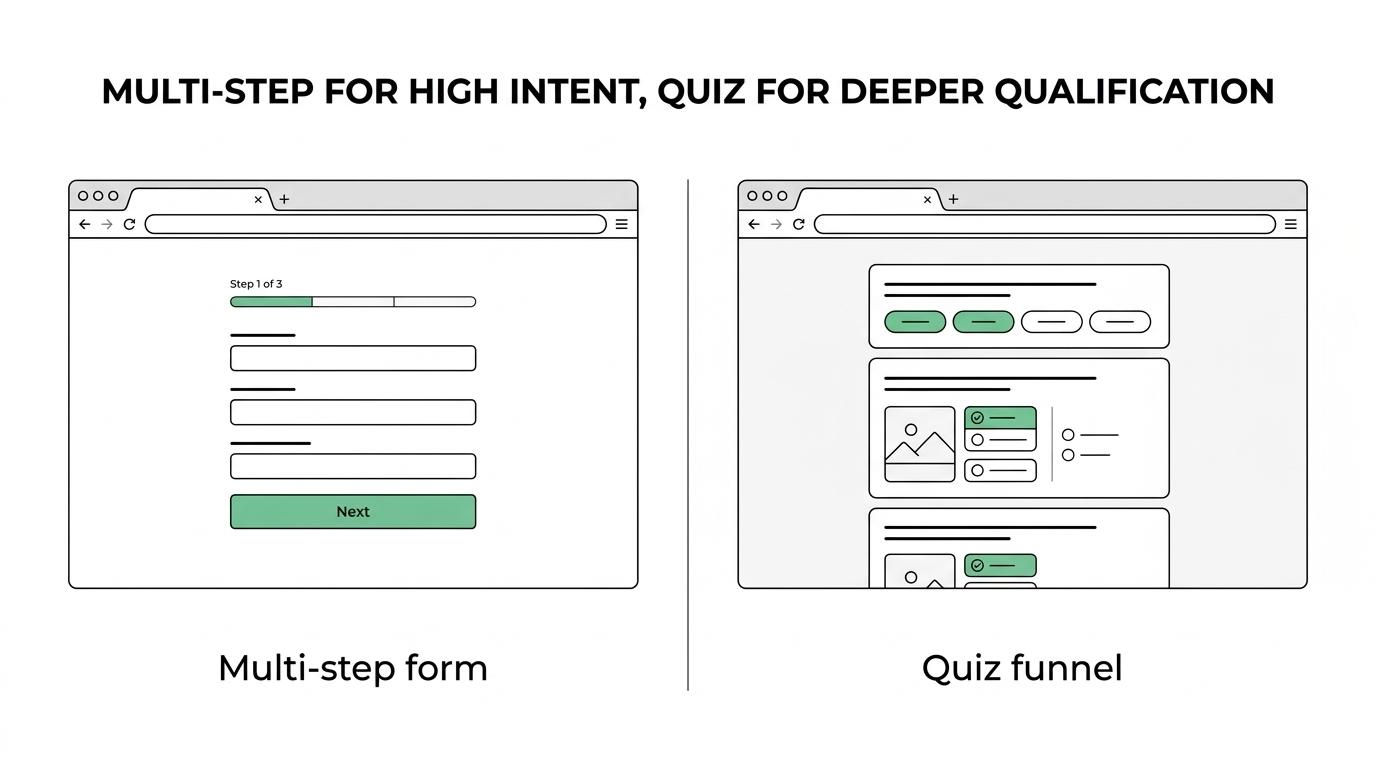
For high-volume consumer lead gen, the distinction shows up fast:
- Multi-step forms are usually the safer default when intent is already high and speed matters.
- Quiz funnels are often stronger when traffic is colder, the offer needs explanation, or lead quality depends on deeper answers.
A lot of teams treat these as separate categories when they should think of them as overlapping patterns. Many of the best funnels are both: a multi-step form with quiz-style copy, progressive disclosure, and conditional logic.
Multi-step form vs quiz funnel comparison for paid traffic campaigns
The table below captures the tradeoff most operators care about.
| Factor | Multi-step form | Quiz funnel |
|---|---|---|
| Primary goal | Increase completion rate | Increase qualification depth without obvious friction |
| Best traffic temperature | Medium to high intent | Cold to medium intent |
| Best use cases | Roofing campaign quote requests, local solar consultations, debt relief checks, mortgage inquiries | Eligibility checks, insurance matching, legal screening, pricing estimators |
| User perception | “Short form broken into steps” | “Guided assessment” |
| Qualification depth | Moderate to high | High |
| Risk | Too many steps with weak copy can still tank completion | Can feel gimmicky if the payoff is thin |
| Mobile experience | Usually strong | Strong if fast and tightly scripted |
| Routing value | Good | Excellent when buyer rules depend on detailed answers |
| Best downstream fit | CRM handoff, appointment setting, simple lead routing | Ping post, buyer segmentation, lead scoring, selective routing |
This is why operators should not ask which format is “better” in the abstract. The better format depends on traffic quality, CPL target, buyer acceptance rules, and how much data you need before the lead hits the CRM or distribution layer.
Form friction research: visible fields matter more than step count alone
There is a useful lesson in the research around form usability: people react more to the work they can see than to the total work hidden in the flow.
Baymard has repeatedly pointed to the impact of visible fields, required field design, and error recovery. In practical terms, eight well-structured fields over four steps can feel easier than six dense fields on one page. That is a big reason multi-step lead forms often beat long single-page forms.
HubSpot has also pushed the basic idea that shorter forms reduce friction and support higher completion. Unbounce has published benchmark-style guidance showing conversion rates dropping as field count rises. The exact percentages will vary by vertical, offer, and traffic source, but the pattern is consistent: more fields usually means fewer submissions.
That does not mean “always ask less.” It means every field must earn its place.
After you have the core offer right, these are the form-friction details that move results the most:
- Fewer visible fields
- Clear progress indicator
- Inline validation
- Fast mobile input
- Smart conditional questions
And when you do need to ask qualifying questions, the highest-performing approach is often this:
- Ask early: one or two easy, low-threat questions that create momentum
- Qualify next: location, service type, property details, age band, ownership, or case type
- Capture last: name, phone, email, consent, and scheduling preference
- Validate live: phone and email checks before submission
That pattern works because it builds commitment before the user reaches the highest-friction fields.
When a multi-step form wins for consumer lead generation
If you are running search or high-intent paid social and the visitor already knows what they want, a standard multi-step form usually wins on efficiency.
Think about common operator scenarios:
A roofing campaign targeting “roof replacement estimate” traffic does not need a playful quiz wrapper. The user wants a quote. The right move is often a direct multi-step form that asks for project type, property type, timeline, address, and contact details, then routes the lead instantly.
The same goes for local solar, debt relief, and many home services offers. In these cases, quiz language can add unnecessary narrative. The better play is to keep the experience direct and compress the visible effort per screen.
A multi-step form is usually the stronger choice when:
- Intent is obvious: the click came from a strong commercial keyword or a tight ad-to-page match
- The sales process is fast: your value depends on speed-to-lead, not a long nurture path
- Buyer rules are simple: a few qualification inputs are enough for routing or sales acceptance
- You need volume: your economics tolerate some lower-intent leads as long as contact rate is solid
This is also where form design details matter more than people expect. Baymard’s work on field design is a reminder that step count alone is not magic. A clumsy multi-step form with bad validation, unclear errors, and awkward name or address inputs can still lose badly.
For operators, that means fixing mechanics before chasing more inventive funnel concepts.
When a quiz funnel wins on lead quality and qualification depth
Quiz funnels tend to shine when the lead is harder to qualify, the buyer demands detailed context, or the user needs a reason to answer more questions.
Insurance, legal intake, and some financing offers fit this pattern well. A final expense funnel may need age range, tobacco status, coverage intent, and beneficiary context. A mass tort flow may need injury details, diagnosis timing, product exposure, attorney status, and state. A “simple form” can struggle here because the qualification burden is real.
A quiz-style frame can make those questions feel purposeful instead of bureaucratic.
That is the key benefit. Not entertainment. Purpose.
The user thinks, “I am checking eligibility,” or “I am seeing my options,” rather than “I am filling out a long form for a call I may not want.”
That said, a quiz funnel can help here because it creates a natural setup for collecting context before the disclosure and contact step. Still, the contact step must be clean, readable, and explicit.
Lead quality tradeoffs: more volume is not always better margin
Operators know the painful version of this story. A shorter form drops CPL by 20%, the team celebrates, and two weeks later contact rates fall, buyer rejections rise, and net revenue gets worse.
That happens because the real metric is not raw form conversion rate. It is qualified lead yield after validation, compliance checks, and downstream acceptance.
Here is a simple way to think about it:
- A shorter, lighter multi-step form usually raises top-line lead volume.
- A deeper quiz-style flow often improves qualification data and sales readiness.
- The winner is the one that produces the best margin per accepted lead.
For high-volume consumer lead generation, quality usually comes from four places:
- Traffic intent: keyword, audience, placement, and creative match
- Question design: the right qualifiers asked in the right order
- Verification: phone validation, SMS OTP, email checks
- Routing logic: sending the lead to the right buyer or team based on real attributes
This is why many lead sellers land on a hybrid model. They use a multi-step form structure to keep completion healthy, then add quiz-style wording and conditional logic so high-value paths can answer more questions without forcing every user through the same burden.
That approach is especially useful in ping post environments where buyer eligibility rules vary. If a solar lead in California with homeowner status and a high electric bill is worth much more than a renter with low usage, the form should surface those differences before the lead hits LeadsPedia, Boberdoo, Phonexa, or another routing stack.
Hidden fields, attribution, and lead distribution matter more than most form comparisons admit
A quiz funnel that “converts better” is not actually better if it breaks attribution or sends half-empty payloads downstream.
This is a common failure point when teams move from simple landing page forms to more complex flows. A multi-step or quiz-style experience has to preserve hidden fields across every step: UTMs, gclid, fbclid, sub IDs, landing page IDs, campaign names, and any internal source markers.
If those fields disappear, you lose the ability to optimize media buying and prove lead source quality.
The same goes for real-time delivery. For operator-grade lead gen, the form layer should cleanly pass data into:
- CRMs like HubSpot, Salesforce, or GoHighLevel
- Lead distribution platforms like Boberdoo, Phonexa, LeadByte, Databowl, or LeadsPedia
- Verification tools
- Consent evidence systems like TrustedForm and Jornaya
This is one reason direct-response teams often outgrow generic form builders. They need the front end to work like part of the lead stack, not just a pretty input screen.
Compliance and trust signals in multi-step lead forms
The more you ask, the more you need to justify why you are asking it.
That is not just a UX issue. It is a compliance issue too, especially in regulated verticals. Consumer lead generators dealing with insurance, legal, mortgage, and other sensitive categories should review consent language regularly and make sure the capture flow matches current campaign requirements. As of 2026, that still means close attention to TCPA-related practices, state-level rules, and how consent evidence is stored.
A quiz funnel can help here because it creates a natural setup for collecting context before the disclosure and contact step. Still, the contact step must be clean, readable, and explicit.
A few practical rules help a lot:
- Keep disclosures close: consent text belongs near the submission action
- Capture proof: TrustedForm or Jornaya should be attached where required by buyers or carriers
- Match the promise: the page claim, quiz framing, and consent language should not conflict
- Verify contactability: bad phone data is both a quality issue and a compliance risk
How to test quiz funnels against multi-step forms without fooling yourself
The right test is not “Which gets more submissions this week?”
It is “Which produces more profit per thousand clicks after validation, contact, acceptance, and sales feedback?”
Run the test long enough to measure the downstream picture. For operator campaigns, that usually means comparing:
- Landing page conversion rate
- Verified phone rate
- Contact rate
- Appointment or transfer rate
- Buyer acceptance or sales-qualified rate
- Revenue per lead and margin per lead
If you stop at step one, you can easily pick the wrong winner.
A strong test design also isolates the real variable. Keep the offer, traffic mix, page speed, and handoff logic stable. Only change the funnel format and question flow.
A practical decision rule for high-volume lead gen teams
If the offer is straightforward and intent is high, start with a multi-step form.
If the lead needs heavy screening or the user needs a reason to answer many questions, start with a quiz-style funnel.
If you need both volume and qualification, build a hybrid: multi-step structure, quiz-style copy, conditional logic, real-time validation, and clean routing into the rest of the stack.
That is where the best paid traffic funnels tend to land. Not at one extreme or the other, but at the point where conversion rate, lead quality, compliance, and delivery all work together.