
2026 Final Expense Leads: Generate & Monetize Success

If you're buying traffic or brokering leads right now, you probably know the feeling. Click volume looks healthy, form fills come in, and then the back end tells a different story. Buyers reject too many records, agents complain that nobody answers, and the campaigns that looked fine on a CPL dashboard don't hold up when you trace them to issued business.
That happens because final expense leads aren't won at one step. They're won when channel choice, qualification logic, compliance evidence, delivery speed, and buyer rules all line up. If one piece is weak, the whole funnel leaks margin.
Demand isn't fading, either. The global Final Expense Insurance Market was valued at approximately USD 169.5 billion in 2025 and is projected to reach USD 181.4 billion in 2026, according to Global Growth Insights' final expense insurance market report. For operators, that means opportunity. It also means more competition for the same high-intent consumer.
A lot of teams still treat this category like a media buying problem. It isn't. It's an operations problem. If you need a clean refresher on what separates a raw inquiry from something sales can work with, this guide to qualified leads is worth reviewing before you scale anything.
Table of Contents
Table of Contents
- Moving Beyond CPL The Modern Final Expense Lead Funnel
- Selecting and Optimizing Your Acquisition Channels
- Designing a High-Conversion Qualification Funnel
- Mastering Compliance and Consent Capture
- Building Your Real-Time Delivery and Attribution Stack
- Pricing Leads and Maximizing Buyer Acceptance
Moving Beyond CPL The Modern Final Expense Lead Funnel
Most losing final expense campaigns have the same symptom. The operator obsesses over cost per lead, while the buyer cares about issued business and the call floor cares about whether the lead is contactable in the first place.
That mismatch is where margin disappears.
A cheap lead can be expensive if it produces no conversations, no accepted records, or no applications that stick. A more expensive lead can be the better buy if the consumer is reachable, properly qualified, and routed fast enough for an agent to work it while intent is still high. In this vertical, CPIA and buyer acceptance rate tell you far more than raw CPL ever will.
The numbers that actually matter
I look at final expense funnels in four layers:
- Front-end efficiency: What did it cost to generate the inquiry?
- Qualification quality: Did the person fit age, geo, and product intent before sales touched it?
- Operational integrity: Did the lead include consent evidence, valid contact details, and usable attribution?
- Back-end value: Did it become an accepted lead, an application, and eventually an issued policy?
Practical rule: If your dashboard ends at form completion, you're not measuring a lead business. You're measuring page activity.
The modern funnel has to connect all four layers. Traffic source affects intent. Form design affects completion and honesty. Verification affects contactability. Routing speed affects connect rate. Buyer rules affect realized revenue. Pull one lever without the others and you usually just move the problem downstream.
Why system thinking wins here
The teams that do well in final expense don't ask only, "Can I get cheaper traffic?" They ask better questions:
- Can this channel produce the kind of intent my buyers want?
- Can my form qualify aggressively enough without crushing completion?
- Can I prove consent and preserve attribution at the moment of submission?
- Can my delivery stack notify the right person immediately?
- Can the buyer accept this lead consistently, not just occasionally?
That is the primary funnel. Media is only the first input.
Selecting and Optimizing Your Acquisition Channels
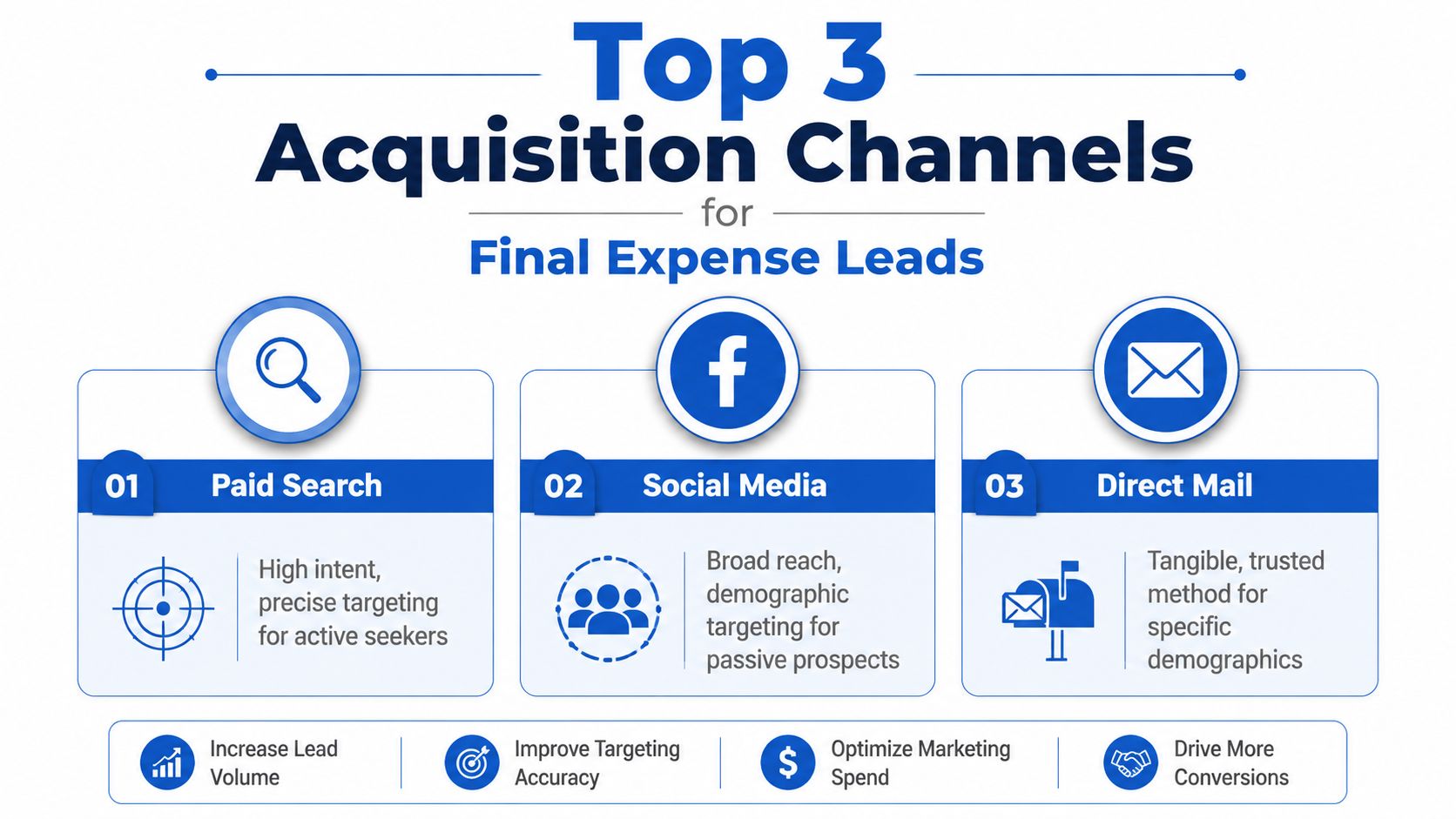
A campaign can look healthy at noon and be unprofitable by Friday. Search clicks are expensive, social form fills pile up fast, direct mail responses come in waves, and live transfers can drain margin if buyers are slow to answer. Channel selection in final expense is a systems decision. The source has to fit your qualification flow, your compliance process, and the way you deliver and monetize each lead on the back end.
What each channel is really buying you
Paid search buys active intent. The prospect is already looking for burial insurance, funeral coverage, or a close variant. That usually improves buyer acceptance, but only if the account structure is tight, the keyword list is controlled, and the landing page confirms product fit fast. Broad matching senior traffic without heavy negatives is one of the fastest ways to burn spend on Medicare, life insurance, and general planning queries that never convert into accepted final expense leads. Teams that need stricter traffic control often benefit from specialized senior Google Ads management because this audience reacts poorly to vague ad copy and generic landing pages.
Social traffic buys interruption at scale. You can produce volume quickly, but the front-end price means very little if your form lets low-intent users slide through. Social only works when the capture flow filters hard enough to protect CPIA and buyer acceptance rate. That means immediate field validation, age and state gating, duplicate checks, and phone verification before the record gets sold. A practical setup uses the same qualification rules in the form and in the CRM so marketing is not optimizing for leads that sales rejects later. Teams trying to cut bad records without crushing completion should review phone verification tactics that reduce junk leads without hurting conversion.
Direct mail buys trust and stronger purchase intent, but response handling decides whether you keep that advantage. A mail piece can produce high-quality inbound demand, then lose value if the response goes to voicemail, sits in a spreadsheet, or reaches a buyer after the contact window has already cooled. Direct mail works best inside a digital operating system. Use a tracked number or personalized URL, route submissions into the same qualification logic as paid traffic, and post to buyers in real time with source metadata attached.
Live transfers buy immediacy. They can support premium pricing because the buyer gets a live conversation instead of a callback task. They also break fast when call center scripts are loose, transfer criteria are vague, or buyers lack agent capacity. If a buyer takes calls slowly or misses handoffs, CPIA rises fast.
A short explainer is useful here before the benchmarks.
Final Expense Lead Channel Performance Benchmarks 2026
| Lead Type | Typical Cost | Exclusivity | Average Close Rate |
|---|---|---|---|
| Aged bulk inventory | Low upfront cost | Usually non-exclusive or recycled | Lower than fresh inventory |
| Shared web leads | Mid-range | Shared to multiple agents | Lower buyer acceptance unless speed-to-lead is strong |
| Exclusive web leads | Higher than shared leads | Exclusive | Better acceptance when qualification is strict |
| Direct-mail leads | Higher acquisition cost | Typically exclusive by response | Often stronger close rates than web form traffic |
| Live transfers | Premium pricing | Exclusive call handoff | Can perform well if the buyer answers immediately |
The table is directionally useful, but it does not answer the operating question. The primary question is what each channel does to accepted lead cost after filtering, returns, and buyer-specific rules. I care more about CPIA and acceptance rate than front-end CPL because those numbers expose whether the traffic source fits the downstream sale.
Channel fit by operating model
Search is usually the best fit for operators selling exclusive leads or routing directly to an in-house call team. Intent is clearer, source attribution is cleaner, and buyers generally tolerate higher prices if contactability is strong.
Social works when the stack is built for it. That means form analytics, duplicate suppression, bot filtering, click-to-call event tracking, CRM feedback loops, and fast return data from buyers. Without that stack, social often looks profitable in the ad account and weak everywhere else.
Direct mail fits teams that can absorb variable volume and respond fast. It also pairs well with digital qualification because the response is already warm. The mistake is treating mail like an offline channel when the monetization depends on digital speed and clean routing.
Live transfers fit buyers with immediate agent availability and clear disposition reporting. If the buyer cannot confirm accepted calls, contact outcomes, and application rates quickly, it becomes hard to price inventory with confidence.
Where aged leads fit and where they break
Aged leads belong in a separate workflow. They are not a substitute for fresh acquisition. They are a margin play for teams with spare dialing capacity, strong reactivation scripts, and low enough labor cost to survive weaker contact rates.
The common failure is operational, not strategic. Teams buy cheap inventory, send it into the same queue as fresh leads, then wonder why agent productivity drops. Aged records need their own cadence, their own suppression rules, and a re-qualification step before they re-enter the main sales flow. If the phone is invalid, the prospect is outside the target age band, or the original product intent is gone, the record should die there instead of consuming more buyer trust and more payroll.
Designing a High-Conversion Qualification Funnel
The form is where lead quality is either created or destroyed. In final expense, a single-step page with a long list of fields usually underperforms because it asks for commitment before trust exists. That gets worse on mobile, where the user is often reading small text, dealing with a slower connection, or deciding whether this page feels safe enough to continue.
A better front end uses progressive friction. Start easy. Confirm relevance. Ask harder questions only after the prospect has mentally committed.
Why long single-step forms underperform
The core problem isn't that seniors won't complete forms. It's that they won't complete forms that feel invasive too early. If the first screen asks for full contact details, health specifics, and compliance language all at once, many users leave before you learn anything useful.
A multi-step flow fixes that by sequencing intent. Start with simple qualification. Then deepen. Then collect the contact details when the person has already invested effort and sees a reason to continue.
That structure also gives you room to disqualify efficiently. Instead of collecting everything and sorting junk later, you can stop a bad-fit user before they consume agent time or trigger buyer returns.
A better multi-step qualification sequence
A practical sequence often looks like this:
- Open with easy relevance checks. Ask age-related or location-related questions first. These are low-friction and quickly narrow eligibility.
- Confirm product intent. Ask whether the person is looking for coverage for funeral or burial costs, or whether they want to speak with a licensed agent.
- Layer in underwriting signals. Depending on your buyer criteria, ask light health or tobacco questions later in the flow.
- Collect contact data near the end. Name, phone, and email should come after the prospect has already moved through key qualifiers.
- Present disclosure clearly before submission. The user should understand what they are agreeing to and who may contact them.
For call-heavy teams, adding a click to call option after qualification can help capture motivated prospects while intent is still high. It also gives the user a choice between waiting for outreach and starting the conversation immediately.
The best qualification flow doesn't feel like underwriting. It feels like guidance.
How to disqualify without wrecking volume
At this stage, most funnels either get too loose or too strict.
If you ask every hard question upfront, completion drops. If you ask nothing meaningful, the sales team gets junk. The solution is conditional logic. Let the early answers determine what appears next. A prospect outside target geo can be stopped politely. A prospect who indicates the wrong product interest can be diverted or filtered. A prospect with clear final expense intent can continue into deeper qualification.
A few practical rules help:
- Use branch logic, not one giant form: Different users should not see the same exact path.
- Hide questions that don't matter yet: Don't ask for details that no buyer uses in acceptance or routing.
- Disqualify gently: Keep the messaging clear and respectful. A hard rejection page creates distrust and can hurt brand perception.
- Verify high-risk fields before handoff: Phone verification matters because bad numbers poison downstream performance.
If you're reworking your verification step, this guide on cutting junk leads without killing conversion is a practical reference for tightening phone capture without turning the page into a brick wall.
One more point. The qualification funnel should match the acquisition source. Search traffic usually tolerates faster movement to intent confirmation because the user came with purpose. Social traffic often needs a softer first step and better reassurance. Direct-mail response often benefits from message match. The language and offer on the form should feel like a continuation of the mail piece, not a different campaign.
Mastering Compliance and Consent Capture
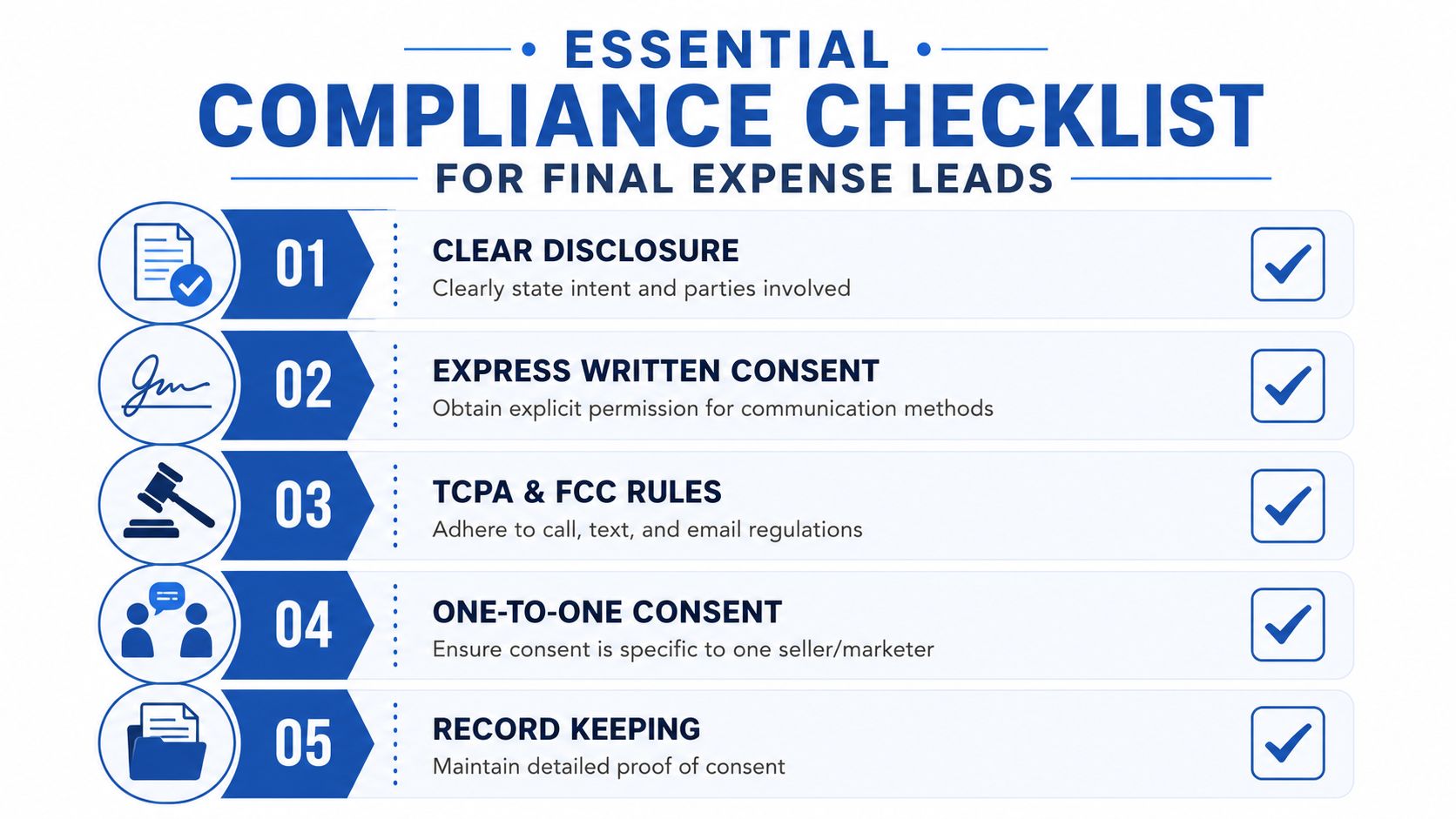
In final expense, a lead without documented consent isn't an asset. It's a liability. Plenty of operators focus on conversion first and try to patch compliance later. That's backwards. If the consent record isn't created at capture, the lead can be rejected by buyers or create legal exposure that far outweighs whatever revenue it generated.
The practical answer is simple. Build proof at the form layer, not after submission.
Consent evidence has to exist at capture
Two tools show up constantly in serious lead stacks: TrustedForm and Jornaya. They serve a similar business purpose. They create an auditable record tied to the lead event, so the buyer can see that disclosure was present and the submission happened under the conditions claimed.
That matters because a screenshot of your page template isn't enough. Buyers want the certificate attached to the actual lead. If you can't pass that evidence with the record, acceptance gets harder and disputes get uglier.
A strong setup usually includes:
- Clear disclosure language: The user should understand that by submitting, they agree to be contacted.
- Consent tied to the exact submission event: The proof should map to the lead itself, not just to the page version.
- Field and page storage: Keep the submitted values, timestamp, and source context available in your system.
- Certificate pass-through: Make sure the buyer receives the consent token or certificate URL in the payload.
What a defensible setup looks like
Good compliance implementation is operational, not cosmetic.
Your form should load the relevant compliance script, generate the certificate at submission, and store that reference alongside the lead record. The disclosure copy should be visible, readable, and connected to the action button. If your buyer or legal team requires one-to-one consent handling, the capture flow has to reflect that requirement directly. This isn't the place for vague wording or buried text.
Operational note: If a buyer asks for consent proof and your team has to "pull it later," the setup is already weaker than it should be.
You also need internal discipline. Version your disclosure copy. Keep records of when it changed. Test the capture flow after every landing page edit. A beautiful redesign that breaks compliance script firing can poison an entire traffic source.
For a concise breakdown of current consent issues lead operators need to think about, this resource on what TCPA means for lead gen operators in 2026 is a useful companion.
Building Your Real-Time Delivery and Attribution Stack
A lead submits at 2:14 PM. By 2:15, the buyer should have the record, the agent should have the alert, and your system should already know which campaign, ad set, keyword, and landing page produced it. If any part of that chain breaks, CPIA rises, acceptance rate falls, and the traffic source gets blamed for a delivery problem.
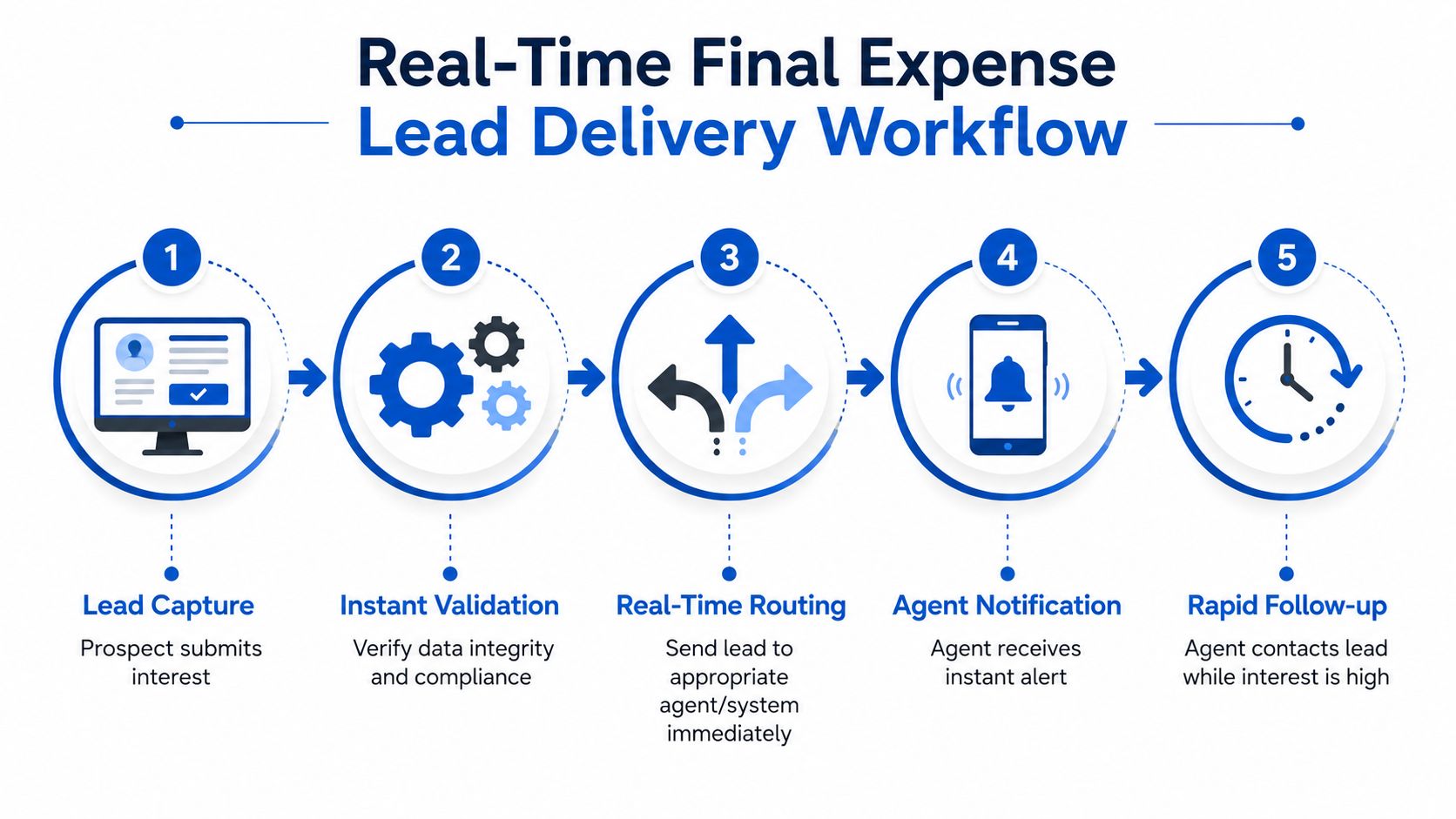
Real-time delivery is not a CRM feature. It is the connection point between acquisition, qualification, and monetization. The front end captures the lead and the consent data. The middle layer validates, enriches, and routes it. The back end decides whether that lead gets sold, where it goes, and whether the source keeps budget.
Build the routing layer like revenue depends on it
For final expense, the minimum stack is straightforward. You need a form layer that can capture hidden fields and post to a webhook, a validation layer for phone and email, routing logic tied to buyer rules, a CRM or lead distribution platform, and an alerting system that fires the second the lead is accepted.
That stack often looks like this in practice:
- Form and capture layer: Growform or another form builder that supports hidden fields, webhook posts, and field-level mapping
- Validation layer: phone verification, email syntax checks, duplicate checks, and required-field enforcement
- Routing layer: Zapier, Make, custom middleware, or direct API/webhook logic
- Distribution system: LeadsPedia, Boberdoo, Phonexa, Databowl, or buyer-direct posting
- Buyer alerting: CRM task creation, SMS, email, dialer queue push, or direct agent notification
- Failure handling: retries, fallback buyer rules, dead-letter logging, and manual review queues
The mistake that burns margin is simple. Teams buy traffic, improve the form, and then treat delivery as an afterthought. A lead can be perfectly compliant and still turn into a bad unit if it sits in a queue, hits a broken endpoint, or routes to a buyer who has already capped out for the day.
I look for three operational signals first: post success rate, median time from submit to buyer receipt, and buyer acceptance rate by source. If those are unstable, media optimization can wait.
Routing rules should match how buyers actually purchase
A good routing setup does more than push every lead to one destination. It scores and sorts inventory based on what the buyer is able to take.
Common routing logic includes:
- State availability
- Buyer hours and daypart
- Capacity caps
- Exclusive versus shared distribution
- TCPA or one-to-one consent requirements
- Age or qualification thresholds
- Campaign source quality
- Ping and post or fixed-priority delivery
Operators usually lose accepted revenue when they route based on convenience instead of buyer economics. If a buyer only wants Medicare-aged prospects in certain states during staffed call center hours, sending them everything lowers acceptance rate and weakens the relationship. The same lead might still monetize elsewhere, but only if the rules account for that path.
Fallback logic matters just as much. If Buyer A times out, reject codes should trigger the next valid buyer or an internal queue. Silent failures are expensive because they look like low-quality traffic when the actual problem is delivery loss.
Attribution has to survive every handoff
Plenty of lead sellers can report CPL. Fewer can tie issued business or even buyer acceptance back to the original click. That gap usually starts when tracking data gets captured on the landing page but disappears during posting, deduping, CRM sync, or buyer transfer.
Store the source data at the moment of form entry and pass it through every downstream system. That includes UTMs, gclid, fbclid, campaign ID, ad set ID, ad ID, keyword, landing page variant, publisher ID, and internal click ID. Keep both the raw values and your normalized reporting values. Raw fields help with audits and debugging. Normalized fields keep reporting clean.
My baseline checklist is short:
- Persist tracking values on first page load
- Write those values into the lead record at submission
- Map them into CRM and buyer payloads
- Return buyer response data to the same record
- Store reject reasons and acceptance timestamps
- Log every post attempt, not just the final outcome
That last point matters. Without post logs, teams cannot tell the difference between weak traffic and broken routing.
If Meta is one of your paid channels, server-side event tracking usually improves match quality and gives the platform cleaner conversion feedback. This guide on sending conversions to Facebook via Conversion API covers the implementation details.
The stack should answer margin questions, not just delivery questions
A real attribution setup does more than prove where a lead came from. It should show which traffic sources produce accepted leads, which buyers reject too aggressively, where duplicate rates spike, and which funnel variants raise CPIA without improving downstream value.
At a minimum, the reporting layer should let you break performance out by:
- Channel and campaign
- Landing page and form variant
- Buyer
- Acceptance and rejection reason
- Time to receipt
- Time to first contact, if the buyer shares it
- Revenue per lead and margin per lead
That is the operating system. Without it, channel decisions happen on front-end conversion rates alone, and that is how teams scale campaigns that look cheap but do not monetize.
Keep the stack boring. Reliable webhook delivery, clean field mapping, retry logic, source persistence, buyer response logging, and clear reporting beat flashy dashboards every time.
Pricing Leads and Maximizing Buyer Acceptance
An agent buys 40 leads on Monday, calls fast, and asks for more by Wednesday. Another buyer takes the same volume, rejects a third of them, then disappears. The difference usually is not your CPL. It is whether the lead package gave the buyer a realistic shot at contact and issue.
Price has to track buyer outcome. In final expense, that means the product type, the contact method, how fast the lead arrives, how much qualification happened before delivery, and how clean the record is once it hits the buyer's system. A live transfer, an exclusive web lead, and an aged shared record are three different products. Treating them like one product creates margin problems and buyer churn.
Price by buyer economics, not media cost
Start with CPIA and acceptance rate. Those two numbers keep pricing honest.
If a source converts cheaply on the front end but produces low acceptance or weak contact rates, the lead is overpriced at almost any premium tier. If a funnel costs more to run but consistently produces accepted leads that buyers can work, you can defend a higher price and keep the account longer. I would rather run a more expensive acquisition channel with stable acceptance than chase cheap volume that gets returned all week.
A practical pricing model usually breaks on these factors:
- Exclusivity: Exclusive inventory supports higher pricing because the agent is not racing other callers.
- Freshness: Real-time delivery commands more than delayed delivery.
- Qualification depth: Verified phone, product interest, state match, age fit, and clear consent reduce buyer risk.
- Lead format: Live transfers, booked calls, web leads, and aged data should each have their own pricing logic.
- Observed buyer performance: Buyers who contact quickly and work leads well often justify better routing priority, but pricing still needs to fit the measured issue path.
Do not price from averages alone. Price from cohorts. The right view is source plus funnel variant plus buyer plus lead type. That is how operators find the pockets where margin holds.
Set acceptance rules before traffic goes live
Buyer acceptance problems usually start long before the first dispute. They start with vague definitions.
Every buyer agreement should define what counts as a valid lead, what qualifies for a return, how duplicates are identified, how fast the lead must be delivered, and what proof is available if there is a challenge. If those rules are loose, the buyer's CRM becomes the default referee, and that usually ends with avoidable credits.
The return policy needs specifics:
- Valid lead fields: Required phone, state, age range, product intent, and any other delivery fields tied to the campaign
- Duplicate window: Exact matching logic and lookback period
- Invalid reasons: Disconnected number, wrong geography, fake data, prior sale under the agreed rules
- Freshness standard: Real-time only, or the maximum delay allowed
- Proof package: Timestamp, source ID, landing page variant, consent record, and call or form event logs
Clear rules protect both sides. They also improve close rate on new buyer conversations because experienced agents can tell when a seller has operational control.
Better buyer acceptance comes from the system behind the lead
Higher acceptance is rarely a sales script problem. It is usually a systems problem.
If the form lets bad phone numbers through, if routing delays delivery by five minutes, if the buyer receives inconsistent field mapping, or if your duplicate suppression misses obvious repeats, acceptance falls fast. Buyers do not care that the ad account performed well. They care whether the lead was contactable, compliant, and usable the moment it arrived.
That is why pricing and acceptance sit downstream of the whole stack. Channel selection affects intent. The funnel affects qualification depth. The compliance layer affects trust. The delivery stack affects speed and payload quality. Monetization gets easier when those pieces are built to work together instead of being managed as separate projects.
If you're rebuilding the front end of your final expense lead stack, Growform is built for this exact job. It lets lead gen teams launch multi-step qualification funnels, add conditional logic and disqualification paths, capture attribution data, and send leads in real time to CRMs and distribution platforms without waiting on developers.