
Roofing Leads, How Generators Improve CPL and Lead Quality at the Form Layer

Updated Published 9 min read
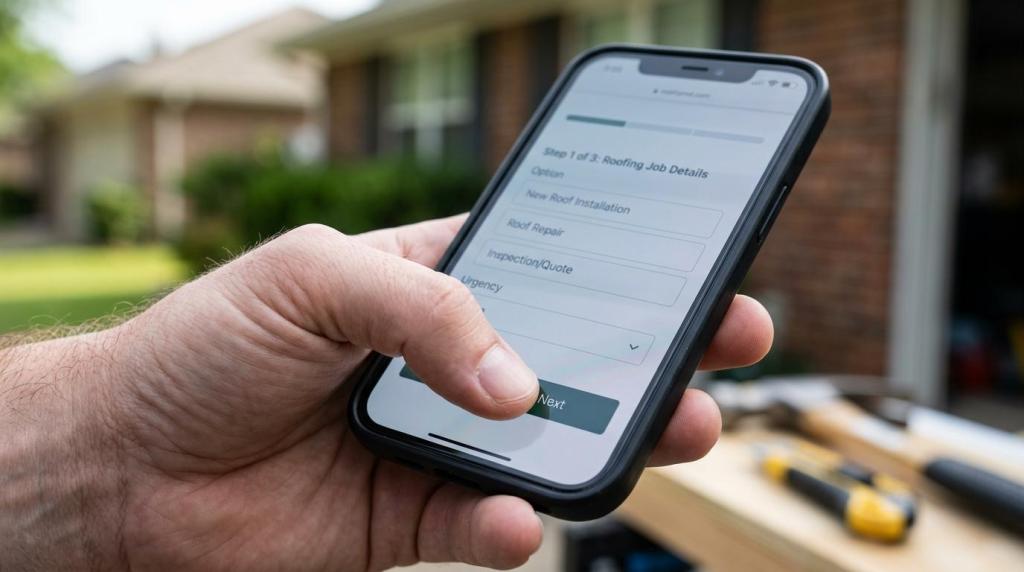
Roofing lead generation looks simple from the outside. Buy clicks, send traffic to a quote page, collect names and phone numbers, then hand the lead to a roofer or an inside sales team.
In practice, the margin is won or lost much earlier, at the form layer.
That matters more in roofing than in many other home-services categories because paid traffic is not cheap. LocaliQ’s 2025 home-services search benchmarks, drawn from US campaigns run between April 2024 and March 2025, put average home-services CPC at $7.85, while Roofing & Gutters sits at $10.70. When each click costs that much, a low-intent lead, fake phone number, out-of-area property, or renter inquiry is not just annoying. It directly pushes CPL up and revenue per lead down.
Google’s own guidance points in the same direction. Google Ads Help says lead form assets can capture intent directly in the ad, and its best-practice guidance recommends qualifying responses to filter out low-intent prospects. For roofing operators, that is a useful signal: stricter qualification is often rational, even if raw form completion dips a little.
Roofing lead economics make form qualification worth the effort
If you generate roofing leads at volume, raw CPL is only half the story. The real number is qualified CPL, meaning what it costs to produce a lead that can actually be contacted, worked, and sold.
A three-field form may look great in a dashboard. It can also hide the real problem: too many leads that should never have entered the funnel. Roofing traffic picks up renters, DIY researchers, price shoppers outside service areas, and storm-chasers with weak intent. If your form does not filter them, your call center, CRM, and buyers inherit the mess.
That is why the form should not be treated as a static web element. It is a screening system.
| Form-layer setup | Raw CPL | Qualified CPL | Best use case |
|---|---|---|---|
| 3-field short form | Usually lowest at first glance | Often worst after invalids and bad-fit leads | Very high-intent traffic with heavy offline filtering |
| Multi-step qualification form | Slightly higher or flat | Often lower after better fit and contactability | Paid search and Meta traffic where click costs are meaningful |
| Form with phone verification | Higher front-end friction | Better when fake or mistyped numbers are common | Broad traffic, PMax, Meta, aggregator funnels |
| Form with service-area and job-fit logic | Can reduce raw volume | Usually strongest for buyer acceptance and routing | Lead sellers, aggregators, multi-branch roofing offers |
The key shift is to stop asking, “How do we get more submits?” and start asking, “How do we get more sellable roofing leads per 100 clicks?”
Roofing lead qualification questions that actually change lead value
The best roofing lead forms do not ask more questions just to look serious. They ask questions that change routing, price, contact priority, or buyer acceptance.
A good rule is simple: if a field does not affect what happens next, it probably does not belong on the form.
Useful roofing qualification fields often include:
- Homeowner status
- Property type
- Service zip code
- Roof issue or job type
- Repair vs replacement
- Timeframe
- Insurance claim status
- Best contact number
These fields do real work. Homeowner status filters weak-fit inquiries. Property type separates residential from commercial. Zip code drives service-area rules and buyer matching. Repair vs replacement changes lead value. Timeframe tells the sales team who needs an immediate callback. Insurance claim status can matter a lot in storm-related campaigns.
Question order matters too. Start with easy, low-resistance answers, then move toward harder qualification. A user is more willing to share a phone number after they have already described the property and problem. That sequence also fits the way roofing shoppers think. They know the issue first. Contact details come later.
Growform’s roofing template follows this pattern, with carefully ordered questions and harder questions later in the flow. That structure fits what many operators see in paid traffic: long single-page forms often feel heavier than a step-by-step flow with the same amount of data collection.
Multi-step roofing lead forms can lower waste without killing conversion
A common objection comes up here: “If we ask more, our conversion rate will drop.”
Sometimes it will. That is not always bad.
If extra questions remove junk and improve contact rate, booked inspections, or buyer acceptance, the form is doing its job. Google explicitly recommends qualifying questions to filter out low-intent prospects. For expensive home-services clicks, that trade is often worth making.
The right way to do it is with progressive qualification, not a wall of fields. Multi-step forms work well for roofing because they turn one intimidating page into a short sequence. That is especially useful on mobile, where a large share of paid traffic lands.
A simple roofing flow often looks like this:
- Step 1: job type and urgency
- Step 2: property details and location
- Step 3: contact details and verification
That structure does two things at once. It keeps the user moving, and it lets you branch the experience with conditional logic. A repair lead can see different follow-up questions than a full replacement lead. A user outside the service area can be disqualified early. A commercial inquiry can be routed into a different pipeline than a residential one.
For lead generators selling to multiple buyers, this is where margin starts to show up. Better classification at capture means cleaner downstream routing.
Phone verification and email validation for roofing leads
Roofing traffic is vulnerable to fake submissions, bad numbers, duplicates, and low-quality intent spikes after storms or broad-match expansion. Real-time verification helps contain that before the lead hits the CRM.
Phone validation should be the default. OTP verification should be used selectively.
A mistyped phone number can ruin a lead just as effectively as a fake one. Invoca’s 2026 home services lead conversion benchmarks say only 52% of calls to home-services businesses speak with a person. If contact is already hard, sending bad numbers into the system makes the sales problem worse.
A practical verification setup usually looks like this:
- Use OTP verification: broad Meta traffic, Performance Max, native traffic, or any funnel with a history of fake leads
- Use real-time phone validation only: high-intent search campaigns where extra friction could cost good leads
- Use email validation: quote flows that rely on estimates, reminders, or appointment follow-up by email
There is no need to force the same verification logic on every traffic source. Search campaigns built around high-intent roofing terms may perform best with lighter validation and strong qualification questions. Meta campaigns, storm funnels, and wider audience buys often need stricter controls.
The same source-specific logic should apply to routing. If a lead passes OTP and answers “need service ASAP,” it can trigger instant call alerts or move to the front of the queue. If it fails phone validation but still submits, it can be flagged for a lower-value follow-up path or held back from buyer delivery.
Google Ads roofing leads: when ad lead forms work and when landing pages win
Google lead form assets deserve real attention in roofing. Google says they can capture interest directly in the ad and can be attached to Search and Performance Max campaigns. That can work well when speed matters and the user does not want another page load.
They are not a full replacement for a strong landing-page form, though.
Google ad lead forms are good for fast capture, especially on mobile. They also support lead delivery by email, CSV download, or webhook. That makes them usable for operators who need quick implementation. If the goal is to test a new market, seasonal storm demand, or a narrow offer, ad-native forms can be a smart first move.
Landing-page forms still win when you need more control:
- conditional logic by job type
- stronger design and brand consistency
- richer qualification
- OTP or deeper verification
- hidden field pass-through for UTMs and click IDs
- custom routing into CRM or lead distribution logic
For many roofing generators, the best answer is hybrid. Use Google call assets where calls close best. Use lead form assets where ad-native capture makes sense. Send the rest to a purpose-built multi-step landing page when you need tighter qualification and better tracking.
Roofing lead routing and speed-to-lead start at capture
A roofing lead is perishable. Storm traffic is even more perishable.
If your form captures the right data but delivers it slowly, the economics still break. Real-time delivery into the CRM, sales queue, or lead distribution platform matters because roofing shoppers often contact several contractors at once.
This is also where many form setups quietly fail. Hidden fields drop. UTMs do not persist across steps. Zip code and job type do not make it into the payload. Sales gets a generic “new lead” alert with no context. Buyers reject the lead because the proof or metadata is missing.
For operators using Boberdoo, Phonexa, LeadsPedia, or a custom buyer stack, the form should pass structured fields that support immediate decisions. At minimum, that often includes service zip, homeowner status, job type, urgency, click IDs, source, landing page, and verification status. If calls or texts are part of the follow-up flow, consent evidence tools like TrustedForm and Jornaya can also be attached where needed.
The point is not just speed. It is usable speed.
The same Invoca report says 55% of home-services businesses do not ask leads to buy or book the job. That puts more pressure on the system after capture. A better form can help by classifying urgency, improving contactability, and pushing higher-intent leads into tighter follow-up paths from the first second.
Roofing lead quality metrics that matter more than headline CPL
A generator can make a campaign look good by optimizing for cheap submissions. That does not mean the campaign is good.
Roofing lead quality should be judged with a tighter operating set:
- Qualified CPL: cost per lead that passes your routing and fit rules
- Contact rate: percentage of submitted leads that actually connect
- Appointment rate: inspections or booked visits per lead
- Buyer acceptance rate: accepted leads divided by delivered leads
- Duplicate and invalid rate: bad numbers, repeated entries, bad emails
- Revenue per lead: what the lead earns after rejects and clawbacks
Here is a simple example. Campaign A produces 100 leads at $55 CPL. Campaign B produces 72 leads at $72 CPL. At first glance, A looks better. But if A only contacts 42% of leads and books 14 inspections, while B contacts 68% and books 24 inspections, B is the stronger campaign by a wide margin. The form layer often explains that gap.
This is why form tests should not be judged after 24 hours and one front-end metric. Roofing operators need to watch the full chain from click to contact to inspection to accepted revenue.
Practical roofing lead form setup for lower waste and better margins
If a roofing campaign is already spending real money on Google Ads, Meta, or Performance Max, the form should be treated as part of the media buying system, not an afterthought.
A solid operating setup usually includes:
- Traffic source logic: stricter forms for broad traffic, lighter forms for exact high-intent search
- Qualification logic: homeowner, service area, property type, job type, urgency, claim status
- Verification logic: phone validation by default, OTP where fake or low-intent leads are common
- Delivery logic: instant webhook delivery to a CRM such as ServiceTitan, GoHighLevel, or lead distribution platform with full attribution fields
For teams building this stack, the technical details matter. Multi-step forms, hidden field pass-through, conditional disqualification, real-time phone and email checks, and direct delivery into downstream systems are not “nice to have” in roofing. They are often the difference between a campaign that scales and a campaign that only looks good in the ads manager.
The operators who win roofing leads over time are usually not the ones with the shortest form. They are the ones who make each click earn its way through better qualification, cleaner verification, and faster handoff. To test that on your own traffic, start a free trial and clone the roofing template.
Related articles

Insurance Lead Gen: The Complete Playbook for 2026
“Get more insurance leads” is still the typical advice many receive. It's also the fastest way to hide a broken funnel.
September 30, 2026

High-Converting Insurance Quote Forms: A Practical Guide
Insurance quote forms have to ask for far more fields than a typical lead form, so every field, branch and webhook has to earn its place.
September 30, 2026
Home Services Lead Generation: A Practical Playbook
You’ve paid for the click, the homeowner has completed the form, and the notification arrives after dinner. By the time someone on the team sees it the next morning, the prospect has already called another contractor. Worse, some submissions were never serviceable, never urgent, or never a fit for the crew in the first place….
September 30, 2026