
6 Powerful Paid Media Examples to Copy in 2026
You're spending money on traffic, the dashboards look busy, and the lead sheet still feels wrong. That usually means the problem isn't just the ad. It's the handoff from click to form to CRM, the part where tracking breaks, qualification is too loose, and sales gets flooded with junk instead of opportunities.
Paid media became powerful because digital channels made performance visible through metrics like CTR, CPC, CPM, and conversion rate. Search still matters enormously, with organic and paid search together accounting for 80% of all trackable website visits, and paid search alone at 27% of trackable visits, while 19% of marketers name it their most profitable channel according to HubSpot's PPC statistics roundup. The economics swing hard by vertical too, with WordStream-reported benchmarks showing average Google Ads search CPC around $2.69 and average conversion rate around 1.91%, while legal can run much hotter at $6.75 CPC and dating or personals can reach 9.64% conversion rate in paid ads, which is why the best teams treat paid media like a statistical system, not a branding stunt.
Table of Contents
Table of Contents
- 1. Meta Facebook and Instagram for High-Volume Lead Gen
- 2. Google Ads for High-Intent Search Leads
- 3. Native Ads Taboola and Outbrain for Arbitrage Scale
- 4. LinkedIn Ads for B2B and High-Value Professionals
- 5. TikTok Ads for Home Services and Emerging Verticals
- 6. Programmatic Retargeting to Reclaim Abandoned Leads
- 6-Channel Paid Media Comparison
- The Common Thread Tying Your Paid Media Together
1. Meta Facebook and Instagram for High-Volume Lead Gen
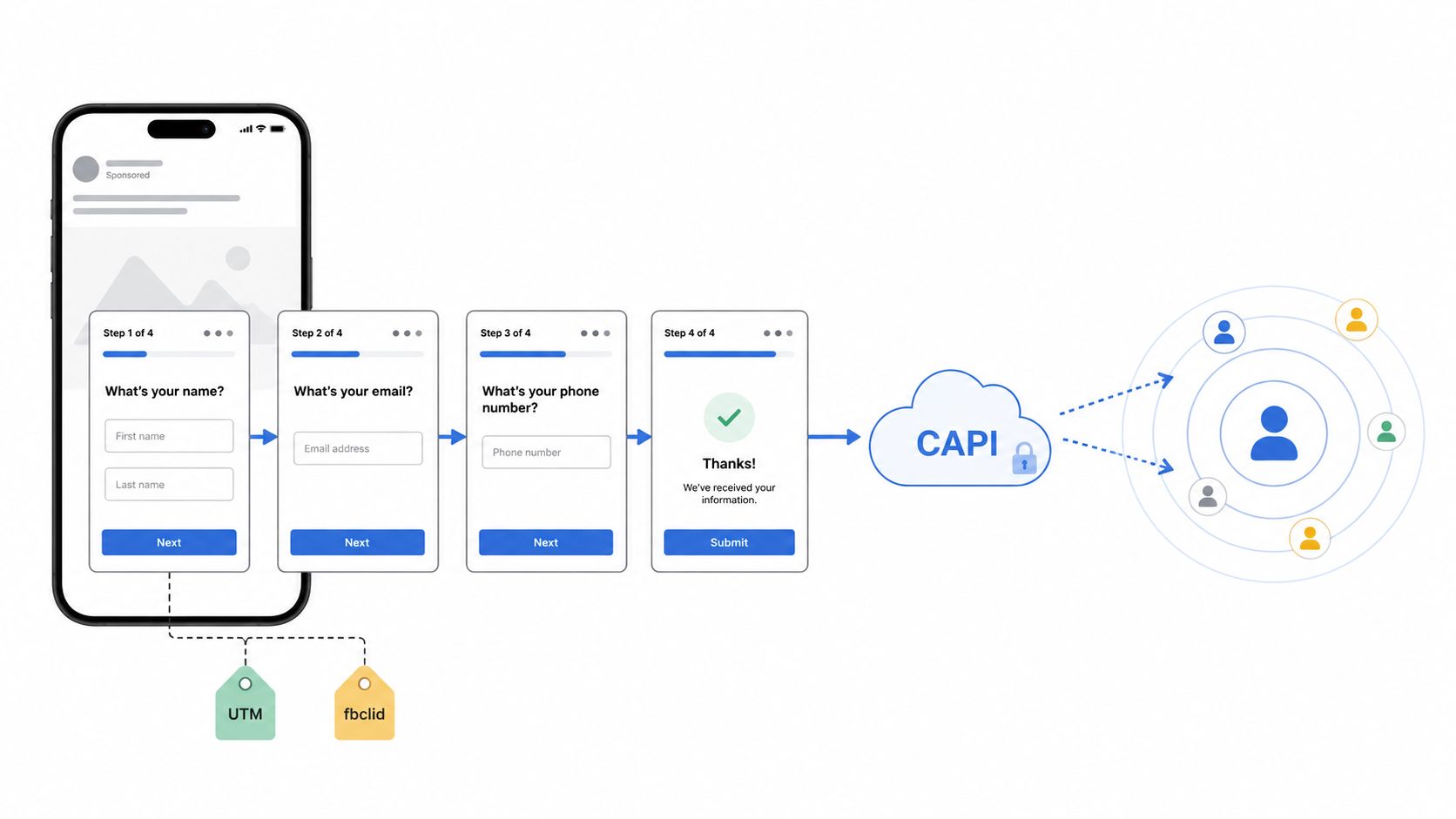
Meta still earns a place in a lot of lead gen stacks because it can push volume fast, especially when the offer is simple to understand and the funnel is built to filter hard. The platform is strongest when you combine broad reach, retargeting, and a form that can qualify the click instead of letting every visitor through the same generic path. That's where a multi-step flow matters more than a static landing page.
What makes Meta work in lead generation
For high-volume verticals like solar, legal, roofing, HVAC, insurance, and home services, Meta usually works best when the first click lands on a quiz-style form instead of a long traditional page. A question like “What's your main reason for going solar?” feels lighter than a wall of fields, and it gives you room to branch users into different paths based on their answers. That means the ad can stay broad while the form does the heavy lifting.
The cleanest setup uses pixel tracking plus Meta Conversion API, so the platform gets both browser and server-side signals. If the browser signal drops, the server-side event still gives Meta something reliable to optimize against, which is exactly why teams wire hidden fields like fbclid and UTM parameters through the form and into the CRM or buyer system. For a direct setup guide, the internal technical workflow is laid out in Growform's Meta Conversion API implementation guide.
A few practical moves tend to matter most:
- Use broad targeting first, then narrow with form logic: Meta can find volume, but the form should decide who's serious.
- Capture compliance evidence at submission: In regulated spaces, TrustedForm or Jornaya evidence should travel with the lead.
- Compare native Lead Forms against an embedded form: Native forms often win on initial friction, but embedded qualification usually wins on lead quality.
- Pass hidden fields everywhere: If the click ID disappears before CRM handoff, optimization gets noisy fast.
Practical rule: Don't judge Meta on lead volume alone. Judge it on how many leads survive qualification and make it through the downstream sales or buyer process.
How the funnel should be wired
The strongest Meta lead gen funnels are sequential. Cold audiences see a broad promise, lookalikes get a tighter message, and retargeting pushes people back into a more specific offer. Solar installers often use this structure well, because a simple ad can send traffic into a Growform flow that asks about panel type, roof material, and location before the lead is routed to a platform like Phonexa or LeadsPedia. Legal teams do something similar with mass tort campaigns, using conditional logic to screen by case type and jurisdiction before CPL gets out of control.
The CRM handoff is where too many Meta programs break. If the form submits without the campaign name, source, click ID, and consent evidence attached, the sales team gets a lead but loses the context that explains why the lead exists in the first place. That's the hidden plumbing that makes Meta profitable instead of merely busy.
2. Google Ads for High-Intent Search Leads
Google Ads is the channel marketers reach for when they want intent, not interruption. Search users tell you what they want in the query, and that makes the click more valuable before you've even written the ad. In practice, that also means your form can be shorter for high-intent traffic, because the keyword has already done part of the qualification.
The best Google Search funnels are almost always built around a tight promise, a matching landing page, and a form that respects where the user is in the decision process. Personal injury, mortgage, and HVAC are classic examples because the search intent is obvious. A person searching for “car accident lawyer near me” doesn't need a brand story, they need a fast path to the right next step.
Why search intent changes the economics
Google's auction rewards relevance, and that's why the page experience matters as much as the bid. HubSpot's PPC statistics page notes that paid search alone drives 27% of all trackable website visits, which is a strong reminder that search still captures a huge slice of measurable demand. The same source also shows 19% of marketers naming paid search their most profitable channel, which lines up with what most operators see when the funnel is built to close the loop properly.
That doesn't mean search is cheap or forgiving. WordStream-reported benchmarks cited by HubSpot place average Google Ads search CPC around $2.69, with legal among the priciest verticals at $6.75 CPC. Those economics punish weak qualification and sloppy routing fast. If the search term is high intent, the form should reflect that with fewer steps, not more.
A “buy now” keyword should not land on a brand essay. It should land on a direct qualifier that gets the user to contact details, service area, or case fit quickly.
A good mortgage broker funnel might capture the keyword with a hidden field, ask about loan goal, then move straight into contact details. An HVAC contractor can do the same for emergency service, using service area and availability as the first filters. If the traffic is on mobile, the form has to be thumb-friendly, fast, and obvious.
How to keep attribution intact
Google campaigns fall apart when the gclid is dropped between the ad click and the CRM record. That's why hidden-field pass-through matters so much. If the gclid never makes it through the submission payload, you can't reliably tie the lead back to the keyword, ad group, or campaign that generated it.
The cleanest technical setup is simple. Put the gclid into a hidden field, push it through the form submission, and verify it survives every hop into your CRM or loan origination software. For a detailed build pattern, Growform's Google Ads conversion tracking walkthrough shows the exact tracking logic performance teams usually want.
For higher intent searches, shorten the form. For colder informational terms, use a longer qualification path. The point is to match friction to intent, not to force every visitor through the same process.
3. Native Ads Taboola and Outbrain for Arbitrage Scale
Native ads are where a lot of lead aggregators and performance marketers learn the hard lesson that cheap traffic isn't the same thing as usable traffic. Sponsored content can be efficient at scale, but it often arrives with lower intent and a lot more variability in publisher quality. That makes the form, the verification layer, and the buyer routing system much more important than the ad itself.
Native works when the offer feels like content and the funnel does the screening. It usually fails when teams send broad traffic to a generic form and hope the volume will sort itself out later. It won't.
Why native traffic needs qualification
Taboola and Outbrain place sponsored stories in publisher environments where the user is still in browse mode, not purchase mode. That means the click can be plentiful without being precious. A solar lead aggregator might run native campaigns into a Growform quiz, then route the resulting leads through a system like Boberdoo for distribution across multiple buyers. A mass tort firm can do something similar on legal-news inventory, but only if the form identifies case type early enough to keep junk away from intake.
The best native teams are selective about placement. Tier-1 publisher whitelisting helps protect quality, and it also reduces the chance that low-quality placements pollute your optimization signals. The same logic applies to form design. A short quiz can work better than a long application because it feels like content, not bureaucracy.
This is also where verification matters. If you're buying bulk traffic, you should assume some portion of it will be malformed, fake, or low quality. Real-time phone and email verification helps cut that off before the lead ever reaches a buyer. It's not glamorous, but it saves a lot of downstream headaches.
How to separate qualified from disqualified leads
Native campaigns should be measured on more than lead count. They need separate events for qualified and disqualified submissions, otherwise you're optimizing to junk volume. That distinction is the difference between a campaign that looks active and one that makes money.
A useful native funnel often looks like this:
- Step 1, hook the reader: Use a headline that feels editorial, not salesy.
- Step 2, start with a short quiz: Three steps is often enough to engage colder traffic.
- Step 3, verify immediately: Run phone and email checks before routing.
- Step 4, send only usable leads downstream: Tag source, campaign, and qualification outcome before CRM delivery.
The important part is the handoff. If the lead passes the quiz but fails verification, the system should know that before it ever enters the sales queue. If it passes both, the buyer payload should already contain the source data needed to evaluate performance. That's how native becomes an arbitrage engine instead of a margin leak.
4. LinkedIn Ads for B2B and High-Value Professionals
LinkedIn is expensive in the way serious B2B channels usually are, which means it rewards specificity and punishes sloppy segmentation. It's strongest when the target audience has a defined role, a defined company profile, and a buying process that needs context before a rep can sell. For enterprise and mid-market demand gen, that makes it one of the most useful paid media examples in the stack.
The channel's real value isn't just that it reaches professionals. It's that it lets you speak to them in a work mindset, with context that matches how they evaluate solutions. That's useful for software, staffing, and commercial real estate, where a quick click rarely turns into a ready-to-buy lead.
Where LinkedIn earns its keep
A B2B SaaS company can target titles like VP of Sales, then use a Growform flow to route enterprise accounts to sales while sending smaller companies to a self-serve path. A staffing agency can pre-qualify by skill level, salary band, and location before the recruiter spends time on a bad fit. A commercial real estate firm can ask about property type, investment amount, and timeline before scheduling a conversation.
LinkedIn's own native Lead Gen Ads can work well at the top of the funnel because they reduce friction. But that's not the same thing as quality. Many teams use native capture as the first touch, then retarget those engaged users to a more detailed embedded form on their site. That second step is where qualification becomes real.
The desktop-heavy behavior of the audience matters too. LinkedIn users are often willing to engage with a more detailed flow if the page looks clean and the progress is obvious. That gives you room for a richer conditional form, especially when the information is needed for routing.
How to route the right accounts downstream
Attribution on LinkedIn gets messy when teams rely only on native integrations. The safer move is to build UTMs manually and capture them in hidden fields, then pass them through to the CRM with the submission. That way, campaign source isn't dependent on a platform shortcut that may not map cleanly to your sales process.
Matched Audiences can also sharpen the funnel. If you upload account lists, then tailor follow-up questions based on company size or industry, the form can feel more relevant without becoming longer in a way that hurts completion. The logic should reflect the account tier. Enterprise prospects should see an enterprise flow, and smaller accounts should be guided somewhere lighter.
Practical rule: Use LinkedIn to identify the right people, then use the form to decide whether they belong in a sales queue, a nurture path, or a self-serve flow.
For teams building a cleaner capture layer, Growform's LinkedIn lead form guide is a useful reference point for the kind of embedded qualification that keeps the handoff from getting sloppy.
5. TikTok Ads for Home Services and Emerging Verticals
TikTok can surprise people who still think of it as a pure awareness channel. In reality, it's become useful for home services and newer lead gen plays because it can create fast attention on mobile, especially when the creative feels native to the feed. The trick is not to force a corporate tone into a platform that rewards immediacy and personality.
That's why TikTok works best when the ad opens the loop fast and the form keeps the momentum going. A creator-style video can earn the click, but the landing experience still has to qualify the lead. If the funnel feels slow or desktop-first, the traffic leaks.
Why TikTok can work even for practical offers
Roofing, solar, and debt relief don't sound like obvious TikTok categories, yet they can perform when the creative is built around a real problem. A roofing ad that asks, “Does your roof leak when it rains?” gives the user a reason to self-identify. A solar ad that shows a local install story can make the offer feel concrete. A debt relief message can speak to pressure and relief in a format that feels less like a pitch and more like a conversation.
This channel is especially sensitive to mobile UX. The audience is effectively living in a thumb-first environment, so the form has to open fast, load cleanly, and avoid tiny controls. A long, clunky page is a bad fit here. An embedded Growform with a progress bar and large touch targets is a much better match.
A TikTok click usually needs less explanation and more momentum. If the first screen looks slow, the user is gone before your offer gets a chance.
TikTok's attribution also needs backup. Manual UTM capture and ttclid pass-through are important because the platform's measurement is still maturing relative to older channels. If that identifier disappears, you lose one of the few reliable ways to connect the video to the submission.
How to keep mobile traffic from leaking
For TikTok traffic, the form itself should feel like part of the content. Short questions, one screen at a time, and a clear sense of progress all help reduce drop-off. Conditional logic is especially useful here because it lets you ask more questions without making the experience look long at the start.
Testing the native lead form against an external form is worth doing, but the external form usually wins on qualification and user experience. Native capture may be easier to start with, yet a dedicated landing experience gives you more control over the downstream logic, the hidden fields, and the CRM handoff. That matters a lot more once you're spending real budget.
Creators can help too. A local creator showing an AC install, a roof inspection, or a solar visit often makes the ad feel more believable than a polished brand asset. That extra realism can do more for lead quality than a thousand words of copy.
6. Programmatic Retargeting to Reclaim Abandoned Leads
Retargeting is where paid media stops acting like a megaphone and starts acting like a recovery system. A lot of visitors won't submit on the first visit, but that doesn't mean they were bad leads. Sometimes they got distracted, sometimes they needed time, and sometimes they just weren't ready to finish the form in one sitting.
That's why abandoned leads deserve their own audience segment. The people who started a form are warmer than general site traffic, and they've already signaled intent. If you don't retarget them, you're leaving easy money on the table.
Why abandoned forms are worth money
A solar company can run cold Meta traffic into a form, then retarget anyone who began but didn't finish with an ad offering 3 Free Solar Quotes. A mass tort firm can show urgency-driven reminders to bounced visitors, while an insurance agency can display the estimated savings a user left behind. These are not flashy tactics, they're practical ones, because they return already-engaged users to a funnel they nearly completed.
The key measurement move is to fire a tracking pixel when the form starts, not just when it ends. That lets you create a true abandoner audience instead of lumping all site visitors together. Once that audience exists, retargeting becomes much more precise.
You also need a burn pixel on the confirmation page so you stop serving ads to people who already converted. Without that, you're paying to annoy your newest lead. Frequency control matters too, because too many impressions can turn a recovery campaign into brand fatigue.
How to build sequential retargeting
The best retargeting sequences are staged. Day 1 can focus on brand recall. Day 3 can introduce social proof. Day 7 can add urgency. The message should change as time passes, because the user's memory and intent shift too.
A practical retargeting stack often includes:
- Form-start audience: People who began the form but didn't submit.
- Form-complete audience: Exclude these immediately with a burn pixel.
- Sequential messaging: Match the ad to the time since last visit.
- Conditional form personalization: Welcome returning users back into the flow instead of making them start from zero.
For a returning visitor, a simple line like “Welcome back, let's finish your quote” can make the funnel feel less like a restart and more like a continuation. That kind of continuity can lift completion because it reduces the sense of repetition. When teams pair that with a clean CRM handoff, the retargeting audience becomes a serious conversion asset rather than just a reminder list.
6-Channel Paid Media Comparison
| Channel | Implementation Complexity 🔄 | Resource & Speed ⚡ | Expected Outcomes 📊 | Ideal Use Cases 💡 | Key Advantages ⭐ |
|---|---|---|---|---|---|
| Meta (Facebook & Instagram) | 🔄 High, pixel + CAPI setup, strict UTM/fbclid handling, compliance checks | ⚡ High resource needs (creative + budget); very fast traffic scale | 📊 Very high lead volume; low CPC in many consumer verticals but CPL can inflate in competitive niches | 💡 Consumer lead gen at scale (solar, insurance, legal, home services) with multi-step qualification | ⭐ Largest audience, strong mobile performance, extensive creative/audience testing |
| Google Ads (Search) | 🔄 Medium, keyword structure, gclid pass-through, conversion tracking | ⚡ Medium–High spend; immediate intent traffic and fast conversion signals | 📊 High-quality, intent-driven leads; higher CPC but stronger conversion value | 💡 High-intent queries (legal, mortgages, B2B, emergency services) | ⭐ Precise intent targeting, reliable attribution (gclid), measurable ROAS |
| Native Ads (Taboola/Outbrain) | 🔄 Medium, publisher whitelisting/blacklisting, URL param discipline, fraud controls | ⚡ Moderate budget; large-scale reach but requires tuning for quality | 📊 High volume at lower CPM/CPC; lower intent and higher fraud risk without verification | 💡 Arbitrage and bulk lead buying (aggregators, solar, mass lead networks) | ⭐ Scale at lower cost, flexible pricing models, less keyword/regulatory friction |
| LinkedIn Ads | 🔄 Medium, matched audiences/ABM setup, UTMs, lead gen forms integration | ⚡ High CPM/CPC; slower scale but targeted reach of professionals | 📊 High-quality, lower-volume B2B leads with strong downstream value | 💡 B2B SaaS, staffing, professional services, account-based marketing | ⭐ Best professional targeting, native pre-filled forms, low fraud risk |
| TikTok Ads | 🔄 Low–Medium, mobile-first creative, ttclid/UTM capture, creator partnerships | ⚡ Lower CPM than Meta/LinkedIn; very fast reach among younger audiences | 📊 High-volume, variable-quality leads; strong for emerging/local verticals | 💡 Home services, local businesses, younger-demo offers, creator-driven campaigns | ⭐ Fast-growing reach, mobile-native engagement, organic creator amplification |
| Programmatic Retargeting | 🔄 Medium, pixel audiences, DCO setup, burn-pixel & frequency caps | ⚡ Efficient spend; lowest CPL when targeting warm audiences | 📊 Very high ROAS for warmed users; reclaims abandoned leads effectively | 💡 Recover form abandoners and nurture warm prospects across verticals | ⭐ Lowest CPL, strong personalization, effective sequential messaging |
The Common Thread Tying Your Paid Media Together
Successful paid media isn't about finding one magic channel. It's about building a system where tracking, qualification, and delivery all work together. The ad gets the click, the form decides whether the lead is worth keeping, and the CRM or buyer system receives a record that still carries the source, campaign, click ID, and consent proof.
That's why hidden fields matter so much. Whether the identifier is gclid, fbclid, or ttclid, the point is the same, preserve attribution all the way through the funnel. Once that data falls out, optimization gets blurry and teams start making decisions from partial information.
Measurement also has to account for incrementality, not just clicks. Many paid media examples look fine on paper because they capture demand that already existed, but the better questions are whether the channel created new leads, improved qualified lead volume, or helped recover users who would've otherwise disappeared. That's why branded search and retargeting are easier to measure directly, while channels like influencer sponsorships, audio, OOH, and streaming TV usually need lift tests or modeled attribution to estimate their true impact.
The common thread across the strongest funnels is simple. Keep the ad promise tight, keep the form logic smart, and keep the CRM handoff clean. If you're building this from scratch, start with your highest-intent channel first, then layer in qualification, retargeting, and compliance capture so the whole system can scale without turning into a lead-dump.
If you're building paid lead gen funnels and the form layer is where things keep breaking, Growform is built for multi-step qualification, hidden-field attribution, and real-time handoff into CRMs and lead distribution tools. It's a practical fit when you need the front end of the lead stack to convert better and pass cleaner data downstream.