
When Conversational Forms Hurt Lead Quality and CPL

Conversational forms are easy to oversell.
Put one question on the screen, add a progress bar, sprinkle in a few transitions, and the experience instantly feels cleaner than a long static form. That can help. But in paid consumer lead generation, where every click has a real cost and every bad lead drags down margin, a conversational form is not automatically a better lead capture form.
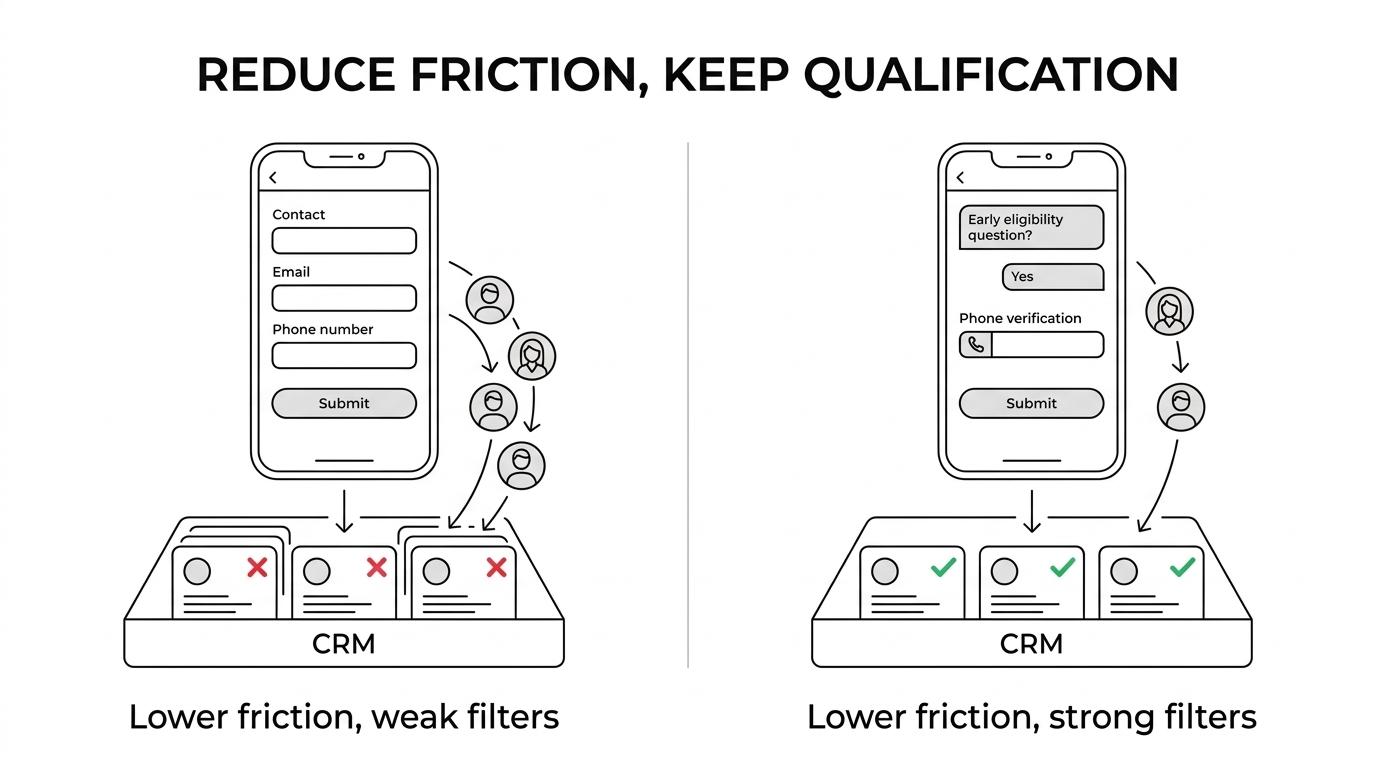
The real question is simpler: does the form lower friction without lowering standards?
If the answer is no, conversational design can hurt both lead quality and cost per lead. You may see a prettier funnel, a higher top-line submit rate, and weaker economics once those leads hit sales teams, buyers, or a ping/post stack.
Table of Contents
Conversational forms and CPL in paid traffic lead generation
A conversational form usually means a step-by-step or one-question-at-a-time flow. Instead of showing every field at once, the form reveals questions gradually. Done well, that can reduce cognitive load, especially on mobile. Done badly, it turns a short form into a slow one.
That difference matters when you are buying traffic on Meta, Google, or native sources. If a roofing lead costs $14 per click and your form conversion rate falls from 10% to 7%, your CPL jumps from $140 to $200 before lead quality is even part of the picture. If the new form does not improve qualification enough to offset that drop, you just paid more for a weaker funnel.
Research on form friction backs this up. Baymard’s 2024 checkout research found that users are sensitive to form complexity, and that the number of form fields affects usability more than the number of steps. Baymard also reported that 17% of users had abandoned due to checkout complexity. Checkout is not the same as lead gen, but the mobile behavior pattern carries over well: unnecessary questions, awkward inputs, and bloated flows create abandonment fast.
That is why conversational forms should not be judged by style. They should be judged by economics.
The lead quality tradeoff behind shorter and easier forms
Lead gen operators already know an uncomfortable truth: easier forms usually create more submissions, but not always better submissions.
An older but still useful benchmark from MarketingSherpa, published through HubSpot, framed form length as a tradeoff between quantity and quality. Shorter forms tend to increase submission volume. Requiring more information tends to reduce conversion while improving qualification. That pattern still shows up across high-volume consumer funnels today.
This matters more in consumer verticals with expensive traffic and strict downstream filters. In solar, legal, insurance, finance, and home services, a low-friction form can fill the CRM with contacts who are hard to reach, outside buyer criteria, missing compliance proof, or just not serious enough to monetize.
Pretty forms do not fix weak economics.
What matters after the click is rarely just the submit rate:
- Contact rate
- Verified phone rate
- Buyer acceptance rate
- Appointment or quote rate
- Revenue per lead
- Margin after traffic cost
A conversational form can help if it asks fewer irrelevant questions while keeping the important qualification intact. It hurts when it removes the friction that was filtering out low-intent users, then fails to replace that filter with smarter logic, verification, or routing.
Common conversational form mistakes that raise CPL
Most failures come from the same place: the form becomes easier to start but harder to finish, or easier to finish but less useful to monetize.
| Funnel metric | Why it matters for conversational forms | Warning sign |
|---|---|---|
| Visitor-to-lead conversion rate | Shows whether the new flow actually reduces friction | Step-by-step form converts worse than static form with same questions |
| Valid lead rate | Catches fake, duplicate, or incomplete submissions | Submit volume rises, but valid leads do not |
| Phone verification pass rate | Strong proxy for contactability in many verticals | More leads, lower verified phone percentage |
| Sales contact rate | Tests whether leads are real and reachable | Form fills increase, answer rate drops |
| Buyer acceptance rate | Critical for sold leads and ping/post funnels | Rejection codes climb after launch |
| CPL to accepted lead | Better than raw CPL | Front-end CPL looks good, accepted CPL gets worse |
| Revenue per lead | Ties form UX to actual monetization | More leads, lower EPC or margin |
| Source and device breakout | Reveals where the form works or fails | Mobile Meta improves, desktop search weakens, or vice versa |
A lot of conversational forms lose on these metrics for predictable reasons.
- Too many micro-steps: Five fields become eight screens and every transition adds delay
- Qualification asked too late: Low-intent users glide through early steps and bounce only after spending your time and traffic
- Weak verification: No OTP, no phone validation, no email checks, more junk slips through
- Broken hidden fields: UTMs, click IDs, and sub IDs fail to persist across steps
- Compliance gaps: Consent language, TrustedForm, or Jornaya proof is not captured cleanly
- Style over speed: Animations and chat-like effects slow mobile completion
This is where operators get misled. A conversational form often looks more advanced than a static form, so teams assume it must convert better. But one-question-at-a-time only helps when each step feels relevant, fast, and necessary. If the user is forced through fluff, the design becomes friction in disguise.
There is also a qualification timing problem. If a lead is going to fail because they are a renter, outside your target state, under the minimum policy age, or missing injury criteria, finding that out at step eight is worse than finding it out at step two. Early disqualification protects traffic spend.
When conversational forms actually improve lead quality
The upside is real when the form is built around operator goals rather than UI trends.
Conversational forms work best when they reduce visual overload and preserve the fields that help route, verify, and monetize the lead. In that setup, the user sees a simpler experience, but the business still gets the data needed for sales, compliance, and distribution.
That usually means conditional logic is doing the heavy lifting. Instead of asking everyone every question, the form asks only what is relevant based on prior answers. A homeowner sees a different path than a renter. A mass tort prospect sees case-specific follow-ups only if they meet threshold criteria. A solar lead can be filtered by ownership, utility bill range, and property type without dumping ten irrelevant questions on every click.
This is where multi-step design earns its keep.
A strong conversational flow usually has a few traits in common:
- Relevant branching: each answer changes the next question
- Early filtering: junk and out-of-policy leads are disqualified fast
- Mobile-friendly inputs: tap choices, address lookup, autofill, minimal typing
- Verification in flow: phone or email checks before submission
- Clean handoff: CRM, webhook, or lead distribution payload gets the full data set
A well-built form can feel shorter without being less selective. That is the sweet spot.
Why more friction can improve lead quality
Not all friction is bad.
Some friction is productive. Asking for a phone number, confirming it with SMS verification, collecting an address, or requiring a case detail can lower submission rate while raising contactability and buyer acceptance. In high-CPC verticals, that trade often makes sense.
This is why conversational forms can be dangerous when a team treats friction as the enemy. If you remove every moment of effort, you may also remove the signals that separate intent from curiosity. A lead gen form is not just there to gather names. It is there to qualify demand.
That is especially true when traffic is broad, social, or interruption-based. A user clicking a Meta ad in final expense or debt relief may need more structure than a user searching a high-intent Google term. Conversational design can soften that structure, but it cannot replace it.
A simple test is to ask whether each field does one of three jobs:
- increase routing accuracy
- improve contactability
- protect compliance or monetization
If a field does none of those, cut it. If it does one of them well, keep it even if conversion rate dips a bit.
Conversational forms can break downstream lead economics
Lead quality is not just about what the user sees on screen. It is also about what reaches the systems behind the form.
In high-volume lead generation, the form is the front end of a larger stack. Hidden fields need to persist. Click IDs need to survive multiple steps. Consent evidence may need to attach to every record. Webhooks need to fire in real time. If the conversational form creates a prettier UX but breaks payload integrity, attribution and routing suffer.
That problem gets expensive fast.
A lead that looks good in the form dashboard but arrives without the right sub ID, buyer-required field, or consent proof can be rejected downstream. A form that improves submit rate by 20% but lowers accepted leads by 10% is not a win. Neither is a form that strips away verification and forces the call center to sort through bad numbers.
This is why advanced operators test conversational forms against the full lead lifecycle, not just the first conversion event.
How to test a conversational form against lead quality and CPL
The cleanest way to evaluate a conversational form is to keep the offer constant and isolate the form experience. Too many tests change the ad, the landing page, the qualification logic, and the form structure at the same time. Then nobody knows what caused the result.
A better testing process looks like this:
- Match the question set: compare static and conversational versions with the same core qualification fields, consent language, and verification rules.
- Track full-funnel metrics: read results at valid lead, contact rate, acceptance rate, and accepted CPL, not just submit rate.
- Segment by source and device: Meta mobile traffic may respond very differently than Google desktop traffic.
- Test qualification placement: move key filters earlier or later and watch how that changes conversion, lead quality, and drop-off.
- Check data delivery: confirm UTMs, click IDs, consent records, and buyer-required fields survive the full submission process.
If you are buying at volume, give the test enough time to generate downstream outcomes. A two-day read on form fills is rarely enough. You need enough data to see contact rate, approval rate, and monetized CPL.
It also helps to resist “chat UI” gimmicks unless they prove themselves. A conversational form should feel faster, not more theatrical. Operators do not get paid for novelty. They get paid for clean, compliant, contactable leads at a margin.
A better standard for conversational lead capture forms
The strongest conversational forms are not the ones that hide the most fields. They are the ones that ask the right questions in the right order, keep typing light, qualify decisively, verify key data, and pass everything downstream without loss.
That standard is much higher than “this looks modern.”
For teams running paid traffic into consumer lead funnels, the winning form is the one that protects economics all the way from click to contact to acceptance. Sometimes that will be conversational. Sometimes it will be a tighter static layout. Sometimes it will be a multi-step form with a few moments of deliberate friction.
If the flow cuts visual clutter while keeping real qualification intact, it can be a strong upgrade. If it just adds steps, hides effort, or weakens filters, it is not reducing friction. It is moving cost around until it shows up in lower lead quality and higher CPL.