

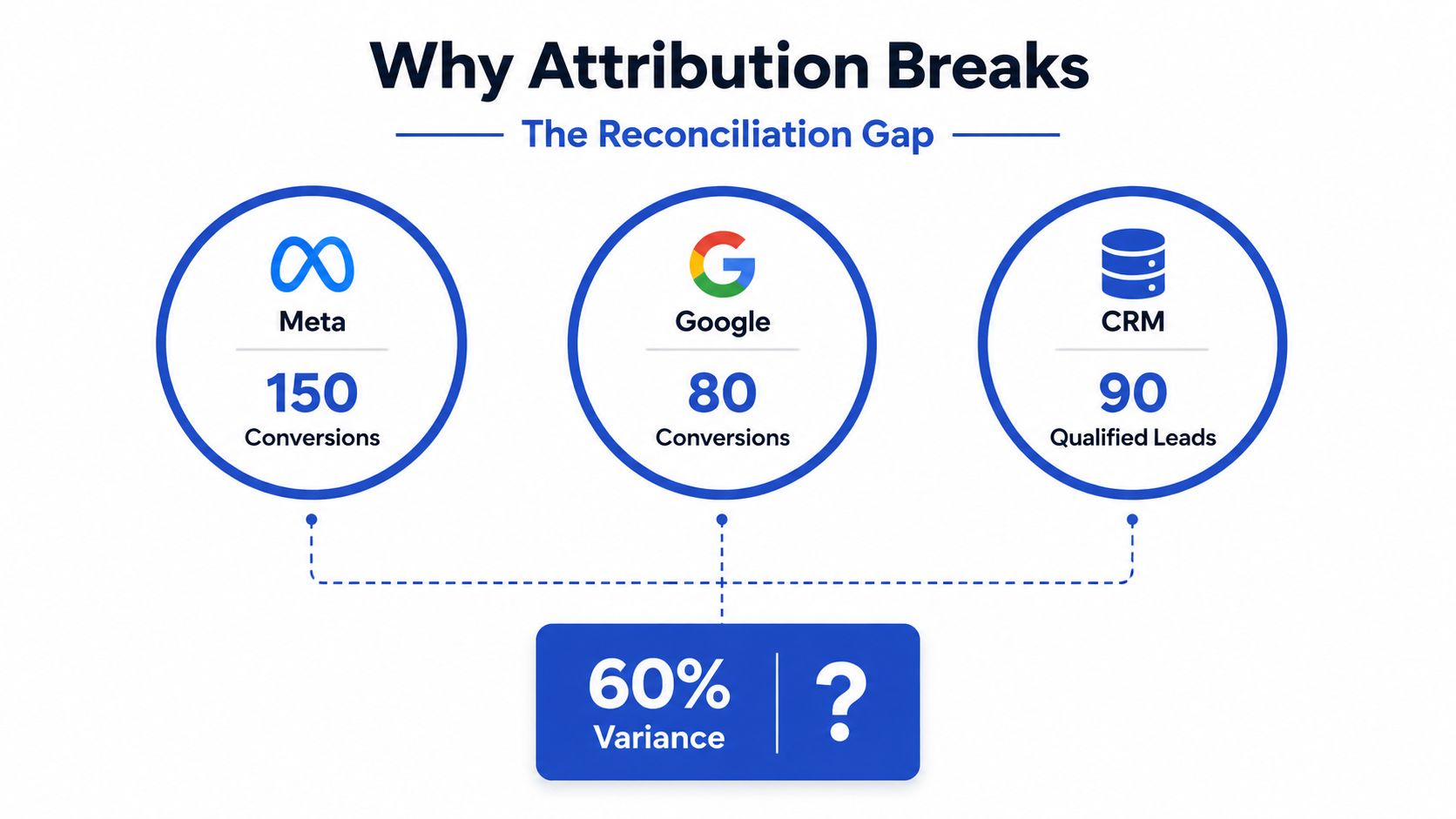
Your Meta Ads dashboard says 150 conversions. Google Ads claims another 80. Then the CRM reports only 90 qualified leads for the same period. At 2 AM, you're staring at three numbers that can't all describe the same business outcome, tracing redirects, checking form submissions, and wondering whether the problem is the media, the tracking, or the sales team.
This isn't an unusual reporting nuisance. It's the operating reality of high-volume lead generation. Ad platforms record the events they can observe, while your CRM records qualification, progression, and revenue. Phone calls, repeat research on another device, sales conversations, offline appointments, consent restrictions, and duplicate submissions sit between those systems. Campaign attribution only becomes useful when it connects those layers instead of treating a platform conversion as a finished result.
Why campaign attribution breaks in lead generation
The example above shows why lead generation is more difficult than counting ecommerce purchases. Meta may optimize around a browser event, Google may claim a conversion through its own click path, and the CRM may reject duplicates, disqualify prospects, or combine records. Each system can be internally consistent while the overall measurement is wrong.
Ad platforms optimize toward signals available to them, such as pixel events, form completions, imported offline conversions, and modeled interactions. They generally can't see whether a lead answered the phone, met qualification criteria, reached an opportunity stage, or produced revenue unless you send those outcomes back. That creates a structural bias toward visible activity rather than business value.
Lead generation is especially exposed because the journey often stretches across time, devices, and channels. A prospect might click a paid social ad on a phone, return through branded search on a laptop, speak with a sales representative, and complete an appointment offline. Privacy controls can remove part of that path, while consent banners and browser restrictions can prevent identifiers from being stored at all.
The history of campaign attribution helps explain the current tension. Marketing mix modeling predates digital advertising by decades, establishing the idea that sales can be explained by multiple inputs rather than one last click. Modern teams have added multi-touch systems, CRM data, and server-side events, but the fundamental problem remains: observed interactions aren't the same thing as causal contribution.
The operational bridge starts with durable data capture. Store the original source, campaign, creative, click identifiers, landing page, consent state, and lead status on the record that enters the CRM. If your stack also routes leads to buyers or downstream systems, the same identifiers must survive that handoff. A lead distribution workflow can help only if the receiving system preserves the acquisition fields rather than replacing them with a generic source label.
That gives you three distinct questions:
- What happened? Analytics and ad platforms report clicks, sessions, and conversion events.
- Who became valuable? The CRM reports qualified leads, opportunities, sales activity, and revenue.
- What caused the change? Experiments and broader models estimate incremental contribution.
A credible measurement system keeps those questions separate. It doesn't force one number to answer all three.
Attribution models explained with real scenarios
Consider one lead journey: a prospect first sees a LinkedIn ad, later searches Google for the company, clicks a retargeting ad, reads an organic article, and submits a form. The model determines which touchpoint receives credit, but it doesn't change what happened.
Last-click attribution assigns all credit to the organic article in this example. It's simple and useful for diagnosing the final conversion path, especially when the immediate action is the main optimization question. It also routinely over-credits branded search, retargeting, and conversion-page activity, while ignoring the earlier interaction that created awareness.
First-click attribution gives all credit to LinkedIn. That helps answer, “Which channel introduces new demand?” It fails when awareness is plentiful but the nurture sequence, sales enablement, or high-intent search does the work required to create a qualified lead.
Linear attribution divides credit evenly across LinkedIn, Google, retargeting, and organic content. This avoids choosing a single winner, but it can dilute meaningful signal across low-value visits, repeat ad exposures, and routine email activity. Equal credit is a rule, not proof that every interaction mattered equally.
Time-decay attribution gives more weight to interactions near conversion. For a short sales cycle, that can reflect buying intent well. For a long B2B cycle, it can undervalue the early content or event that made the account willing to engage later.
Position-based, or U-shaped, attribution emphasizes the first and last touchpoints, with the remaining credit distributed across the middle. It fits a journey where introduction and conversion are strategically important, but it assumes those positions deserve priority before the data demonstrates it.
Data-driven attribution uses observed journeys and statistical modeling to estimate relative contribution. It can handle complex paths better than fixed rules, but it needs clean identifiers, sufficient conversion volume, and transparent governance. A model built on duplicated leads and missing offline outcomes is still unreliable.
| Model | Credit Distribution | Best For | Key Limitation |
|---|---|---|---|
| Last-click | All credit to the final tracked touchpoint | Bottom-funnel optimization | Rewards retargeting and branded demand |
| First-click | All credit to the initial tracked touchpoint | Awareness and acquisition-source analysis | Ignores conversion efficiency |
| Linear | Equal credit across tracked touches | Simple multi-channel reporting | Treats noise and influence alike |
| Time-decay | More credit near conversion | Shorter or recency-sensitive journeys | Undervalues early demand creation |
| Position-based | Greater weight at first and last touches | Journeys with clear entry and conversion moments | Relies on a fixed assumption |
| Data-driven | Model-estimated contribution | Mature stacks with reliable path data | Can be opaque and sensitive to data quality |
Use the model that matches the decision, not the model that produces the most flattering channel report. First-touch can inform prospecting, last-click can help debug conversion paths, and a multi-touch view can describe the full journey. None of them proves causal lift by itself.
The technical plumbing behind attribution tracking
Start with the URL. A campaign link should carry a consistent set of UTM parameters, typically including utm_source, utm_medium, utm_campaign, and, where useful, utm_content and utm_term. The exact taxonomy matters less than the governance. If one team writes Facebook, another writes facebook, and a third uses paid_social, your reports split one channel into several labels.
Build naming rules before campaigns launch. Validate required fields, standardize case, define permitted values, and test the final URL through every redirect. Common production failures include UTMs stripped by a tracking redirect, parameters omitted from a new ad variation, and case-sensitive values creating duplicate categories.
Click IDs add platform-specific detail. Google uses gclid, Meta commonly uses fbclid, and Microsoft Ads uses msclkid. Preserve those values in first-party storage and hidden form fields, but don't confuse their presence with complete measurement. They can support platform matching, yet they remain vulnerable to consent choices, browser controls, ad blockers, redirects, and cross-device breaks.
Cookies create another dependency. First-party cookies are set by your domain, while third-party cookies depend on external domains and browser policies. Safari's ITP and Firefox's ETP have shortened effective tracking windows, in some situations to as little as 24 hours, as WebKit documented when it announced Intelligent Tracking Prevention 2.2. That makes long lead journeys difficult to reconstruct through browser storage alone.
Server-side tracking moves key event handling away from the page. Meta Conversion API, server-side Google Tag Manager, and first-party endpoints can receive a conversion from your backend after the CRM validates the submission. The design still needs careful identity handling and deduplication. Send a stable event identifier with both browser and server events, then configure the destination to treat matching identifiers as one conversion.
A server setup can fail too. Payload schemas change, authentication expires, consent flags are omitted, or a webhook returns an error that nobody monitors. Test event delivery with known records, log responses, alert on failure, and compare accepted backend events with CRM submissions. A practical implementation guide to sending conversions to Meta through Conversion API is useful when the browser signal alone no longer represents the funnel.
For a visual walkthrough of the capture chain, use the following video.
Common failure modes in paid channel measurement
Paid channel measurement usually fails in recognizable ways. The difficult part isn't finding a possible explanation. It's identifying exactly where the identifier or business outcome disappeared.
The reconciliation gap deserves a formal definition. It's the difference between conversions reported by an advertising platform and outcomes confirmed in the CRM. One 2026 benchmark claims that this gap averages 22% across major ad platforms, while another reports that brands using server-side tagging reduce the gap by 41% versus client-side tracking alone. Treat those figures as benchmark context, not as a universal tolerance for your own stack. Your first job is to measure the gap by channel, event, device, and funnel stage.
| Failure Mode | Diagnostic Signal | Typical Data Loss | Triage Step |
|---|---|---|---|
| Privacy restrictions | Browser events fall below backend submissions | Qualitative loss of observable paths | Compare browser events with CRM records by day |
| Cross-device journeys | Click IDs exist on one device but not the converting session | Broken identity stitching | Test a mobile click followed by desktop submission |
| Platform credit inflation | Platform conversions exceed accepted or qualified leads | Overstated channel contribution | Reconcile event IDs with CRM lead IDs |
| Expired or blocked cookies | Older journeys appear direct or unattributed | Missing early touchpoints | Inspect first-touch persistence and consent logs |
| Ad blockers | Click identifiers disappear for a subset of traffic | Incomplete campaign matching | Submit test leads with blocking enabled |
| URL truncation | Some campaigns arrive without content or click values | Partial campaign metadata | Compare generated and received query strings |
The iOS privacy changes that altered browser-level visibility are only one part of the problem. A lead who clicks LinkedIn on mobile and converts on desktop later may be a new anonymous visitor to the form, even when the person is the same prospect. The CRM can sometimes resolve that identity through email, phone, or account matching, but the ad platform may not be able to connect the path.
Don't diagnose from totals alone. Export raw leads, retain event timestamps, compare unique identifiers, and sample records from each source. A platform total that looks plausible can still contain duplicate events, view-through claims, or conversions that never reached qualification.
Debugging order: Check the raw landing URL, then the browser data layer, then the form payload, then the CRM record, and finally the ad-platform response.
That sequence matters. If the UTM disappeared before the form loaded, changing the CRM report won't fix it. If the CRM has the value but the platform rejects the offline event, the problem belongs in the integration layer.
Integrating attribution with lead capture and CRM systems
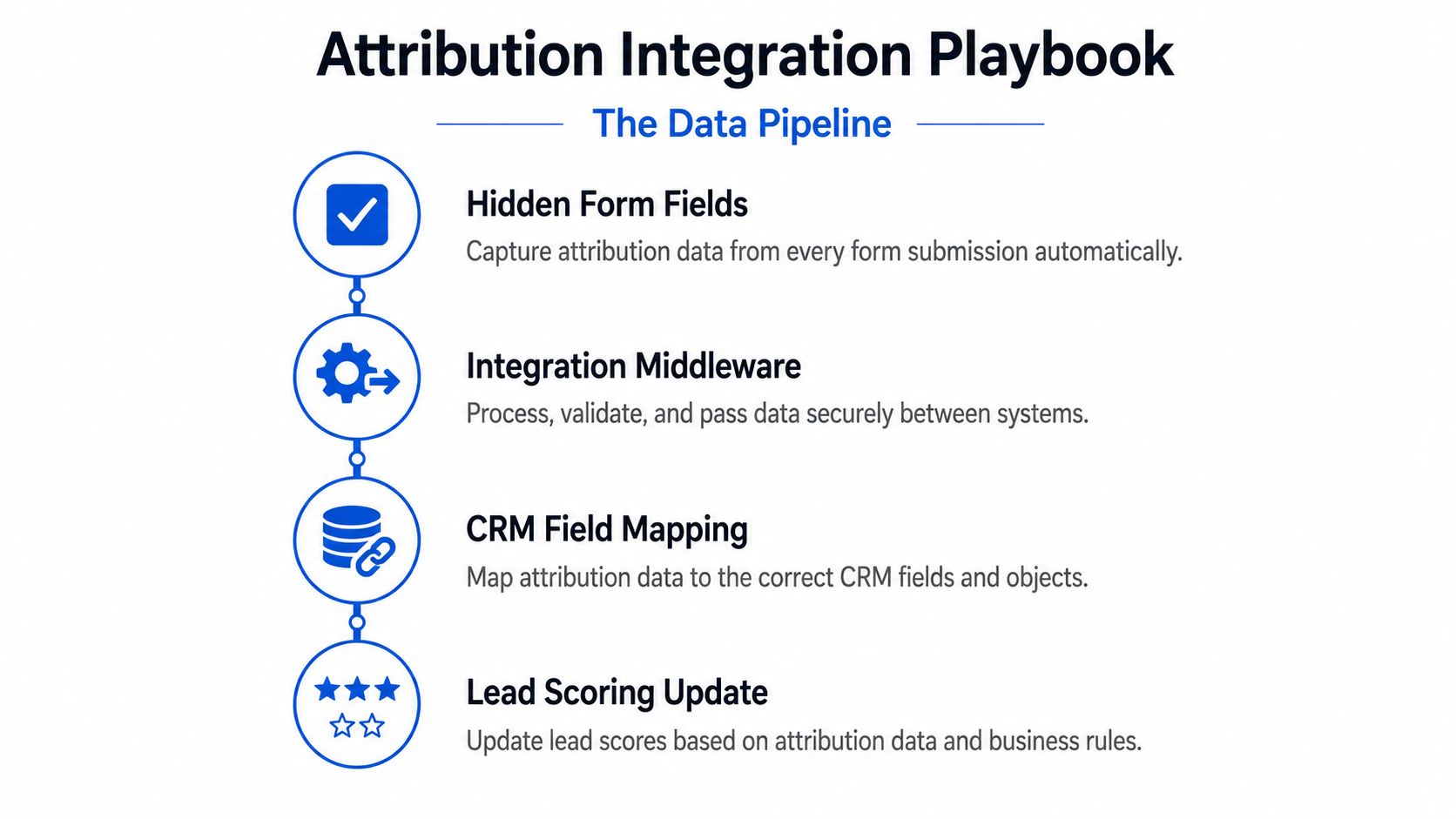
Attribution data is most valuable at the moment a lead becomes identifiable. Capture it in the form, store it in the CRM, and preserve it through qualification and revenue stages. If you wait until the weekly report, the missing identifier is usually unrecoverable.
Capture the first visit
Create hidden fields for the original and latest values. A practical baseline includes:
- Original source fields:
original_utm_source,original_utm_medium, andoriginal_utm_campaign. - Latest touch fields:
latest_utm_source,latest_utm_medium, andlatest_utm_campaign. - Creative context:
utm_contentandutm_term, where applicable. - Click identifiers:
gclid,fbclid, andmsclkid. - Operational keys: landing page, session or visitor identifier, consent status, and capture timestamp.
Write the first-touch fields only when empty. Update latest-touch fields according to an agreed rule, such as preserving paid acquisition unless a later qualified interaction should replace it. Without that rule, different forms overwrite one another and the CRM can't distinguish acquisition from re-engagement.
A hidden field is not magic. The value must persist between pages, survive validation errors, and reach the webhook payload. Test direct traffic, tagged traffic, redirect traffic, returning visitors, and submissions after a consent decision. Hidden fields for passing campaign values through forms can support this pattern when the form layer needs to retain acquisition context.
Map the record downstream
In HubSpot, Salesforce, Unbounce, or another capture stack, map each hidden field to a defined CRM property. Keep the naming consistent across systems. A field called utm_campaign in one tool and campaign_source in another creates unnecessary transformation work and makes audits harder.
Use the lead ID as the primary join key. Add the CRM contact or account ID when available, then associate opportunity and revenue records with that same entity. Offline events should include the platform click ID where available, the event name, event time, value or stage, and a deduplication key. Never send a generic “conversion” event for every form completion if the optimization objective is qualified opportunity or funded revenue.
Send outcomes back
A webhook should trigger when the CRM status changes, not only when the form submits. Route events such as qualified, booked, opportunity, and closed outcome according to the channel's accepted schema. Log the request, response, retry state, and event identifier. If a schema update removes a required field, monitoring should catch the failure before the weekly report exposes it.
The practical sequence is straightforward: capture identifiers, validate them, store them, map them, send status changes, and reconcile responses. The hard part is enforcing that sequence across every landing page, form, buyer, CRM, and agency account.
Triangulating attribution with incrementality and MMM
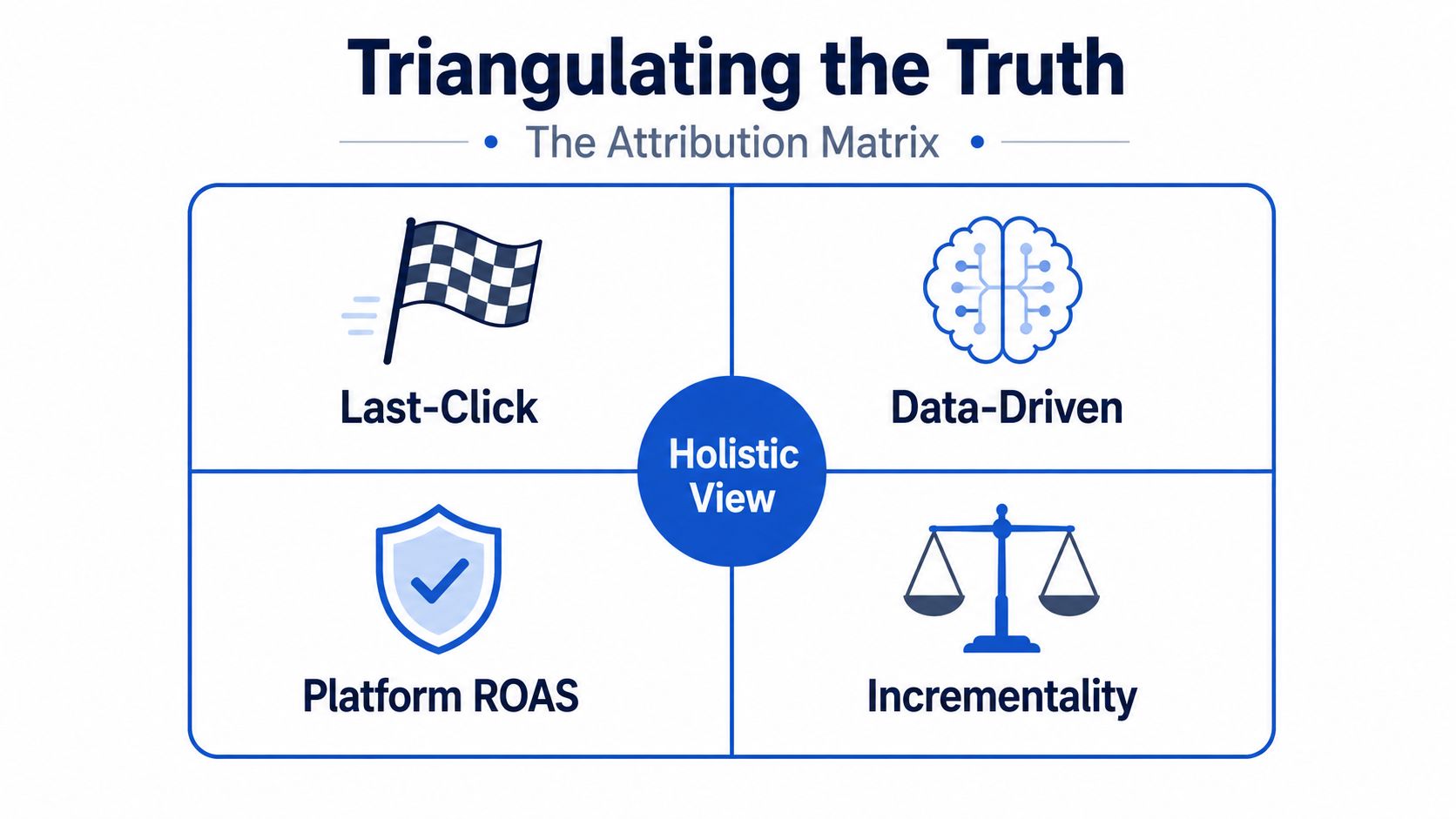
No credit-assignment model can establish causation on its own. Multi-touch attribution describes how observed interactions are distributed, while incrementality asks what additional outcome occurred because a channel or campaign was present. The strongest measurement setup uses both, alongside broader modeling and durable first-party data, rather than choosing one supposedly perfect model. This approach is consistent with the technical argument for combining path data with holdout groups in research on attribution and incrementality.
Start with the operational model already used for optimization. Then add controlled tests where the business can protect a holdout. A geo-based holdout can pause or reduce exposure in comparable regions, while a budget pulse changes spend according to a preplanned schedule. Compare qualified CRM outcomes, not just browser conversions, and define the test window and success metric before launch.
Marketing mix modeling provides a macro-level check. Tools such as Robyn or LightweightMMM can help teams examine channel contribution against aggregate outcomes, seasonality, and spend. MMM won't repair missing lead identifiers, and it won't explain an individual journey. Its value is different, it can challenge a channel narrative that looks strong in touchpoint reports but weak at the business level.
Use a simple decision matrix:
- Attribution and incrementality agree: Scale while continuing to monitor lead quality.
- Attribution is strong, incrementality is weak: Investigate retargeting overlap, branded demand, and platform credit rules.
- Attribution is weak, incrementality is strong: Check missing UTMs, offline touches, and cross-device identity loss.
- Both are weak: Repair data capture and experiment design before changing budget.
Run the review on a recurring cadence that the team can sustain. A quarterly assessment of the principal spend channels is usually more useful than a permanent analysis project that never reaches a budget decision. The output should be a short list of actions, such as increase, hold, test, or stop, with the evidence and uncertainty recorded beside each decision.
Best practices for high-volume lead gen and agency stacks
High-volume teams need attribution governance, not another dashboard. The operating standard should be set before spend begins and enforced across every account, form, CRM, and distribution endpoint.
- Validate campaign metadata before launch: Require approved source, medium, campaign, creative, and click-ID handling before an ad reaches production.
- Make server-side events part of the architecture: Use backend or server-side signals where browser tracking is incomplete, then monitor delivery and deduplication rather than assuming the connection works.
- Separate optimization from truth: Let platform dashboards guide immediate bidding decisions, but use CRM-confirmed qualification, opportunity, and revenue for weekly business reporting.
- Standardize hidden fields: Every form endpoint should capture the same acquisition fields, preserve original and latest touch where appropriate, and pass them into downstream payloads.
- Monitor the handoff: Trigger CRM enrichment and buyer delivery through webhooks, log failures, and investigate missing fields before they become reporting debt.
- Test causality: Use incrementality testing for the channels receiving the most budget, especially when platform-reported performance conflicts with CRM outcomes.
Multi-account agencies also need clear ownership. An agency operations platform can support workflow standardization, but it won't replace naming governance, CRM reconciliation, or experiment design. The tool can organize execution. Your measurement rules still determine whether the numbers deserve trust.
Campaign attribution is an ongoing operating discipline. Teams that review only reported conversions can scale apparent efficiency while real qualification and revenue drift in the opposite direction. Teams that preserve identifiers, reconcile outcomes, and test incremental lift can make budget decisions with a clearer view of what each channel contributes.
Growform provides a no-code multi-step form layer for capturing qualified leads while preserving UTMs, click IDs, and other hidden-field values through CRM and distribution handoffs. If your paid campaigns are losing acquisition context between the ad click and the pipeline, visit Growform to evaluate a cleaner capture and attribution workflow. Every plan starts with a 14-day free trial. Start free trial.
Related articles

7 Form Builders With Hidden Fields for Attribution
September 30, 2026
Zapier Webhook to Google Sheet How to Connect Fast
You've paid for the click, a prospect has completed a multi-step form, and the sales team is waiting for the lead.
September 30, 2026
8 API Integration Examples for Lead Capture
A lead stack can lose more value after the form is completed than before it.
September 30, 2026