
We Found the 10 Best Wufoo Alternatives for Creating High-Converting Forms
Quick Summary
Wufoo’s been around since 2006, and for a long time, it was THE form builder for anyone who wanted something simple and reliable.
But it hasn’t really evolved much, especially since SurveyMonkey acquired it back in 2011.
So if you’re currently using Wufoo or considering it, let’s look at some Wufoo alternatives that might actually fit what you need in 2025 and beyond.
| Name | Best For | Pricing (USD) | Free Trial? |
|---|---|---|---|
| Growform | High-converting multi-step lead forms | Basic $59, Professional $99, Scale $199 | Yes – 14 days |
| Jotform | General-purpose forms with heavy integrations | Bronze $34, Silver $39, Gold $99+ | Yes + Free plan |
| Typeform | Conversational, one-question-at-a-time forms | Basic $29, Plus $59, Business $99+ | Yes + Free plan |
| Formstack | Enterprise workflows, approvals, and compliance | Starts around $59/month | Yes |
| Cognito Forms | Advanced calculations and complex logic | Pro $19, Team $39, Enterprise $129 | Yes + Free plan |
| Paperform | Visually rich, document-style forms | Essentials $24, Pro $49, Business $99 | Yes – free trial |
| Formsite | General forms with stronger data handling | $21, $34, $59, $84, $209 | Yes + Free plan |
| Google Forms | Simple surveys with free unlimited use | Free (Workspace $7–12/user) | Free forever |
| Zoho Forms | CRM-connected forms and internal workflows | $10, $25, $50/month | Yes + Free plan |
| HubSpot Forms | Forms tied directly to CRM + automation | Free (Marketing Hub from $20) | Free forever |
10 Top Wufoo Alternatives for Engaging Online Forms
1. Growform
Growform is a modern Wufoo alternative specifically for multi-step, high-converting lead forms, rather than general-purpose surveys. It’s designed to help you get up to twice as many, better qualified leads from the same traffic, using layouts and flows based on UX research and psychological principles.

You can embed forms almost anywhere and send leads to thousands of tools via Zapier, including CRMs, email platforms, and spreadsheets, so leads go straight into your existing workflows.
One of the biggest differences between Growform from Wufoo is our focus. Wufoo is a solid, general-purpose form builder. But Growform is narrower and more opinionated: we optimize specifically for high-converting, multi-step lead gen forms, rather than trying to cover every form use case.
Key Features
- Multi-Step Forms: Create forms that guide users through a series of steps, reducing abandonment and boosting completion rates.
- Conditional Logic: Display or hide questions based on previous responses, creating a personalized user experience.
- Drag-and-Drop Builder: Easily design forms by dragging and arranging elements without any coding.
- Customizable Templates: Access over 100 templates to quickly create effective forms.
- Embedded Forms: Seamlessly integrate forms into platforms like WordPress, WebFlow, or Instapage using custom HTML.
- Validation: Ensure data accuracy by validating inputs such as email addresses, phone numbers, or dates.
- A/B Testing: Experiment with different form elements to identify the most effective combinations for conversions.
Pricing

Each plan comes with a 14-day free trial (no credit card required).
- Basic – $47/month (billed annually): Includes 300 leads per month, 1 domain embed, unlimited forms, and no Growform branding.
- Professional – $79/month (billed annually): Offers 1,000 leads per month, unlimited domain embeds, Twilio & Zerobounce validation, Google Tag Manager integration, and priority support.
- Scale – $159/month (billed annually): Designed for larger campaigns with 3,000 leads per month, all Professional features, plus CNAME hosting for standalone forms.
- Custom – Contact for pricing: Built for high-volume lead generation, includes custom integrations, SLA guarantee, and advanced compliance tools.
- For full details, visit the Growform pricing page.
Pros
- Ideal for small businesses and non-technical users
- Pre-tested template designs help boost lead capture rates
- Forms don’t look generic and can match branding
- Works well with WordPress, Wix, and HTML sites
- Great for capturing leads and engaging users
- Built specifically for CRO and form conversions
Cons
- Limited native integrations beyond Zapier
- Advanced design customization requires custom CSS instead of built-in settings
Looking for simpler or more powerful form tools? Check out these top Microsoft Forms alternatives to find the best fit for your needs.
2. Jotform
Jotform is a general-purpose online form builder that’s often seen as a straightforward upgrade from Wufoo. In our tests, you can go from zero to working form extremely fast, especially using its big template library.

Where it pulls away from Wufoo is breadth: far more templates, integrations, payment options, and add-ons like Tables and Apps. The tradeoff is that once you start using it heavily, pricing and usage limits become something you actively manage.
Key Features
- Drag-and-Drop Form Builder: Easily design forms using an intuitive interface with customizable templates and elements.
- Payment Processing: Collect payments directly through forms via integrations with gateways like PayPal, Square, and Stripe.
- Conditional Logic: Implement “if-then” conditions to show or hide fields based on user responses, enhancing form interactivity.
- Integrations: Connect with numerous third-party applications, including CRMs, email marketing services, and cloud storage platforms.
- Widgets: Enhance forms with over 100 widgets, such as e-signatures and date pickers, to add functionality.
Pricing
- Starter (Free): Includes 5 forms, 100 monthly submissions, 100 MB storage, 5 AI agents and Jotform branding.
- Bronze – $34/month (billed annually): Offers 25 forms, 1,000 monthly submissions, 25 AI agents, 1 GB storage, and removes Jotform branding.
- Silver – $39/month (billed annually): Provides 50 forms, 2,500 monthly submissions, 50 AI agents, and 10 GB storage.
- Gold – $99/month (billed annually): Grants 100 forms, 10,000 monthly submissions, 100 GB storage, 100 AI agents, 1,000 signed documents per month, and HIPAA compliance
- Enterprise – Custom pricing: Includes unlimited forms, user management, SLA agreements, and dedicated support.
Pros
- Easy to use, even for beginners
- Works with payment processors, CRMs, and marketing tools
- Offers a variety of pre-built, customizable forms
- Features like workflows and conditional logic streamline processes
- Good for small businesses with minimal form needs
- Suitable for healthcare and secure data collection
Cons
- Requires an expensive Enterprise plan for team collaboration
- Users report occasional form-breaking issues and saving errors
3. Typeform
Typeform is built around one-question-at-a-time, conversational forms. Compared with Wufoo, the experience feels more polished and respondent-friendly, which is helpful when you care about how the form reflects your brand.

Logic is easy to set up for straightforward branching, and it plays well with common marketing tools. The main friction is pricing and response caps, which become noticeable once forms start getting serious traffic.
Key Features
- Conversational Forms: Presents questions sequentially to simulate a natural conversation, improving respondent engagement.
- Customizable Templates: Provides 1,500+ templates that can be fully customized to match branding and specific needs.
- Conditional Logic: Adapts questions based on user responses, creating personalized and efficient form experiences.
- Integrations: Seamlessly connects with various applications like Slack, Salesforce, and Google Sheets, facilitating efficient data management.
- Advanced Security & Compliance: Ensures data protection with GDPR and HIPAA compliance, encryption, and access controls.
Pricing
- Free Plan: Includes unlimited typeforms, 10 questions per typeform, 10 responses per month, and logic jumps.
- Basic – $25/month: Includes 100 responses per month, 1 user, unlimited typeforms, and unlimited questions.
- Plus – $50/month: Offers 1,000 responses per month, 3 users, removes Typeform branding, and allows a custom subdomain.
- Business – $83/month: Provides 10,000 responses per month, 5 users, conversion tracking, drop-off rate analysis, and priority support with live chat.
- Enterprise – Custom pricing: Includes tailored response limits, VIP support, Single Sign-On (SSO), HIPAA & GDPR compliance, and custom branding options.
Pros
- Forms look professional and engaging on all devices
- One-question-at-a-time format improves user experience and response rates
- Works well with Stripe, Google Sheets, Slack, and other tools
- Flexible enough for event registrations, surveys, and lead generation
- Simple interface makes form creation accessible for non-technical users
Cons
- Typeform branding is present in the basic paid plan, must upgrade to Plus to remove it
- Users report slow response times and difficulty resolving account problems
4. Formstack
Formstack Forms is a no-code online form builder designed to automate data collection and streamline workflows. With enterprise-grade features like AI-powered form creation, prefilled links, and advanced automation, it simplifies complex processes for businesses of all sizes.
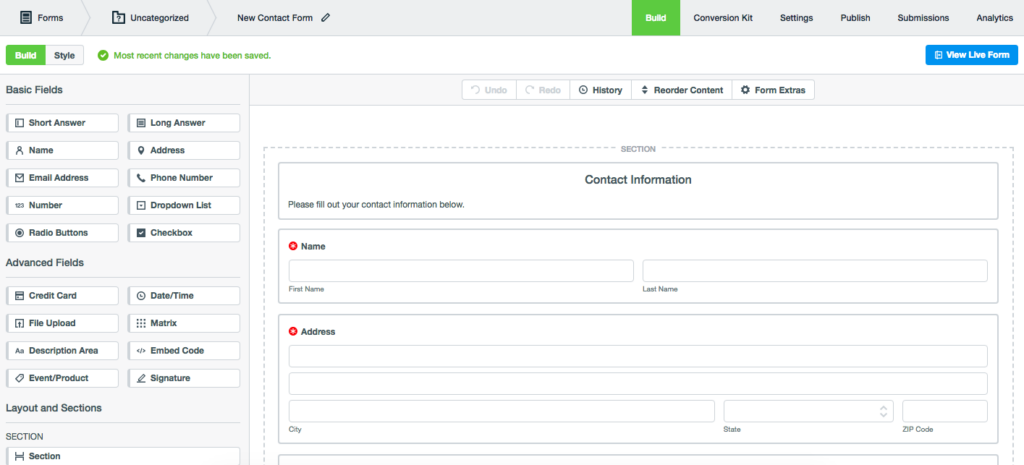
Formstack Forms is closer to a workflow tool than a simple form builder. It targets teams that collect data, route it internally, and need approvals and documents along the way. When we tried it, the form builder itself was straightforward, but the value was in the automation and compliance features behind the scenes.
Key Features
- AI-Powered Form Creation: Generate smart, customized forms effortlessly using AI technology.
- Prefill Functionality: Save users time and improve accuracy by auto-filling form fields.
- Advanced Automation: Use approvals, logic, and workflows to streamline data collection.
- Seamless Integrations: Connect with core business systems like Salesforce, Google Sheets, and more.
- Custom Branding: Design forms that align with your brand’s identity, colors, and style.
Pricing
- Forms – $83/month (billed annually): Includes 1 user, 25 forms, store 1,000 submissions per form, and 2 GB storage.
- Suite – $250/month (billed annually): Offers 3 user licenses, unlimited forms, store 10,000 submissions per form, 10 GB storage, and access to documents, and eSign tools.
- Enterprise – Custom pricing: Provides a custom-built package with features like advanced security, and user-level permissions.
Pros
- Enables dynamic forms by showing/hiding fields based on responses
- Works well with OneDrive, Dropbox, Zapier, Salesforce, and more
- Sends responses to managers, reducing manual follow-ups
- Simple dashboard for reviewing form performance
- Drag-and-drop builder makes setup fast and simple
Cons
- Some users report layout problems on mobile screens
- Lacks basic organization tools for managing submissions
5. Cognito Forms
Cognito Forms is a versatile online form builder that enables users to create, publish, and manage forms with ease. It caters to a wide range of industries, including healthcare, education, and government, offering features like data collection, payment processing, and workflow automation.
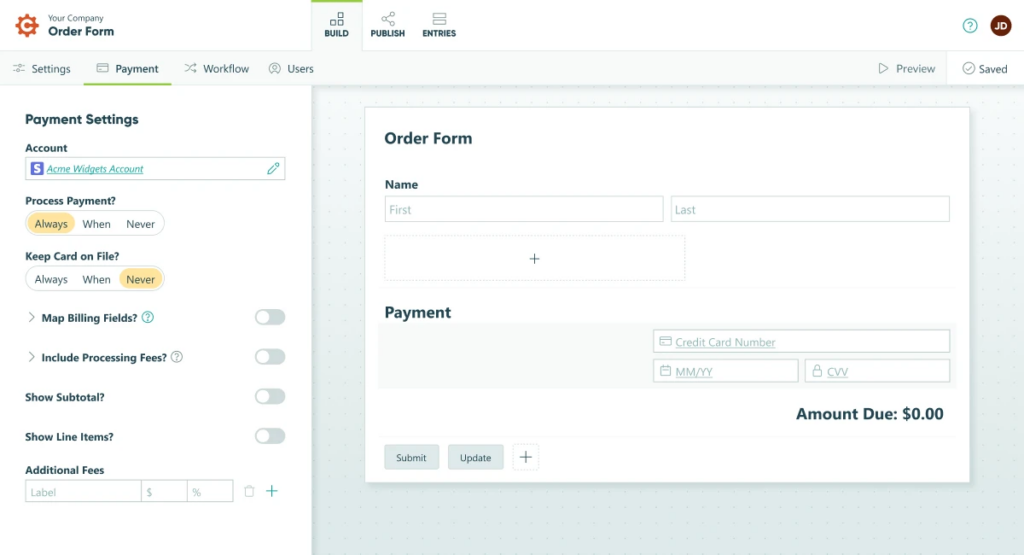
As a Wufoo alternative, Cognito Forms is a good fit when you need advanced logic, calculations, and workflows without custom development. While the interface is more utilitarian than some competitors, it handled complex scenarios well in testing: multi-stage applications, calculated quotes, and approvals felt native, not hacked in.
Key Features
- Data Collection: Easily gather, format, and validate data through customizable field types.
- Workflow Automation: Build flexible workflows to engage the right people at the right time, automating tasks and notifications.
- Data Management: Organize, configure, and transfer data, and create reports and documents.
- Security & Compliance: Stay compliant with HIPAA, GDPR, CCPA, and other privacy regulations.
- Integrations: Expand functionality through native apps and third-party integrations.
Pricing
- Individual – Free: Includes 1 user, unlimited forms, 500 entries per month, and 100 MB storage. Supports payment collection.
- Pro – $19/month: Offers 2 users, unlimited forms, 2,000 entries per month, 1 GB storage, and removes ads.
- Team – $39/month: Provides 5 users, unlimited forms, 10,000 entries per month, 10 GB storage, and integrates with Square & PayPal.
- Enterprise – $129/month: Includes 20 users, unlimited forms & entries, 100 GB storage, and advanced team management features.
Pros
- Offers flexible, no-code logic and scripting for advanced form behaviors
- Provides unlimited forms and payment collection even on the free tier
- Supports HIPAA and GDPR for secure data handling
- Embeds seamlessly into websites with customization options.
- Enables workflow automation and data routing for efficiency
- Users report quick and helpful assistance when needed
Cons
- Some users experience problems receiving Cognito Forms emails
- PDF upload and page-linking features are a bit clumsy
6. Paperform
Paperform works like a form builder and simple page builder in one. It lets you lay out copy, images, and questions on a single scrolling page instead of rigid blocks.
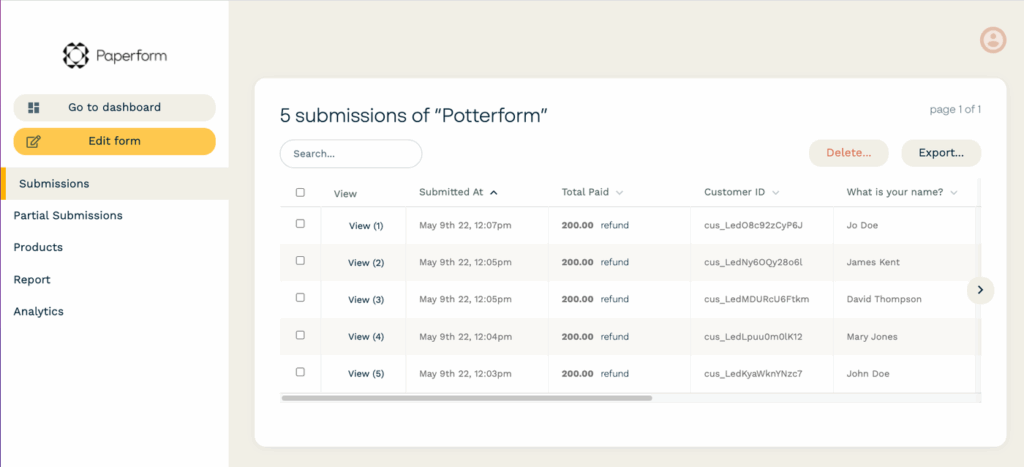
It’s particularly strong for branded forms that also take payments or bookings without sending people to another system. The main tradeoffs are the lack of a forever-free plan and submission limits on each tier, which you need to keep an eye on as usage grows.
Key features
- Document-style editor: Build forms as long-form pages with mixed text, media, and fields.
- Payments and bookings: Accept payments, subscriptions, and appointments directly in forms.
- Branding controls: Customize themes, layouts, and remove branding on higher plans.
- Automation & integrations: Connect to tools like Google Sheets and HubSpot or use webhooks.
Pricing
Essentials $29/month, Pro $59/month, Business $129/month; free trial available.
Pros
- Easy to design on-brand, content-rich forms.
- Strong payment and booking capabilities.
- Well-rated for flexibility and support.
Cons
- No forever-free plan.
- Submission limits on lower tiers.
- More than you need for basic internal forms.
7. Formsite
Formsite is a traditional hosted form builder focused on reliable data collection. Basic forms are quick to set up, and exports work smoothly, which suits teams that care about getting clean data into spreadsheets or other systems.
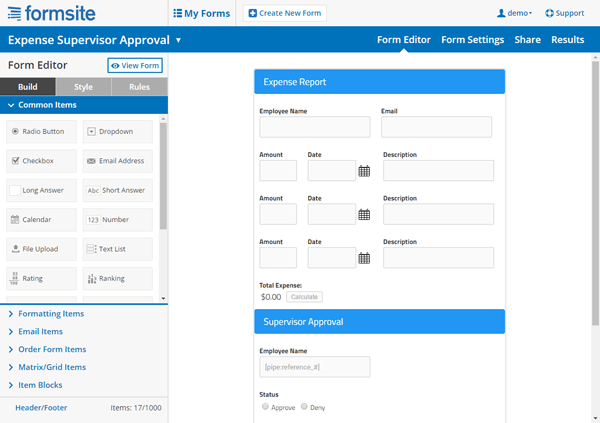
The interface is straightforward but looks dated, and every plan comes with limits on forms, results, and storage, so capacity planning becomes part of using it at scale.
Key features
- Template and field variety: Templates plus many question types for surveys, registrations, and applications.
- Multi-page & logic: Supports multi-page layouts with conditional paths.
- File uploads & exports: Handles attachments and offers flexible export options.
- Integrations & Zapier: Native integrations and Zapier support for automation.
Pricing
Starts at $24/month, with higher tiers for more forms, entries, and storage; 14-day free trial.
Pros
- Quick to launch stable, production-ready forms.
- Reliable export and attachment handling.
- Long-running platform with predictable behavior.
Cons
- UI looks and feels outdated.
- Strict caps on forms and results.
- Can feel clunky for more advanced builds.
8. Google Forms
Google Forms is another old, but strong Wufoo alternaitve contenfer. It is a free, lightweight tool best suited for simple surveys and internal data collection. You can create forms in minutes, and responses flow directly into Google Sheets for analysis.

It works well for quizzes, polls, and quick feedback tasks, especially in teams already on Google Workspace. Branding, integrations, and advanced logic are very limited, so it’s not a fit for polished customer-facing forms or complex workflows.
Key features
- Simple builder: Clean interface with core question types and sections.
- Templates: Basic templates for events, quizzes, and feedback.
- Sheets integration: Automatically syncs responses to Google Sheets.
- Basic logic & quizzes: Section-based branching and quiz scoring.
Pricing
Free for personal Google accounts; included in Workspace plans.
Pros
- Free and extremely fast to set up.
- Ideal for internal surveys and simple forms.
- Strong integration with Sheets and other Google tools.
Cons
- Very limited branding and layout control.
- Minimal analytics and native integrations.
- Not suited for advanced or high-volume use cases.
9. Zoho Forms
Zoho Forms is a no-code form builder that fits neatly into the Zoho ecosystem. Submissions can be pushed straight into Zoho CRM and other Zoho apps, which simplifies automation and reporting for existing Zoho users.

The builder covers standard use cases with a low learning curve, and the free plan is workable for small workloads. Design options and third-party integrations are more limited than many standalone builders.
Key features
- Drag-and-drop builder: Create forms with core field types and validation.
- Zoho CRM & apps: Send submissions directly into Zoho CRM and other Zoho services.
- Skip logic & rules: Basic conditional logic on free and paid plans.
- Sharing & embedding: Public links, embeds, and mobile-responsive forms.
Pricing
Free plan available; paid plans start around $10/month and scale by users, submissions, and features.
Pros
- Strong fit for teams already using Zoho CRM or Zoho One.
- Functional free plan for smaller needs.
- Good feature-to-price ratio on lower tiers.
Cons
- Limited design customization.
- Fewer third-party integrations than leading standalones.
- Plan structure can feel confusing as requirements grow.
10. HubSpot Forms
HubSpot Forms is the built-in form tool inside HubSpot’s CRM and Marketing Hub. Every submission creates or updates a contact automatically, making it useful for lead capture when the CRM is already central to your workflow.
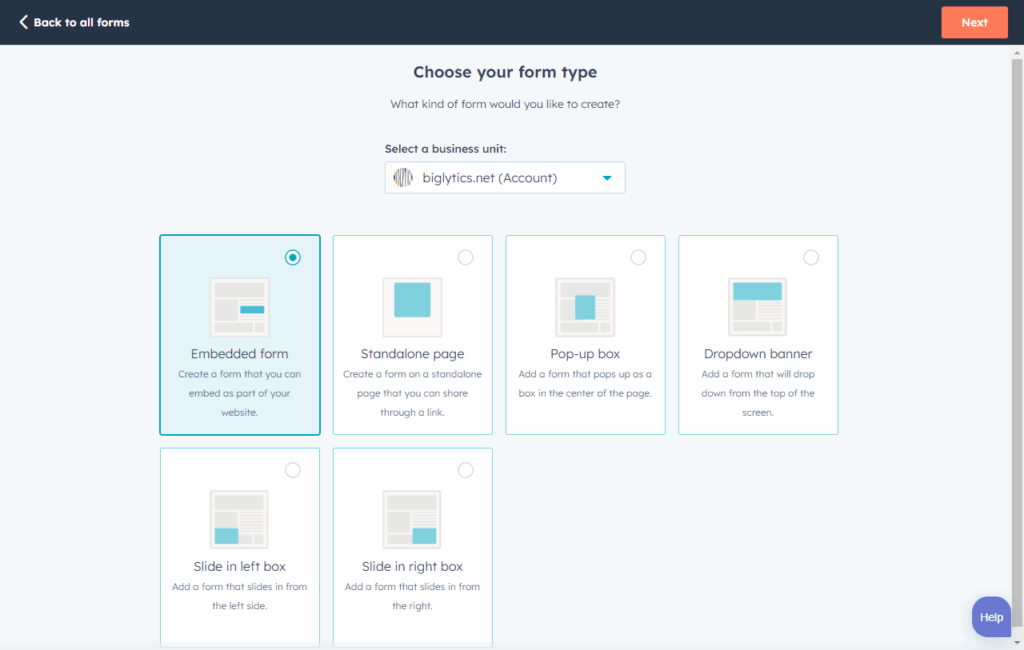
Forms are simple to build, and automation rules can trigger emails, tasks, or pipeline updates based on submissions. It’s most practical when HubSpot is already in use; as a pure form solution, the broader platform cost can be excessive.
Key features
- CRM-linked forms: Automatically create or update contacts.
- Workflows & automation: Trigger sequences, tasks, and routing rules from submissions.
- Landing page & email integration: Use the same forms across HubSpot pages and campaigns.
- Reporting & attribution: Track performance and tie form activity to deals and pipeline.
Pricing
Included in HubSpot’s free CRM; advanced automation and reporting require paid Marketing Hub tiers.
Pros
- Very strong option when using HubSpot as your CRM.
- No extra connectors needed between forms and contacts.
- Capable free tier for basic lead capture.
Cons
- Not ideal outside the HubSpot ecosystem.
- Costs rise quickly as contacts and features scale.
- Limited for research-style or complex internal workflows.
What Is Wufoo?
Wufoo by SurveyMonkey is a cloud-based form builder designed to help businesses create and customize online forms with ease. From registration and payment forms to surveys and applications, Wufoo offers a simple drag-and-drop interface, built-in themes, and powerful integrations. It’s trusted by millions of users for its automation, security, and seamless data collection capabilities.

Key Features
- Drag-and-Drop Form Builder: Easily create and customize forms without coding.
- Payment Integrations: Accept online payments through Stripe, PayPal, Square, and more.
- Automation & Workflows: Connect with CRMs and marketing tools for seamless data transfer.
- Security & Spam Protection: 256-bit SSL encryption and CAPTCHA to keep data secure.
- Custom Branding & Themes: Design forms that match your website’s look and feel.
Pricing
- Free Plan: 5 forms, 100 entries, 1 user, basic support.
- Starter ($22/month): 10 forms, 1,000 entries, 1 user, file storage included.
- Professional ($39/month): Unlimited forms, 5,000 entries, 5 users, increased file storage.
- Advanced ($99/month): 25,000 entries, 20 users, priority support.
- Ultimate ($249/month): 200,000 entries, 60 users, maximum scalability.
Why Look for a Wufoo Alternatives?
- Limited Customization: Wufoo’s design options are basic, with restricted styling and branding flexibility.
- High Pricing for Scaling: Advanced features and higher form submissions quickly increase costs.
- Outdated Interface: Wufoo’s UI feels outdated compared to modern form builders like Growform.
- Lack of Advanced Lead Generation Features: No built-in multi-step optimization or psychology-backed design.
- Limited Integrations Without Workarounds: Most integrations require Zapier or custom API setup.
Create High-Converting Forms with Growform
Finding the right form builder is crucial for capturing more leads and streamlining workflows. This guide explored the top Wufoo alternatives, each offering unique features for different needs.
If you’re looking for a form builder designed specifically for lead generation, Growform stands out as a high-converting, multi-step form solution.
Growform helps businesses generate up to 2x more leads with customizable, responsive, and conversion-optimized forms, without needing a developer. With seamless integrations and A/B testing, it’s built to maximize results.
Capture more high-quality leads with Growform – Start your FREE Trial today!
Commonly Asked Questions About Wufoo Alternatives (and Our Takes)
What’s the best Wufoo alternative for lead generation?
Growform is one of the strongest Wufoo alternatives if your main goal is higher conversion rates. It focuses on multi-step forms, clear tracking, and frictionless lead capture, which matters if you run Google Ads or paid campaigns. Unlike broader Wufoo competitors, Growform pricing is straightforward and includes unlimited forms, custom branding, and CRO-focused templates that work well for acquisition funnels.
Which Wufoo alternative has the best conditional logic?
If conditional logic is a priority, Cognito Forms and Jotform are reliable choices. Cognito handles detailed branching and calculations, while Jotform offers accessible logic for most use cases. Typeform also appears often in Typeform Wufoo alternatives searches, though its logic is simpler. Teams wanting maximum control over form paths usually lean toward Cognito.
Which Wufoo alternative has the best free plan?
Google Forms and Jotform stand out if you specifically want free plans. Google Forms works for quick surveys and internal workflows, while Jotform’s free tier is more flexible for business use. Both show up frequently in Google Forms vs Wufoo searches because they remove the submission and form-count limits that often frustrate Wufoo free plan users.
Which Wufoo alternative is best for multi-step forms?
Growform is built around multi-step forms rather than one long page, which helps improve completion rates. This is useful for Quote forms, Funnels, and higher-intent flows tied to Google Ads or click-based traffic. Many users looking for top Wufoo alternatives specifically switch for better multi-step performance, especially when Wufoo’s structure feels too rigid.
What’s the best Wufoo alternative for small businesses?
Small businesses usually want something simple, affordable, and fast to set up. Growform works well for lead capture, Jotform fits broad use cases, and Google Forms is ideal if cost is the priority. These tools generally appear at the top of searches for “Wufoo alternatives” and “Wufoo competitors,” mainly because they avoid tight submission caps.
Which Wufoo alternatives integrate best with CRMs and marketing tools?
HubSpot Forms is the best fit if you already use HubSpot’s CRM, since submissions automatically create contacts. Jotform offers the widest third-party CRM integrations, including Salesforce, Zoho, and HubSpot. Growform connects cleanly through Zapier and webhooks for common marketing stacks. These tools cover most needs behind queries like “Wufoo Google Sheets integration,” “Wufoo HubSpot integration,” and “Wufoo Salesforce integration.”