

“Get more insurance leads” is still the typical advice many receive. It's also the fastest way to hide a broken funnel. A cheap form fill that lacks usable consent, fails verification, arrives after the prospect has spoken with another agent, or gets rejected by the buyer isn't a growth asset. It's an operating cost.
Modern insurance lead gen has moved toward compliance-qualified intent. Consumers increasingly research online, while agencies need stronger capture, attribution, qualification, and handoff systems. J.D. Power's U.S. Insurance Shopping Study found that 74% of auto insurance shoppers use insurer websites or aggregators to get quotes and research providers, and a QuoteWizard statistics summary links digital marketing adoption with a 2.8 times higher revenue growth expectancy for agencies.
The practical standard is no longer cost per lead alone. It's the number of accepted, contactable, provable-consent leads your operation produces at a sustainable acquisition cost.
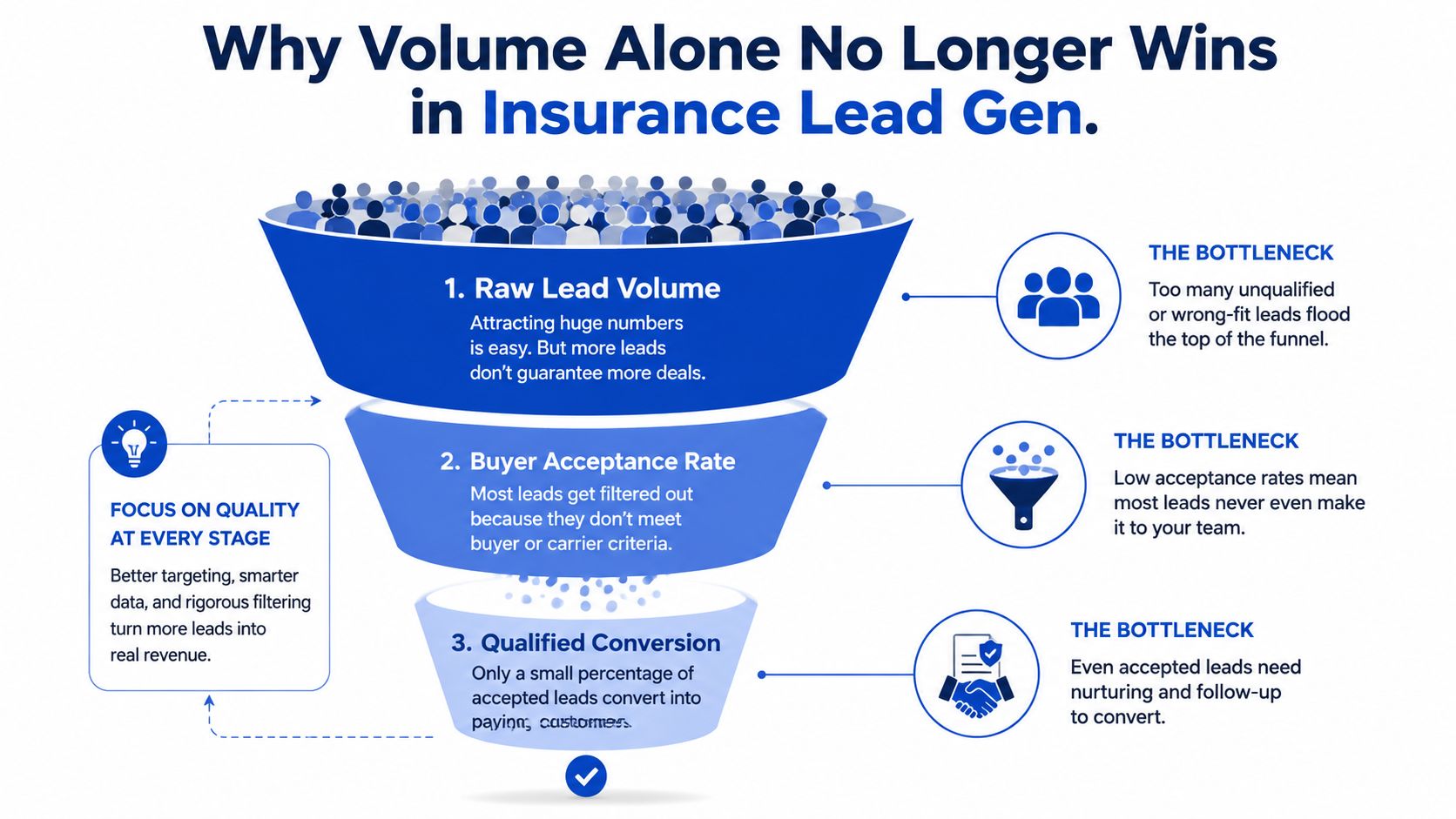
Why Volume Alone No Longer Wins in Insurance Lead Gen
More leads do not automatically create more revenue. Revenue improves only when buyers accept the records, agents can contact prospects quickly, and the business can prove that each consumer agreed to the relevant outreach.
Insurance acquisition still depends on trust. Research and Markets projects the global insurance brokers and agents market at $636.9 billion by 2029, as reported by Insurance Business, and Abstrakt Marketing Group states that 65% of new insurance business originates from referrals. Digital acquisition expands reach, but it does not replace credible messaging, transparent consent, or a handoff that preserves the prospect's context.
The metric that exposes weak funnels
A completed form can look healthy while downstream economics deteriorate. Reporting only CPL can cause an advertiser to scale a source that produces duplicate records, unreachable phone numbers, unclear seller disclosures, or prospects outside a buyer's appetite.
A stronger operating view follows every lead through these gates:
- Capture quality: Did the prospect provide the information required for the product and market?
- Consent integrity: Can the business show what the consumer saw and what action they took?
- Verification: Is the phone number reachable, the email usable, and the submission plausibly human?
- Routing speed: Did the lead reach an agent or buyer while intent was still active?
- Acceptance: Did the buyer accept the record under its stated rules?
- Monetization: Did the accepted lead create a qualified conversation or policy opportunity?
Abstrakt Marketing Group's 2026 review of insurance lead companies projects the U.S. insurance lead generation market at $3.8 billion in 2026, with 8.2% year-over-year growth, and says it had nearly doubled from about $2.1 billion in 2019. It also reported live transfer leads at 28% market share, up from 22% in 2023. The commercial direction is clear. Buyers pay more readily for immediacy, verified intent, and records that survive compliance review.
Consent requirements and state telemarketing rules add another operating constraint. Shared distribution can increase monetization, but it also requires clear seller identification and consent evidence that stays attached to the record. Routing should happen within minutes, not after the prospect has spoken with another agent.
Choosing the Right Paid Channels for Insurance Prospects
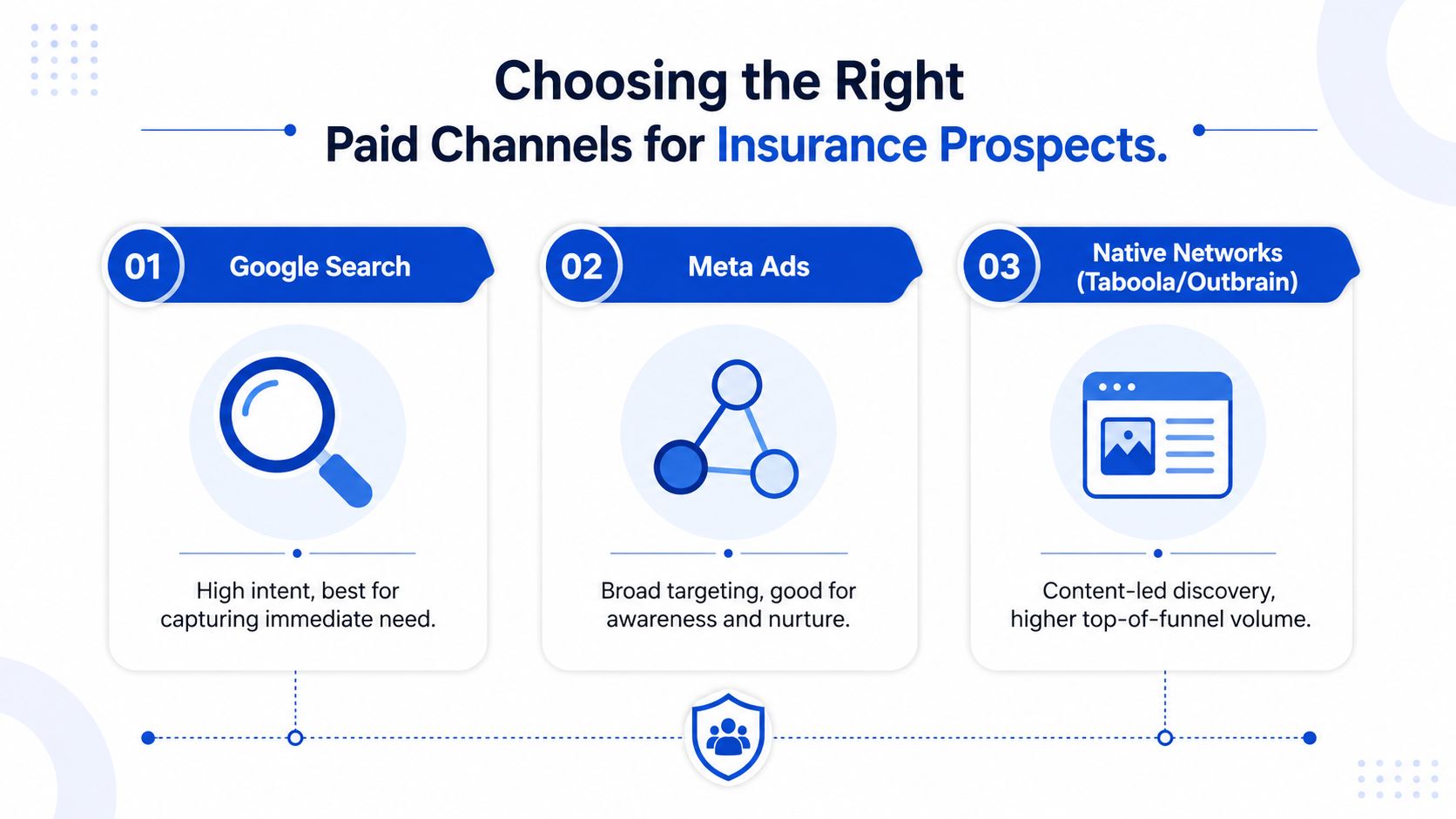
Channel selection should follow the prospect's state of mind, not the platform your team happens to know best. Google Search captures an explicit request. Meta creates demand and supports nurture. Native networks introduce a topic through content and can widen the audience, but they generally require more careful qualification and follow-up.
Match intent to the product
Google Search is usually the cleanest starting point when a prospect is actively comparing coverage, requesting a quote, or looking for an agent. The trade-off is competition and policy complexity. Search campaigns need tightly themed ad groups, negative keyword discipline, location controls, and landing pages that continue the promise made in the ad.
For auto and home, immediate quote language can work when the form asks enough context to route the inquiry correctly. For life and health, educational framing often reduces confusion before the form requests sensitive or qualifying information. Avoid making coverage, savings, eligibility, or outcome claims your operation can't substantiate.
Meta Ads can reach people before they search. That makes the channel useful for life, final expense, health, and other products where education and retargeting matter. Native lead forms reduce the jump to an external page, while landing-page funnels give you more control over disclosures, qualification, analytics, and buyer-specific routing. The compromise is familiar: lower friction can produce more submissions, but those submissions may need stronger filtering and nurture.
Native networks, including Taboola and Outbrain, work best when the creative earns a click through a useful question rather than a blunt sales pitch. A content-led advertorial can explain a coverage issue, then move the visitor into a clearly disclosed quote or eligibility flow. This route can generate broad discovery volume, but the form must make intent explicit before the lead enters a sales queue.
Build a channel mix you can audit
Don't blend every source into one campaign and judge performance by blended CPL. Preserve source, campaign, creative, placement, and click identifiers so you can compare buyer acceptance, contactability, and revenue by channel.
A practical allocation starts with one high-intent search segment, one controlled social test, and native only after the team can handle additional qualification. Give each channel its own disclosure review, suppression rules, creative library, and reporting view. A source that produces fewer leads but materially better acceptance can deserve more budget than a channel that wins the front-end conversion report.
Building Multi-Step Forms That Qualify Without Killing Conversion
Insurance forms fail on mobile when they ask for a dense block of information before explaining the next step. They also fail when they collect almost nothing and send every submission to sales. The answer isn't maximum simplicity. It's controlled friction, where each question earns its place by improving routing, buyer fit, or contactability.
Multi-step design can make a complicated request feel manageable. A widely quoted benchmark says multi-step forms can convert up to 300% better than single-page forms. Treat that as a testing reference, not a promise. The right result depends on traffic intent, product complexity, disclosure placement, and the quality threshold your buyer uses.
Put the easiest commitment first
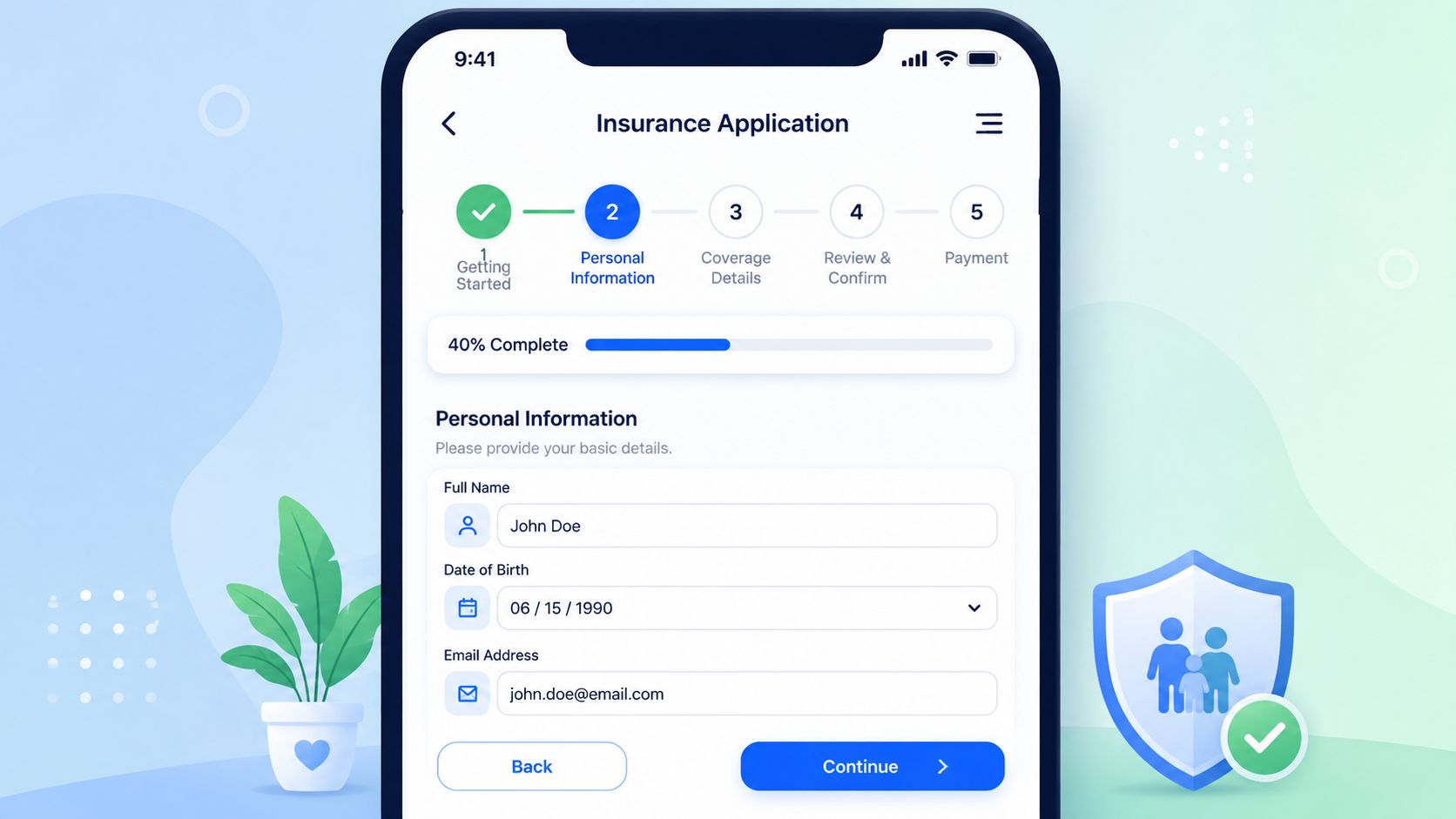
Start with a low-effort question that confirms relevance, such as the insurance product or the applicant's broad location. Then introduce questions that determine eligibility, urgency, ownership, or routing. Keep the most sensitive fields until the user understands what they're requesting and who may contact them.
A strong mobile flow usually includes:
- A visible progress indicator: Show the number of stages without making the journey feel endless.
- One decision per screen: Use large tap targets, short labels, and answer options that don't require typing.
- Inline validation: Flag an invalid phone or email before submission, not after the lead has been sold.
- Logic jumps: Skip irrelevant questions and route disqualified prospects to an appropriate outcome.
- A review step: Let the user confirm key details before the consent action.
The first questions should separate product and market fit. Later questions can gather contact details, coverage preferences, and context needed by the agent. Don't ask an agent-specific question if the answer won't change routing or qualification.
Test quality against completion
A higher completion rate can be a false win if buyer rejection rises. Conversely, a lower completion rate may be acceptable when the remaining leads are more relevant and easier to contact. Track both sides of the trade-off by comparing completion, verification pass, acceptance, contact, and downstream outcomes for each form variant.
Use a form builder that supports conditional logic, disqualification paths, hidden field capture, and real-time delivery. Growform is one example of a capture-layer tool built for multi-step and quiz-style lead funnels, with integrations for qualification, attribution pass-through, consent evidence, and CRM or distribution delivery. You can also review its insurance quote form templates when deciding how to structure a mobile-first flow.
Don't hide the consent disclosure behind a tiny link or bury it after the submit action. The form should make the request, the potential contact method, and the relevant seller relationship understandable at the moment the consumer acts.
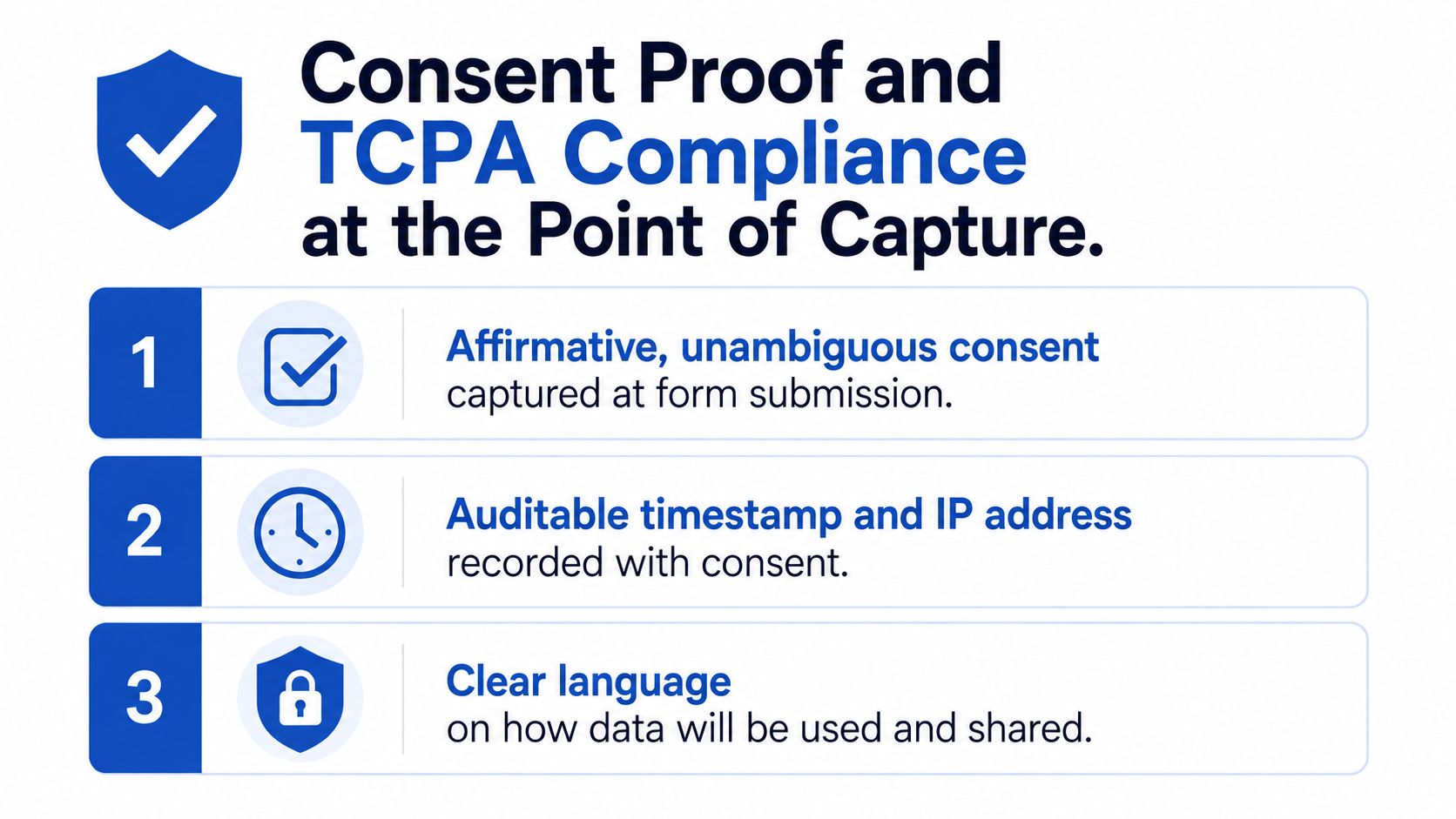
Consent Proof and TCPA Compliance at the Point of Capture
Consent isn't a CRM checkbox. It's an event that must remain connected to the lead from the first page view through distribution, call handling, and any later audit.
Best-practice implementations preserve the timestamp, IP address, form URL, displayed disclosure, and affirmative consumer action, as ActiveProspect describes. A buyer needs more than a field marked “yes.” The record should show what the person saw and how they expressed agreement.
Design the disclosure as part of the product experience
The disclosure should be clear, conspicuous, and specific. If several sellers or a seller category may contact the consumer, the wording and presentation must accurately describe that possibility. Don't rely on a generic statement that suggests a vague group of partners if the intended distribution model requires more precise identification.
Capture the rendered disclosure, not only the text stored in a back-office template. Creative, page, form version, and routing logic can change. Without a versioned record, an operator may know the current wording but have no reliable evidence of what a particular consumer encountered.
A consent payload should travel with the lead and remain retrievable. Useful fields include:
- Event metadata: timestamp, IP address, page and form URL, user action, and form version.
- Disclosure evidence: the exact displayed language and seller or seller-category information.
- Source context: campaign, ad, placement, click identifier, and landing-page path.
- Distribution record: buyer, route, delivery time, response, and any rejection reason.
Treat compliance as a monetization requirement
Buyer consent requirements and state mini-TCPA rules can affect how many buyers may receive a lead and how much the lead costs. The FCC's one-to-one consent rule, which would have limited each consent to a single seller, never took effect: the Eleventh Circuit vacated it on 24 January 2025 in Insurance Marketing Coalition v. FCC. Our TCPA guide for lead generation operators covers where that leaves shared distribution (reviewed 30 September 2026).
Operationally, weak proof can cause rejection even when the prospect is genuine. Build a consent review into campaign launch, form changes, buyer onboarding, and vendor evaluation. A dedicated TCPA compliance checklist for lead forms can help teams inspect the capture layer before they scale traffic.
Attribution, Verification, and Real-Time Lead Routing
The lead flow should behave like one pipeline, not a chain of disconnected tools. An ad click creates source data. The form preserves it. Verification determines whether the submission is usable. Consent evidence travels with the payload. The distribution layer sends the record to the right buyer, agent, or call workflow.
Start with hidden fields for UTMs, source names, sub-IDs, and click identifiers such as gclid and fbclid. Store them across every form step and pass them into the CRM or buyer payload. If those fields disappear at the form boundary, the reporting system may credit the wrong source and make a weak campaign look profitable.
Use server-side signals with browser tracking
Pixel-only reporting is fragile, particularly when browser restrictions, consent settings, or platform measurement limits interrupt the event. Meta Conversions API and Google server-side conversion signals can give ad platforms a stronger feedback loop, provided the events are configured consistently and the organization handles consent appropriately.
Don't optimize the ad account on submitted leads if the business can send back accepted or qualified outcomes. That requires a stable event taxonomy. Define what counts as a lead, verified lead, accepted lead, qualified conversation, and sale. Keep event names and source identifiers consistent across ad platforms, forms, CRM stages, and buyer reports. A dedicated guide to campaign attribution for lead generation is useful when hidden fields, click IDs, and downstream conversion events aren't lining up.
Verify before you distribute
Phone and email checks can remove obvious errors before a record reaches a buyer or call center. Use verification to flag invalid numbers, disposable email addresses, duplicates, bot-like behavior, and mismatched fields. It shouldn't become an excuse to reject legitimate prospects through overly aggressive rules, so compare verification outcomes with buyer acceptance and contact results.
Routing should happen through webhooks or native distribution integrations, with failure handling built in. Boberdoo, Phonexa, and LeadsPedia can support lead distribution workflows, while Ringba and Retreaver can connect call activity to source and buyer outcomes. A Harvard Business Review study found that firms contacting a web lead within an hour were nearly 7 times more likely to qualify it than firms that waited even an hour longer, and more than 60 times more likely than firms that waited 24 hours or more. The operational target is therefore immediate routing, ideally into an agent, dialer, SMS workflow, or live transfer process within minutes.
Integrating Your Lead Stack Without Breaking the Flow
Choose integrations based on where decisions happen. A distribution platform is valuable when multiple buyers, ping and post rules, caps, filters, and pricing conditions determine the route. A CRM is better when one sales organization owns the lead and needs lifecycle management, agent assignment, task automation, and reporting.
Native integrations usually reduce field-mapping errors and simplify troubleshooting. Zapier is useful for lighter workflows and rapid experiments, but it can become difficult to govern when delivery timing, retries, consent evidence, and buyer responses affect revenue. Custom webhooks provide more control, though they require clear ownership for authentication, validation, logging, retries, and alerting.
| Tool Category | Examples | Best For | Integration Method | Compliance Support |
|---|---|---|---|---|
| Lead distribution | Boberdoo, Phonexa, LeadsPedia, Databowl | Multi-buyer routing, caps, filters, and ping/post workflows | Native delivery, webhooks, API connections | Preserve consent and source fields in buyer payloads |
| CRM | HubSpot, Salesforce, GoHighLevel | Agent assignment, nurture, pipeline management, and sales reporting | Native integrations, middleware, or webhooks | Store consent evidence and contact permissions with the lead |
| Verification | Twilio, ZeroBounce | Phone and email validation before handoff | API or native workflow step | Record verification status and rejection reason |
| Call tracking | Ringba, Retreaver | Call attribution, buyer routing, and call outcomes | Dynamic numbers, postbacks, and webhooks | Connect call records to source and consent records |
| Form capture | Multi-step form platforms and custom forms | Mobile qualification, conditional logic, and disclosure capture | Embed, native integration, or webhook | Capture the full consent event, not only a CRM value |
The payload contract matters more than the brand name. Define required fields, accepted formats, duplicate rules, consent evidence, response codes, and retry behavior before connecting the tools. Then test a real submission from ad click to buyer response, including a failed delivery and a rejected lead.
What a Fully Operational Insurance Lead Flow Looks Like
A working flow begins with a channel-specific promise. A Google Search visitor might land on a quote page tied to the exact product and location they searched. A Meta visitor may enter through an educational creative and need more context before the form asks for contact details. Native traffic may require the most careful separation between editorial content and a commercial request.
The visitor completes a mobile-first multi-step form. Early questions confirm product, geography, and basic fit. Conditional logic removes irrelevant screens. The final stage presents the applicable disclosure and records the affirmative action together with the form version, timestamp, IP address, page URL, and source identifiers.
The system then verifies the phone and email, checks for duplicates, and sends the payload through a webhook. A CRM can assign the lead to an agent, while a distribution platform can apply buyer rules or initiate a live transfer. The lead's status should return to the reporting layer so campaign managers can see more than front-end form activity.
Measure the complete chain
Track these metrics by channel, campaign, creative, form version, buyer, and agent:
- Click-through rate: Does the advert earn a qualified visit?
- Form completion rate: Can mobile users finish the experience?
- Consent capture rate: Do completed submissions include usable evidence?
- Verification pass rate: Are the contact details plausible and reachable?
- Speed to lead: How quickly does the first action occur after submission?
- Buyer acceptance rate: Which sources meet buyer rules?
- Qualified conversation rate: Which accepted leads produce meaningful contact?
- Policy outcome: Which segments create durable commercial value?
A launch checklist should include creative and policy review, disclosure review, mobile testing, hidden-field validation, duplicate handling, verification tests, webhook retries, buyer acceptance tests, and agent response drills. Don't scale until a test record can be found in every downstream system with its attribution and consent evidence intact.
The strongest insurance lead gen operation isn't the one that produces the most submissions. It's the one that turns paid attention into verified, accepted, quickly routed opportunities while keeping the evidence needed to defend every contact.
Growform helps teams build mobile-first multi-step insurance forms with conditional qualification, consent evidence, attribution pass-through, and real-time delivery into CRMs or lead distribution platforms. If your current funnel is losing buyers through weak qualification, broken tracking, or slow handoffs, fix the capture layer before increasing media spend. Start free trial to build your first insurance form on the 14-day free trial.
Related articles
High-Converting Insurance Quote Forms: A Practical Guide
Insurance quote forms have to ask for far more fields than a typical lead form, so every field, branch and webhook has to earn its place.
September 30, 2026
Home Services Lead Generation: A Practical Playbook
You’ve paid for the click, the homeowner has completed the form, and the notification arrives after dinner. By the time someone on the team sees it the next morning, the prospect has already called another contractor. Worse, some submissions were never serviceable, never urgent, or never a fit for the crew in the first place….
September 30, 2026
Mass Tort Leads: Buy, Sell, & Qualify Guide 2026
Mass tort lead economics get ugly fast.
September 30, 2026