

Mass tort lead economics get ugly fast. In one 30-day snapshot across nine actively litigated torts, $1.03 million in reported advertising spend produced 9,227 qualified leads and only 814 signed cases. That's about $112 per qualified lead and roughly $1,265 per signed case, a reminder that mass tort lead generation can scale into seven figures while still converting only a small slice of traffic into retained matters, especially when intake quality is weak or compliance proof is missing (Mass Tort Ad Agency data, published in the National Law Review).
The mistake is treating a raw lead as the unit of value. In this market, the key unit is the qualified claimant or the signed retainer, because funnel leakage, duplicate records, and poor screening can wipe out cheap top-of-funnel economics before a lawyer ever reviews the file. That's why serious buyers look at signed-case efficiency, not just CPL, and why the cheapest lead is often the most expensive after intake fallout.
Understanding Mass Tort Lead Economics
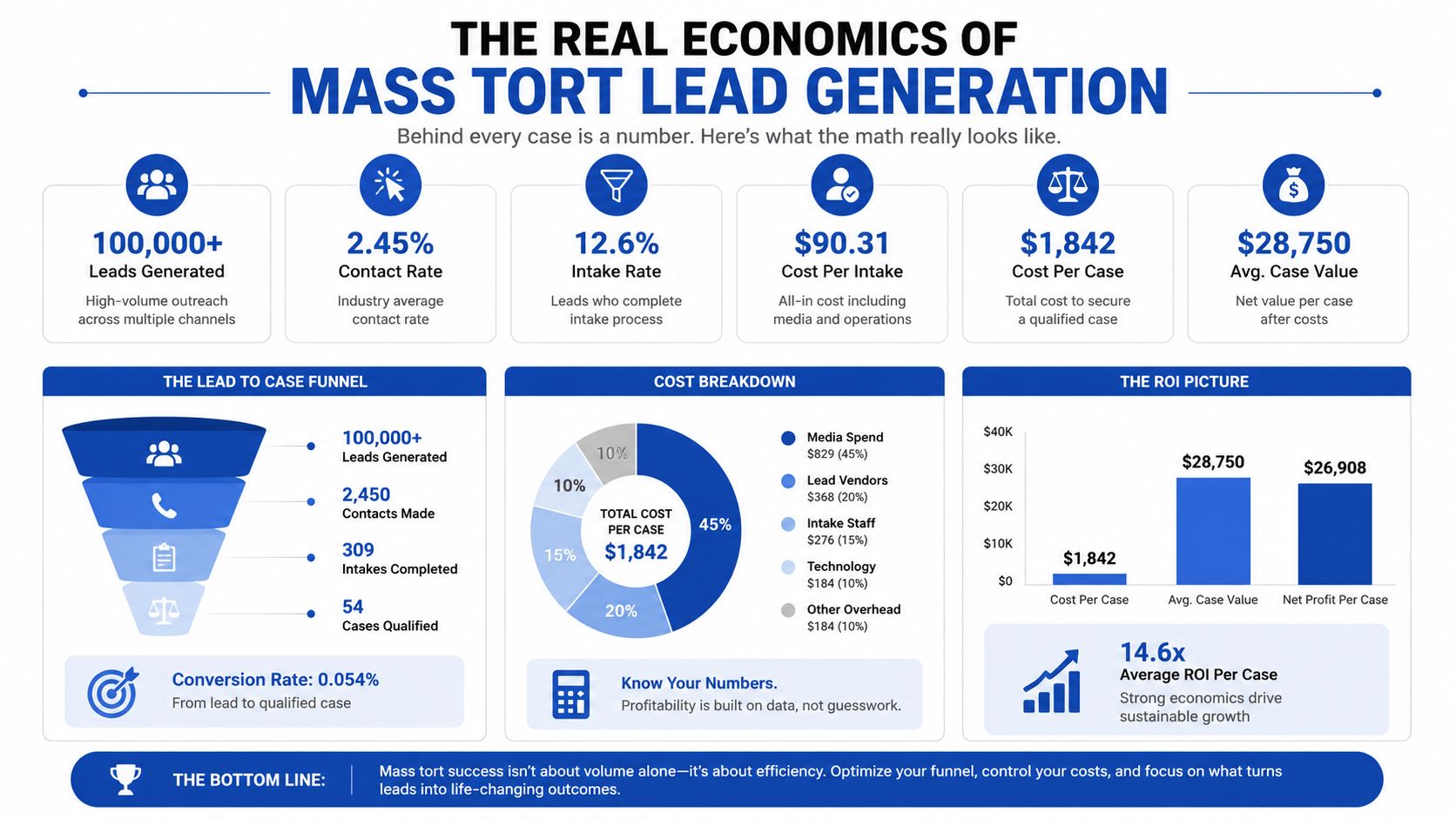
Mass tort acquisition does not behave like ordinary consumer lead buying. The economics are usually decided after intake, when a low-cost form fill turns into a rejected file, a no-response caller, or a retainer that never signs. That is why the only useful benchmark is signed-case efficiency, not raw lead volume. The Mass Tort Ad Agency dataset quoted above showed a 30-day snapshot with $1.03 million in ad spend, 9,227 qualified leads, and only 814 signed cases. The same dataset also showed wide dispersion by tort, with cost per lead ranging from about $84 for IEEPA tariff-refund claims to $322 for birth-injury cases, and Dupixent claimant acquisition running about $1,649 per case.
Why cheap traffic lies
A low CPL can hide a broken funnel. If the lead does not include exposure evidence or a usable timeline, the intake team pays for the missing information later through call-backs, manual scrubbing, and buyer rejection. That is why experienced operators judge campaigns on whether the lead survives qualification and becomes a retainer, not on whether it fills a form.
The market guides back that up. Mass Tort Ad Agency's 2026 guide puts raw CPL at $15-$50 in most torts but cost per signed case at $800-$3,500, while another industry estimate says raw leads can trade at $50-$400 and signed retainers at $500-$5,000+ depending on demand and stage. The spread is the business model, and it explains why a cheap lead often ends up costing more than an expensive one.
The baseline lesson is simple. Mass tort leads only work when the buyer can see how the claim will survive screening, contact, and review. Anything less becomes expensive tire-kicking.
The Three Fields That Determine Lead Value
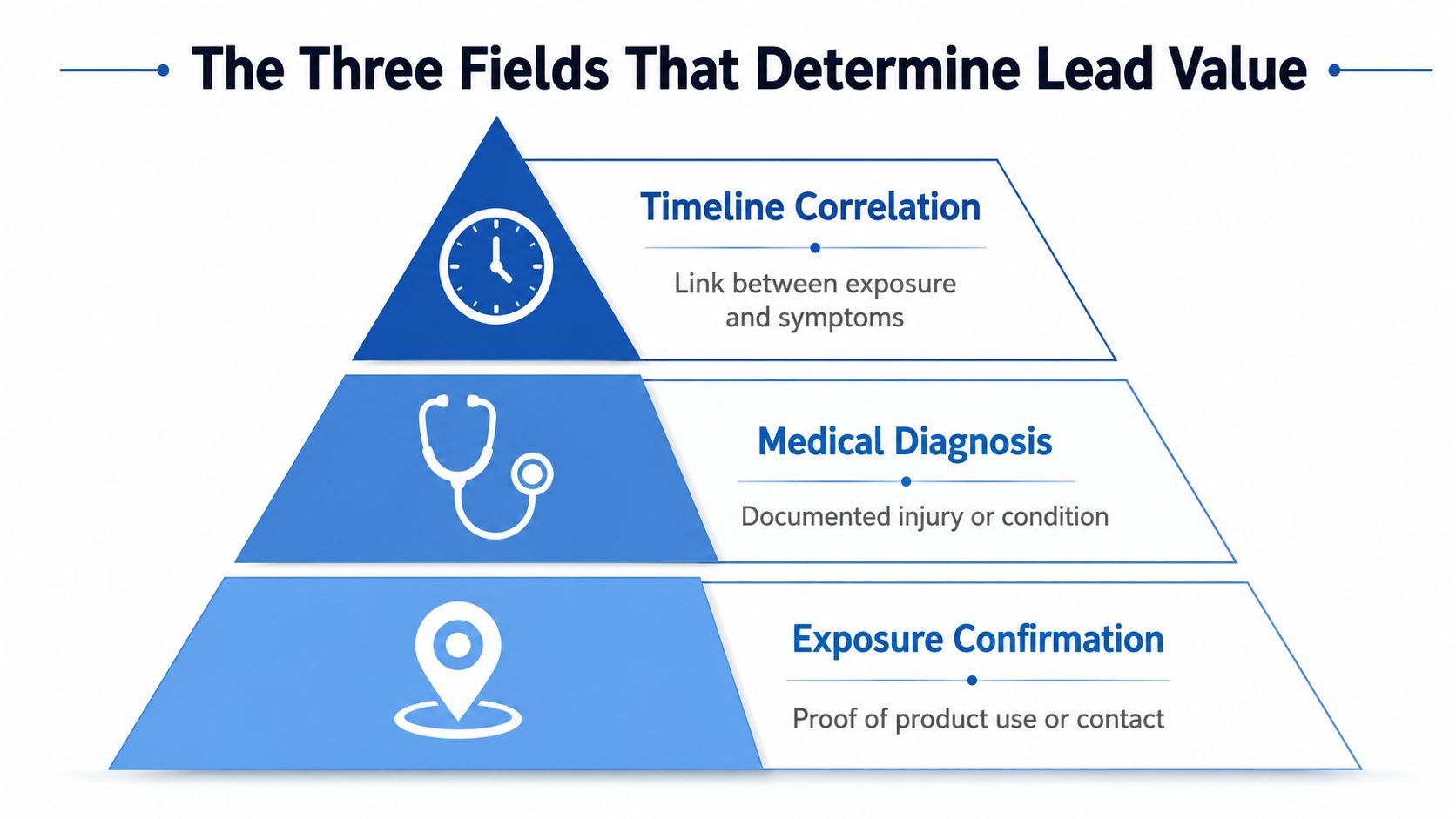
A lead looks cheap until intake starts filling in the blanks. The quickest way to separate usable mass tort leads from expensive noise is to judge three evidentiary fields, exposure confirmation, medical diagnosis, and timeline alignment. A practical leadgen framework puts those fields at the center because they show whether the person was exposed, has the relevant condition, and fits the injury window. The form handles exposure and timeline. The diagnosis is confirmed by the firm on the intake call, where its confidentiality obligations apply, so no medical detail goes into a marketing form.
What to capture before attorney review
The intake form should collect the structure needed for a file that can survive review. That usually means jurisdiction, exposure timeframe, and representation status before the lead reaches legal review. Leave those fields out, and someone downstream has to rebuild the record by phone, which pushes acquisition cost up and slows the whole buy.
- Exposure confirmation: ask where, how, and when the product or environment was encountered.
- Timeline alignment: verify that the exposure dates line up with the qualifying window for the docket.
- Jurisdiction and status: collect state, statute-relevant timing, and whether another firm already has the matter.
Why routing matters
Strong operators do not send every submission to attorney review. They route high-probability claims to legal staff and send weaker files into a lower-cost triage path, or reject them outright. That keeps lawyer time focused on matters that can turn into retained cases and keeps duplicate or unqualified claims from inflating the cost of acquisition.
Speed still matters after the form is submitted. Near-instant CRM delivery is now the expectation for speed-to-lead. Slow handoff lowers contact rates and gives competing buyers more time to reach the same prospect first.
The signed retainer is the last step, not the first signal of value. Buyers who want better signed-case economics build intake around the three fields above, then use the rest of the workflow to confirm whether the lead belongs in legal review at all.
Pricing Across Different Tort Types and Case Stages
Mass tort pricing rarely lines up neatly across dockets, and that inconsistency is the point. A campaign can look costly on CPL and still be the better buy if the docket is mature, the competition is intense, and signed-case economics hold up. A lower-priced channel can still burn cash if the tort is early, underqualified, or not yet generating dependable demand.
Benchmarks that change the conversation
The figures below are from April 2024 and will have moved since. A 2024 benchmark set showed April 2024 cost per lead estimates of $1,300–$3,000 for Camp Lejeune, $1,400 for Roundup, $490–$1,200 for Ozempic, $2,700 for AFFF, $430 for Hair Relaxer, and $470 for Talcum Powder (mass tort leads benchmark). The same source reported average cost per signed case at $2,650–$3,300 for RoundUp, $2,600–$3,400 for Talcum Powder, $900–$1,300 for Zantac, $350–$750 for GLP-1 weight-loss drugs, $750–$1,000 for Bard PowerPort, and $1,900–$2,400 for AFFF.
| Tort type (April 2024) | Cost per lead | Cost per signed case |
|---|---|---|
| Camp Lejeune | $1,300–$3,000 | not reported in source |
| Roundup | $1,400 | $2,650–$3,300 |
| Ozempic | $490–$1,200 | not reported in source |
| AFFF | $2,700 | $1,900–$2,400 |
| Hair Relaxer | $430 | not reported in source |
| Talcum Powder | $470 | $2,600–$3,400 |
| Zantac | not reported in source | $900–$1,300 |
| GLP-1 weight-loss drugs | not reported in source | $350–$750 |
| Bard PowerPort | not reported in source | $750–$1,000 |
What the spread really means
Established dockets with heavy competition can cost several thousand dollars per retained case, and the math still works because the funnel is understood and buyer confidence is high. Newer or lower-awareness categories can convert at materially lower rates, but only when screening is tight and the audience fits the claim profile. The question is not whether one tort is better, it is whether your acquisition model matches the stage and demand behind that tort.
Expensive leads are often expensive for a reason. They are more likely to carry the case attributes that keep buyers in the deal.
That cost spread also changes as a docket matures. Early in a litigation, pricing is often driven by uncertainty and the need for broader reach. As awareness builds and intake teams see clearer patterns, buyers get more selective, weak files get filtered earlier, and the same lead source can move from attractive to overpriced without the media mix changing at all.
When to Scale, Pause, or Reallocate Budget Based on Litigation Health
A lot of lead-gen advice assumes the tort itself is stable. It isn't. Recent MDL developments, Daubert rulings, bellwether outcomes, and statute windows can change buyer appetite quickly, which is why spend decisions should follow litigation health, not just channel performance.
Don't confuse demand with durable demand
When the defense posture hardens or scientific support weakens, traffic volume can keep flowing while economics deteriorate. That's the trap. The ads still run, the form still converts, and the buyer still pays for names, but the case value behind those names has changed.
The smarter posture is to use the current docket status as a budget filter. If a tort is benefiting from favorable movement, you can justify more aggressive testing. If rulings are turning or the window is narrowing, the better move may be to slow spend, tighten qualification, or redeploy budget into a stronger docket.
A simple decision framework
- Scale carefully: when the litigation posture is improving, buyer demand is stable, and screening criteria are clear.
- Pause and re-check: when rulings, scientific support, or claim windows are shifting enough to change case viability.
- Reallocate quickly: when the same traffic is producing weaker signed-case outcomes than another active docket.
Operators get channel tactics, but they rarely get a decision model for whether the tort deserves more capital in the first place. That's how firms keep buying volume in a docket that no longer deserves it.
The right question isn't, “Can we get more traffic?” It's, “Should we be buying this traffic at all, given where the litigation stands?”
Compliance Requirements and Consent Evidence Capture
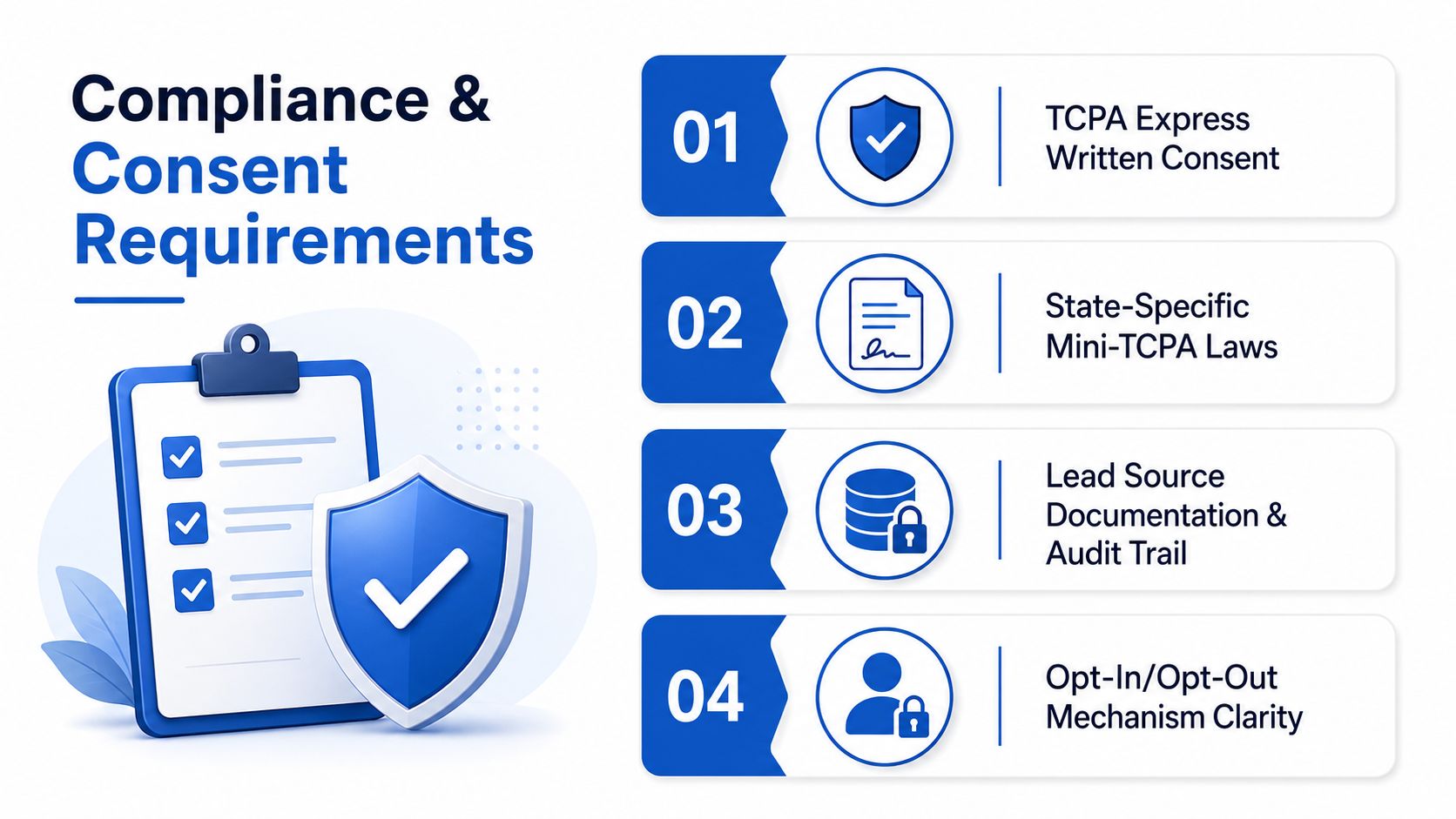
Mass tort buying lives or dies on proof. If a lead can't show consent, it's hard to defend the acquisition, hard to resell, and hard to stand behind when a buyer asks for the audit trail. That's why teams need TCPA express written consent, state-specific mini-TCPA awareness, and source documentation built into the capture flow from day one.
Build the evidence where the lead is born
Consent proof shouldn't be assembled later from screenshots and guesses. It needs to be captured at the point of opt-in, with the lead source, timestamp, and consent language preserved in the handoff. Buyers and networks are asking for screening criteria, replacement policies, and compliance proof, not verbal reassurance.
For a plain-English rundown of the underlying call and text rules, the TCPA guidance for lead gen operators is a useful reference point. The practical takeaway is that the compliance layer isn't separate from the funnel, it is the funnel.
What the capture stack needs
A credible lead file usually depends on a few technical pieces working together:
- Native consent capture: the opt-in language and checkbox state need to be stored with the submission.
- Audit trail preservation: source and timestamp data should stay attached to the record.
- Clear opt-in and opt-out handling: the buyer must know how the lead agreed to be contacted.
- Documentation-ready delivery: the payload needs to travel with the lead, not sit in a separate system.
Buyers get nervous fast when consent evidence is uncertain. Campaigns pause, relationships cool, and the lead source gets scrutinized line by line. If compliance is bolted on after launch, you usually find out the hard way that the entire traffic source is harder to defend than it looked on day one.
Technical Capture and Real-Time Delivery Best Practices
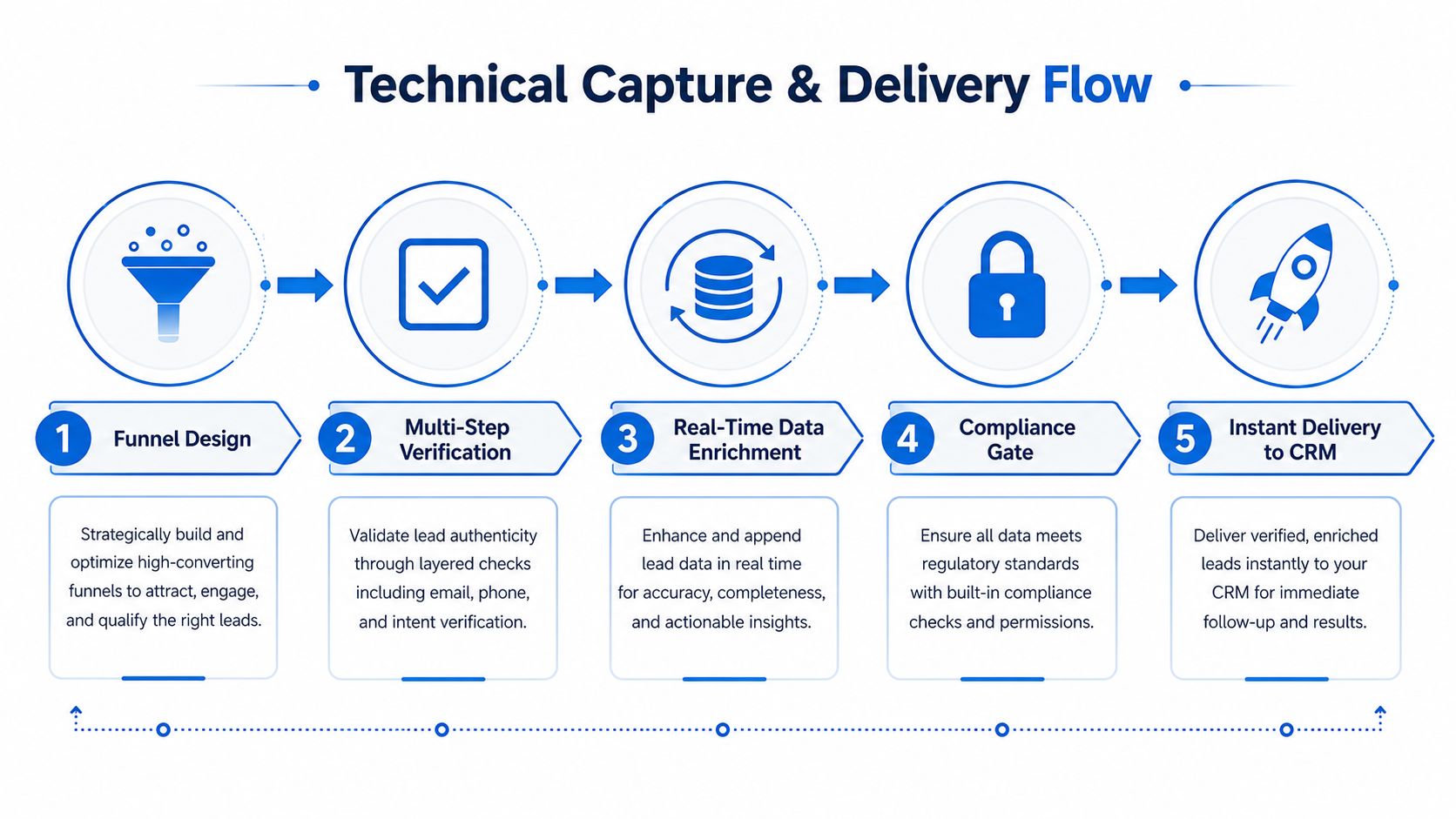
Cheap traffic usually gets expensive at the handoff. If the form is sloppy, the verification is thin, or the delivery lags, intake ends up paying for cleanup instead of case review. The better setup captures cleaner records up front, blocks bad submissions before they spread, and moves qualified leads fast enough to preserve contact intent.
Keep the flow moving
Progress indicators help people finish longer forms because the process feels finite. Conditional logic does the rest of the work, since harder questions only appear after an earlier answer makes them relevant. That keeps the form useful without forcing every visitor through a wall of fields.
Capture the consent trail at the point of submission, not after the fact. Store the opt-in language, checkbox state, source data, and timestamp with the record so the file can be defended later. For a practical walkthrough of how that kind of setup is typically implemented, the Jornaya form implementation guide shows the mechanics in plain terms.
Verify before you distribute
Real-time phone and email verification filters out fake submissions, bot traffic, and records that never had a real chance of converting. If a lead fails that check, it should not reach a buyer queue just so the buyer can pay to discover the same problem again. That gate protects speed and credibility at the same time.
Delivery timing matters just as much as verification. Native webhooks, CRM pushes, and instant alerts keep a qualified submission moving while interest is still fresh, and buyers now expect that handoff to happen fast.
Hidden fields should carry UTMs, click IDs, and source data through the flow so attribution survives the handoff. If that breaks, the team loses visibility into which traffic produced usable files and which traffic only produced clutter. The operating model is straightforward. Capture cleanly, verify fast, and deliver immediately.
How Buyers Evaluate a Lead Before It Hits Intake
Cheap lead volume looks attractive to a buyer until they start paying for cleanup, duplicate review, and intake time on files that were never likely to convert. A lead that arrives with stronger documentation and cleaner consent evidence often costs less in the signed-case math than a bargain record that creates downstream friction. That is the filter your buyers use before money changes hands, so build your offer around it.
Show proof, not promises
Before a firm commits budget, expect it to ask for your screening criteria, historical conversion ranges by tort, your replacement policy, and your consent evidence. It will ask how each submission was qualified, what exposure fields you capture, and how you screen out records that do not belong in the docket. Sellers who can answer those questions with a documented process keep their buyers. Sellers who cannot are asking the firm to cover their uncertainty.
Write the replacement policy down before the first buy: which rejection reasons earn a replacement (duplicate, wrong tort, outside the qualifying window, already represented, unreachable) and how long the buyer has to return a lead. The best buyer conversations sound operational, not promotional. The firm wants to know what gets screened out, how duplicates are handled, what evidence is attached, and how you respond when a lead fails compliance review. For a practical way to tighten that process, see the guide to verifying leads in real time or in bulk.
Cheap leads can still be overpriced
A lower CPL means little to a buyer if the lead is shared across multiple firms, lacks documentation, or never matches the tort criteria. That is why lead quality verification before purchase matters more than raw lead price, and why sellers who verify before they post hold their pricing.
The same logic applies to the consent payload. If a buyer cannot defend the file internally, it will be hard to defend it externally too, so each lead should carry the opt-in language, timestamp, source and sub-ID, and the TrustedForm or Jornaya certificate in the same post as the contact details. Run that checklist against every campaign you sell and fix any source that cannot produce exposure detail, qualifying dates, and consent evidence in one payload.
If you are building mass tort forms that need cleaner qualification, better consent capture, and faster handoff to intake, Growform gives you the capture layer to do it without dragging engineering into every change. The mass tort intake form template asks the case, the date of first use, and legal representation before contact details, and Growform can send each lead with its UTMs and TrustedForm or Jornaya certificate to your buyer or distribution platform. Start free trial to build yours on the 14-day free trial.
Related articles
Insurance Lead Gen: The Complete Playbook for 2026
“Get more insurance leads” is still the typical advice many receive. It's also the fastest way to hide a broken funnel.
September 30, 2026

High-Converting Insurance Quote Forms: A Practical Guide
Insurance quote forms have to ask for far more fields than a typical lead form, so every field, branch and webhook has to earn its place.
September 30, 2026

Home Services Lead Generation: A Practical Playbook
You’ve paid for the click, the homeowner has completed the form, and the notification arrives after dinner. By the time someone on the team sees it the next morning, the prospect has already called another contractor. Worse, some submissions were never serviceable, never urgent, or never a fit for the crew in the first place….
September 30, 2026