
Credit repair lead generation: 17 ways to get credit repair leads
Credit repair businesses need to refine their approach, ensuring they’re not just part of the conversation but leading the dialogue.

Updated Published 16 min read
Credit repair is a business where the client finds you at a low point. Somebody has been turned down for a mortgage, a car loan or an apartment, and they are searching for help on their phone that evening. Credit repair lead generation is about being the business they find, and making it easy for them to ask.
Credit repair lead generation is the process of attracting people with poor credit who want help fixing it and collecting their contact details, through channels such as local search, paid advertising, partnerships and referrals, so that a credit repair business can follow up and sign them as clients.
This guide is written for credit repair businesses that generate their own leads rather than buy them. It covers 17 ways to get credit repair leads, from the free channels that compound slowly to the paid channels that can be switched on this week, which between them make up most of what gets called credit repair marketing. It ends with the form that every one of those channels depends on.
One note before the tactics. Advertising for credit repair services is governed by the Credit Repair Organizations Act, which prohibits untrue or misleading representations and requires certain disclosures. The channels below work with honest claims about what you do, and that is how they are written.
1. Get seen with a Google Business Profile
If you have not already, set up a Google Business Profile. It is free, and it is what puts your business on Google Search and Google Maps when somebody nearby searches for credit repair.
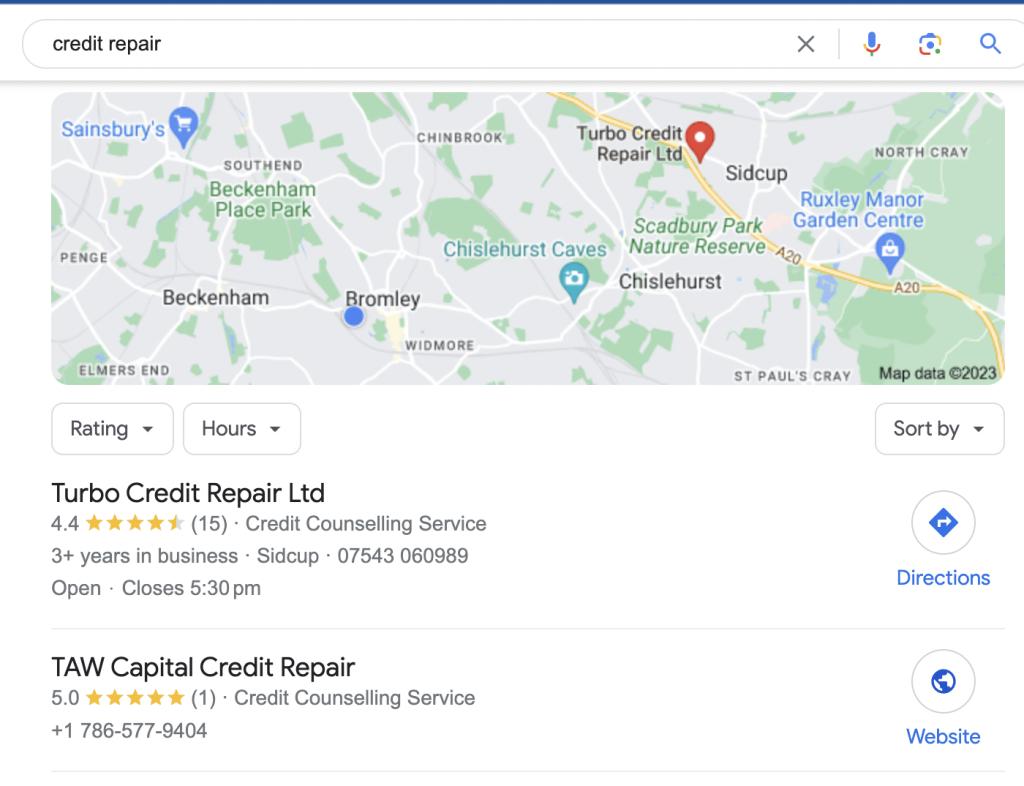
Local searches are some of the highest-intent credit repair leads you will get. The person has typed "credit repair near me" or "credit repair [city]", and the map pack shows three businesses with their ratings, hours and a call button. Being one of those three brings calls without an ad budget.
Your profile also works as a direct line to the client. Fill in the categories, the services, your hours and a description that says who you help, and add photos of your office and team so the listing looks like a real business rather than a placeholder.
The biggest lever is reviews. A profile with recent, specific reviews from clients whose scores you improved will be chosen over one with none, so ask for a review at the moment a client gets good news, and reply to every review you receive.
2. Revamp your landing page
Every channel in this guide sends people to a page, and that page decides how many of them become credit repair leads. The job of the page is to show that you understand their situation and to make the next step small.
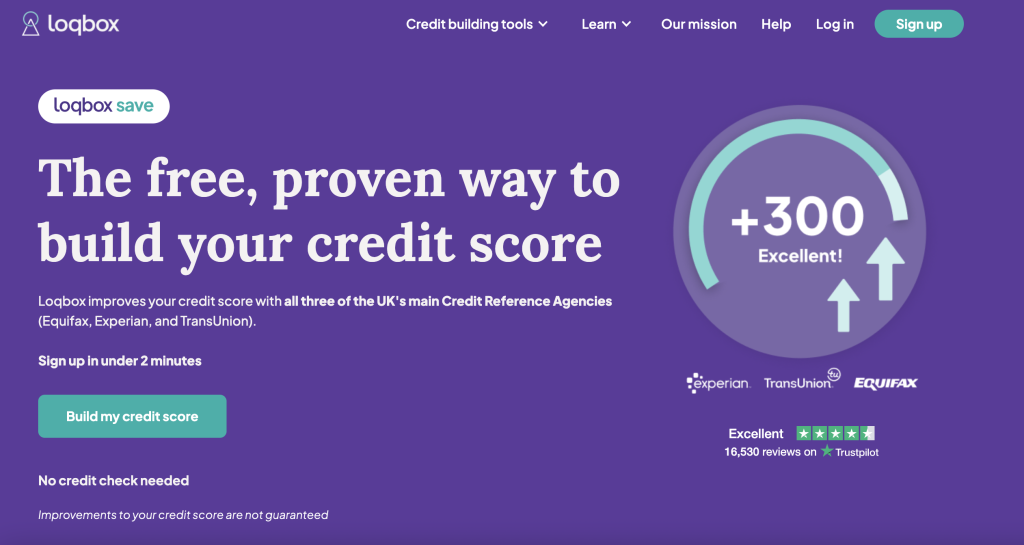
A credit repair landing page that converts is clear and short. It names the problems you fix, such as collections, late payments, charge-offs and errors on a report, it explains what happens after someone gets in touch, and it carries one call to action, usually a free credit review or consultation.
Social proof carries more weight here than in most industries, because the visitor has probably been let down before. Reviews with names, the number of clients helped, your years in business and any accreditations belong near the top. The landing page examples we have collected show how other industries lay this out.
Headlines work best when they speak to the outcome the visitor wants. "Turned down for a mortgage? Let's find out why" or "Fix the errors on your credit report" tell the reader they are in the right place. Avoid promising a score or a timescale you cannot guarantee.
Most visitors will arrive on a phone, often late in the evening, so check the page on a phone first. Large text, a tap-to-call button and a form that fits one screen at a time matter more than anything on desktop.
3. Post on social media
Organic social media costs time rather than money, and for credit repair it works because the subject is something people quietly worry about and rarely ask friends about. A business that explains it plainly earns trust before the first call.

Start where your clients are. For most credit repair businesses that is Facebook and Instagram, where local community groups and short explainer videos reach people who are not yet searching. YouTube and TikTok suit longer walkthroughs of a credit report or a dispute letter.
Post the questions you answer on the phone every day. What a hard inquiry does to a score, how long a collection stays on a report, what to do after a denial letter. Short, specific and repeated is what builds an audience, and every post should point somewhere, whether that is your profile link or a free review.
Reply to comments and messages quickly. A question under a post about collections is a lead, and the person who asked it will go with whichever business answers first.
4. Go to networking events
Networking events put you in front of the people who meet your future clients every day: mortgage brokers, real estate agents, car sales managers, apartment leasing agents and bankruptcy attorneys.
Your introduction should be short and specific. "We help people who have been turned down for a mortgage get approved within six to twelve months" tells a mortgage broker exactly when to think of you, which is more useful than a general description of credit repair.
Ask about their business before you talk about yours. A broker will tell you how many applications they lose to credit each month, and that number is the start of a referral conversation.
The follow-up is where the lead is won. Send a short email or a connection request within a day, offer a referral card or a co-branded flyer for their office, and check in once a month with something useful rather than a sales pitch.
5. Start email marketing
Email marketing turns the people who were not ready today into the clients of next quarter. In credit repair, the gap between first contact and signing up can be weeks, and a steady email keeps you in mind without a phone call.
Build the list from your website. Offer something people want in exchange for an email address, such as a guide to reading a credit report, a checklist for disputing an error or a short course on rebuilding credit after bankruptcy.
Once the list is growing, write to it regularly and keep the sales pitch to a line at the end. Explain one thing per email: how a utilization ratio works, what a goodwill letter is, what changed in a credit scoring model. Include a short client story where you have permission to share it.
Watch the replies and the clicks. The people who open every email and click the "book a review" link are the warm credit repair leads, and they deserve a personal follow-up rather than another newsletter.
6. Add a referral scheme
Referrals are the best credit repair leads you will get, because the client arrives already trusting you. A referral scheme makes them happen on purpose instead of by chance.
Offer something to both sides. A month free for the referrer and a discount on the setup fee for the new client is a common structure, and a small gift card works where a discount does not fit your pricing.
Tell clients about the scheme at the moments they are happiest, which is when a negative item comes off their report or when they get approved for the loan they came to you for. Put a line about it in your status emails and a page on your website that explains how it works in two sentences.
Track every referral in your CRM so the referrer is thanked and paid on time. A scheme that pays late stops producing referrals.
7. Get on Facebook ads
Facebook ads are the fastest way to generate credit repair leads at volume, because the audience is enormous and the targeting lets you reach the right places and life stages. The work is in the offer and the landing page, not in the ad itself.
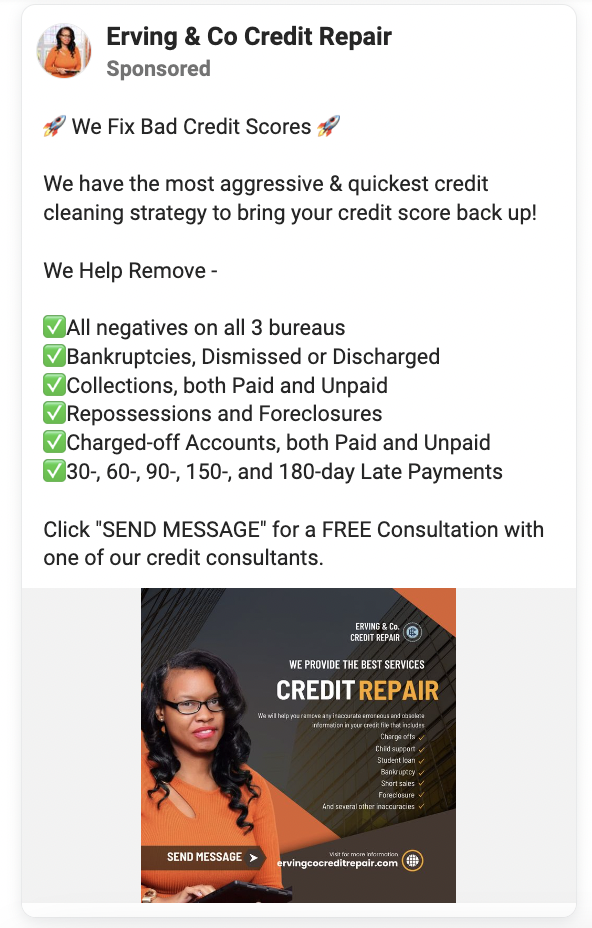
The ads that work name the problem directly. "Turned down for a car loan?" or "Collections holding your score down?" stop the right person mid-scroll. The offer that follows should be free and specific, such as a free credit review or a free consultation, because the person is not yet ready to pay a stranger.
Study what other credit repair businesses are running in the Meta Ad Library. It shows every active ad for any advertiser, so you can see which hooks and offers your competitors have kept running for months, which is the closest thing to a published test result.
Send the click to a landing page with a short form, never to your home page, and keep the UTM parameters attached to each lead so you know which ad produced it. Then measure the whole funnel, not the click. Our cost per lead calculator shows what a campaign has to deliver at your budget, and the number that matters in the end is the cost of a signed client, not the cost of a form fill.
8. Collaborate with an influencer
Personal finance creators have audiences who are exactly the people a credit repair business wants to reach, and their recommendation carries a trust that an ad cannot buy.
Look for creators who talk about budgeting, debt payoff and rebuilding credit, on YouTube, TikTok and Instagram. The right partner is not the largest. A creator with 20,000 engaged followers who answer their comments will send you better credit repair leads than a celebrity account that posts a sponsored story once.
The format can be a mention, a full review of your service or a joint video where you walk through a real credit report together with the viewer's permission. Give the creator a tracking link or a code so you can see what each partnership produced.
Check how the creator talks about money before you sign anything. Your business will be judged by the claims they make for you, so agree the wording in advance and keep it to what you can deliver.
9. Go back to direct mail marketing
In a world where every inbox is crowded, a letter still gets opened. Direct mail suits credit repair because the mail can be targeted by neighborhood and by life event, and because a physical letter feels more private than an ad.
Target the mail rather than spraying it. Neighborhoods with high rental turnover, recent movers and areas near car dealerships you partner with will respond better than a blanket drop.
Make the letter easy to act on. A plain letter that explains one problem you fix, a phone number, a short URL to a landing page and a QR code that opens your form will outperform a glossy postcard with no clear next step. Track each mailing with its own URL or phone number so you know what it produced.
10. Partner with local organizations
Partnerships bring credit repair leads that arrive warm, because a business the client already trusts made the introduction. The two most common partners for credit repair businesses are real estate agents and car dealerships, and both lose customers to credit every week.
A real estate agent or mortgage broker meets buyers who cannot get approved. Instead of losing the buyer for a year, the agent refers them to you, you work on the report, and the buyer comes back to the same agent when they are ready. The mortgage lead generation strategies we have written about describe the other side of that relationship.
Car dealerships see the same problem at the finance desk. A buyer who does not qualify for a loan today is a sale the dealership cannot make, so a referral to you helps the dealership close the sale later.
Make the partnership easy to run. A simple referral form, a named contact at your business and a monthly update on how their referrals are getting on is all most partners need.
11. Host financial literacy seminars
Financial literacy seminars let you show what you know to a room of people who need it, and some of them will need help they cannot do themselves.
One topic that fills rooms is "Understanding your credit score". Walk through the factors that make up a score, how to read a credit report and the first three things anyone can do to improve theirs. Another is "Managing debt effectively", which covers repayment strategies and the effect of debt on credit health.
Partner with libraries, community centers, churches, employers and housing nonprofits, which often want free financial education for their communities and have the room and the audience. Collect contact details at registration and offer a free credit review to everyone who attends, so the seminar produces credit repair leads rather than only goodwill.
12. Create an online course
An online course is a larger piece of work than a seminar, but it keeps producing credit repair leads long after it is built.
A course called "Building and repairing credit" could cover how credit works, how to read a report, how to spot an inaccuracy and how to dispute it. Some people will finish the course and fix their own report, and that is fine. Many will discover that the work is more than they want to take on, and they will know who to call.
Host the course on your own site behind an email sign-up, so every student is on your list, and finish the course with an invitation to a free review.
13. Run search ads on high-intent keywords
Somebody who types "credit repair near me" or "how to remove collections from credit report" into Google is further along than anyone scrolling a social feed. Search ads put you in front of that person at the moment they are asking.
Start with a small set of exact phrases that describe what you do and where, and send each one to a landing page that matches the search. Someone who searched for help with collections should land on a page about collections, not on your home page.
Credit repair keywords are expensive, so the landing page and the form carry the campaign. Write ads that make the honest claims your landing page makes, use the location targeting to stay within the areas you serve, and review search terms every week to add negatives for the people looking for free advice or a job.
14. Host a webinar
A webinar is a seminar without the room hire, and it reaches people who would never attend in person.
Pick a topic that matches a question your prospects ask, such as "Understanding your credit score", "Strategies to repair bad credit" or "How to manage debt effectively". Promote it on social media, through your email list and on your website, and ask a partner such as a mortgage broker or a personal finance creator to co-host so you reach their audience too.
Keep the registration form short. Name and email address are enough, and the confirmation email can ask one more question about the attendee's situation. Run a question-and-answer session at the end, offer attendees a free consultation or a discount with a deadline, and follow up with everyone who registered but did not attend, since they wanted the information too.
15. Sponsor local events or teams
Sponsoring a local sports team or a community event is a brand-building exercise first, and it brings credit repair leads over time as people come to recognize the name.

A youth sports sponsorship puts your logo in front of parents every weekend, and a donation to a local charity associates your business with helping people in the community. Both are slow, and both work best when the sponsorship includes something to act on, such as a free credit review for members or a workshop at the club.
Financial wellness workshops at local events tie the brand directly to credit health, which is the association you want.
16. Get more client testimonials
Testimonials are the proof that your service works, and in credit repair that proof decides whether a visitor fills in your form. They also help your Google Business Profile rank, so make asking for a review part of the process after every success.
Ask at the right moment, which is when a client sees a result, and make it easy with a direct link to your review page. Display the testimonials on your website, in your emails and on social media, and keep them genuine and specific. A review that names what came off the report and how long it took says more than "great service".
17. Get more leads with a form built for credit repair
Every channel in this guide ends at a form. The person has clicked an ad, scanned a QR code or searched for you, and now they are looking at the questions you want answered before you call them back. If that form is a wall of fields, a large share of the leads you paid for leave without finishing it.
Growform is a multi-step form builder made for lead generation. Instead of one long page, it asks a few questions per step, which is easier to finish on a phone and gives you more information about the lead before the first call.
Here is what a financial form looks like on Growform:
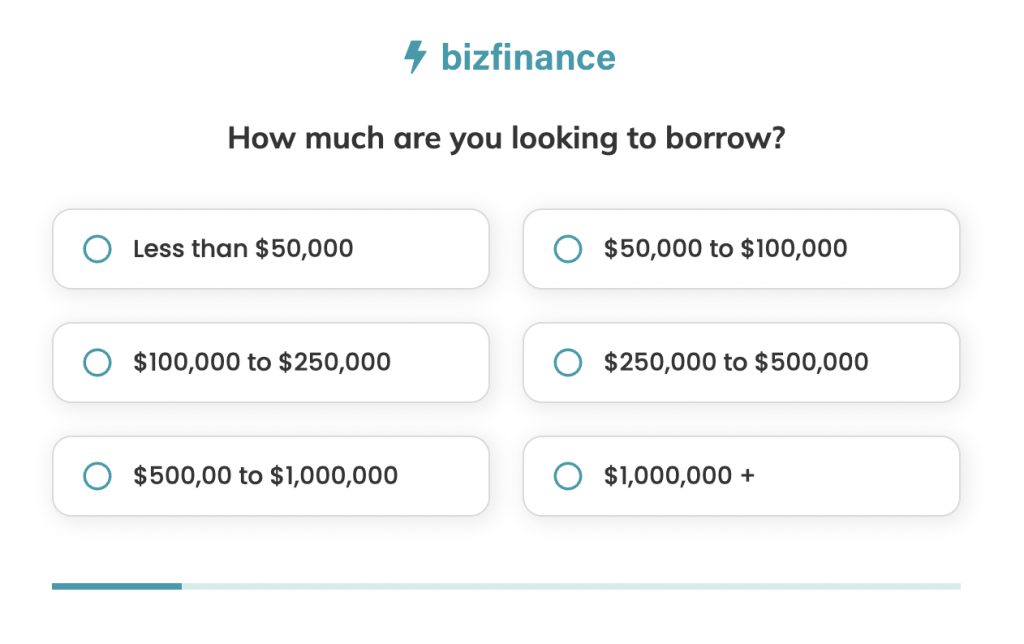
For credit repair, the steps can ask what the person was turned down for, what is on their report, their score range and when they need to be approved, with contact details last. Conditional logic routes each answer, so someone with a goal you cannot help with sees a different ending instead of becoming a wasted call. Hidden fields keep the UTM parameters from the ad that brought the lead, so you know which campaign signed each client, and phone and email validation stops mistyped numbers before they reach your CRM. Our guide to verifying leads explains how that works.
Each lead goes where you work. Growform has a Credit Repair Cloud integration that sends every submission into your pipeline, and webhooks and 7,000+ apps through Zapier reach any other CRM or email tool. The same form embeds on your landing page, your WordPress site or a page of its own.
If you want to see how the best lead forms are built before you build yours, we studied 114 multi-step lead forms and wrote up what the strongest ones have in common.
Credit repair businesses use Growform to get more leads from the same traffic, qualify them before the first call and keep track of what is working. Every plan starts with a 14-day free trial and no credit card. Start free trial.
Frequently asked questions
How do I get leads for a credit repair business?
Start with the channels where people with credit problems are already looking: a Google Business Profile for local searches, a landing page built to convert, and paid search or Facebook ads with an offer such as a free credit review. Then add the slower compounding channels, which are referrals from past clients, partnerships with real estate agents and car dealers, and reviews. Every channel ends at a form, so make that form short, split into steps and connected to your CRM.
Should I buy credit repair leads or generate my own?
Leads you generate yourself are exclusive, arrive with the context of how they found you and cost what your ads and time cost. Purchased leads are often shared with other credit repair firms and arrive cold, so they take more calls to convert. Most firms that grow past a handful of clients a month build their own pipeline and treat bought leads as a top-up at most.
How can I get credit repair leads for free?
A Google Business Profile, client reviews, organic posts on social media, a referral scheme and partnerships with local businesses all cost time rather than money. They build slowly, so most credit repair businesses run them alongside a paid channel rather than instead of one.
What are bad credit leads?
Bad credit leads are people with low credit scores who have asked for help, usually by filling in a form about their situation. For a credit repair business they are the core prospect. For lenders, car dealers and real estate agents they are often customers they cannot serve yet, which is why those businesses make good referral partners.
Related articles

Insurance Lead Gen: The Complete Playbook for 2026
“Get more insurance leads” is still the typical advice many receive. It's also the fastest way to hide a broken funnel.
September 30, 2026

High-Converting Insurance Quote Forms: A Practical Guide
Insurance quote forms have to ask for far more fields than a typical lead form, so every field, branch and webhook has to earn its place.
September 30, 2026

Home Services Lead Generation: A Practical Playbook
You’ve paid for the click, the homeowner has completed the form, and the notification arrives after dinner. By the time someone on the team sees it the next morning, the prospect has already called another contractor. Worse, some submissions were never serviceable, never urgent, or never a fit for the crew in the first place….
September 30, 2026