


Debt relief lead forms have to do more than convert. They need to qualify prospects early, collect structured intake data, show the required disclosures before signup, and hand each submission to the right sales team or buyer without breaking attribution.
Growform is a no-code multi-step form builder built specifically for lead generation, and debt relief is a strong fit for how we work. We help debt relief marketers, lead generators, aggregators, and in-house performance teams launch mobile-first intake funnels that verify contact details, capture consent evidence, and deliver leads in real time to CRMs, GoHighLevel, and lead distribution platforms.
Debt relief lead forms built for qualified intake and cleaner downstream routing
Growform gives debt relief teams multi-step, quiz-style, and single-step lead forms designed for paid traffic. You can embed them on your site, landing page, or funnel builder, or run them as hosted forms when you need speed, cleaner control, or a separate intake experience for campaigns.
Growform is especially useful when your debt relief form needs to balance conversion rate with detailed intake. Instead of forcing every question into one long page, we let you sequence the funnel so prospects start with easier questions and move into deeper qualification only after they have momentum.
That sequencing matters in debt relief. Growform’s debt advice template starts with simpler questions such as debt amount and debt type before moving into employment and contact details, which helps you gather usable case data without creating immediate friction.
Debt relief intake also sits close to regulation. The FTC’s debt relief rule guidance says providers must disclose key information before signup and cannot collect a fee until they have settled or otherwise resolved a consumer’s debts, so your form flow often needs room for qualification, expectation-setting, and approved disclosure language, not just a name and phone field.
Growform helps debt relief marketers qualify prospects before sales calls and buyer delivery
Growform’s conditional logic, logic jumps, and disqualification rules let you ask harder qualifying questions without turning the whole form into a wall of fields. You can branch by answer, skip irrelevant steps, and stop low-fit leads before they ever hit a closer, a buyer, or a call center queue.
That improves lead quality in a very practical way. Your team can qualify around debt profile, geography, contactability, or other campaign rules before delivery, instead of discovering bad-fit leads after the transfer.
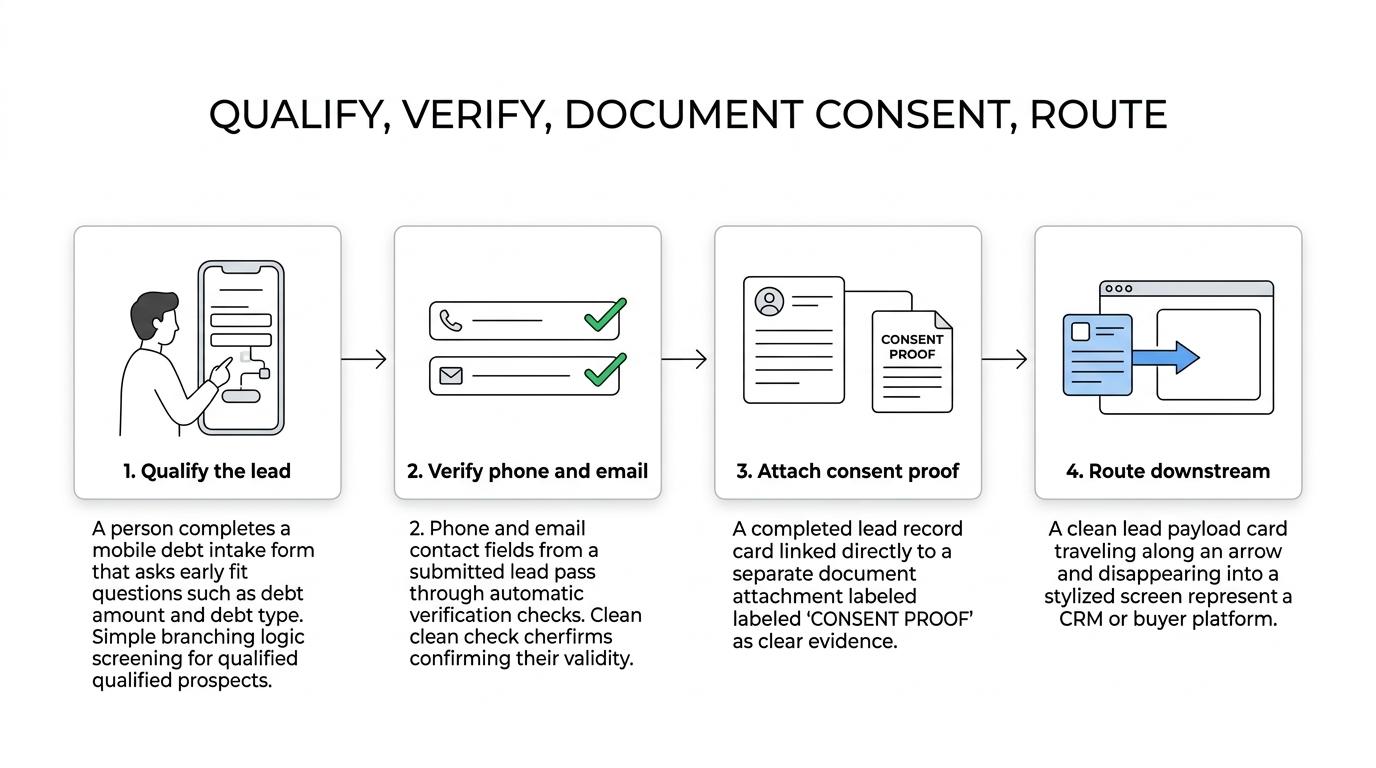
With Growform, your debt relief lead form can capture and act on details such as:
- Qualification data: Debt amount, debt type, household or contact details, and other campaign-specific fit questions
- Lead verification: Real-time phone validation through Twilio Lookup and email validation through ZeroBounce to catch fake, bot-driven, or uncontactable submissions
- Consent and evidence: Native TrustedForm and Jornaya integrations so the lead carries consent proof into your downstream system
- Attribution fields: UTMs, gclid, fbclid, source tags, and sub-IDs preserved across the entire multi-step flow
Growform turns those fields into routing-ready data, so your debt relief operation gets fewer dead-end submissions and more leads that can actually be worked, sold, or assigned.
Debt relief lead routing into CRM, GoHighLevel, and ping post stacks
Growform is the front-end capture layer, not a replacement for your CRM or distribution system. We hand submissions off in real time through webhooks and Zapier’s 7,000+ apps, into tools such as HubSpot, GoHighLevel, Google Sheets, Salesforce (through Zapier), and lead distribution platforms including Boberdoo, Phonexa, LeadByte, and LeadsPedia.
That means your debt relief form can feed the stack you already use instead of forcing a workflow change. Sales alerts can go out instantly by email, or by SMS and WhatsApp through Zapier, which helps protect speed-to-lead when every minute affects contact rate.
Growform also preserves hidden fields and pass-through data across multi-step flows, so UTMs, click IDs, and source parameters land intact in the CRM or buyer payload. If you run Meta, Google, native traffic, or affiliate supply into debt relief offers, that makes attribution cleaner and troubleshooting faster.
Verification, compliance evidence, and conversion tracking for debt relief campaigns
Debt relief teams often lose margin in places that do not show up in a simple form completion report. Fake submissions, bad phone numbers, missing consent evidence, and broken click tracking all make a lead look cheaper than it really is until acceptance rates fall or sales complains.
Growform addresses that at capture. Real-time phone verification and email validation help remove junk before the lead is sold or worked, while TrustedForm and Jornaya integrations attach the evidence many buyers, networks, and compliance teams expect to see.
Growform also supports 1-click pixel firing and custom GTM containers, and server-side conversion tracking for Meta and Google is coming soon. If your current debt relief funnel loses source data between ad click and CRM record, we give you a cleaner way to carry that attribution through the form.
What the debt advice template asks, and what buyers usually screen for
Growform’s debt advice template is a six-step flow. It asks how much the person owes, in bands from under $1,000 to over $10,000, then which types of debt they carry (credit cards, student loans and mortgages can be selected together), how long the debt has lasted and their employment status. An optional notes box follows, and name, email and phone come last.
Most settlement buyers set a floor on total unsecured debt, often somewhere between $7,500 and $10,000, and exclude the states where they do not operate. Secured debt such as a mortgage or car loan usually does not count toward that floor. Those rules belong in the form. Tighten the debt bands around your buyers’ minimum, add a state question, and use disqualification logic to send anyone below the floor or outside your states to a different ending before the lead is delivered. Debt type answers can be passed as separate fields so the buyer sees the unsecured balance without reading the notes.
Employment status is worth keeping even when a buyer does not require it. A settlement program depends on the person being able to save each month, so it gives closers an early read on affordability.
Start with a debt relief form that qualifies before it routes
If your current debt relief lead form is sending too much junk downstream, dropping attribution, or making every change a dev ticket, Growform gives you a faster way to fix the capture layer. Clone the debt advice template, adjust the bands and states to your buyer requirements, and start a free trial to test it on live traffic.
Related articles

Growform Mass Tort Intake Forms for Better Screening
Growform helps mass tort marketers and intake teams turn paid traffic into better-screened claimant leads.
September 30, 2026

Growform CRM Forms With Hidden Field Pass-Through Built In
September 30, 2026

Growform Multi-Step Forms for Paid Lead Generation
Growform is a no-code multi-step form builder built for one job: turning paid traffic into qualified leads.
September 30, 2026