
What Is Lead Qualification: A 2026 Guide to BANT & CHAMP
 Harvey Carpenter Published 12 min read
Lead qualification is the process of deciding whether a prospect is worth a salesperson's time before anyone ever calls. In B2B benchmarks, about 31% of leads become MQLs, but only about 13% of MQLs progress to SQLs, so the gate matters because most inquiries still need validation before sales should spend time on them.
What Lead Qualification Actually Means
Lead qualification is the pre-sales gate that separates raw inquiries from sales-ready opportunities. A form-fill becomes useful only when someone has checked whether the lead has enough fit, intent, and readiness to deserve a rep's time.
That distinction matters because volume alone is deceptive. One benchmark set says properly qualified leads convert at about 40%, while unqualified prospects convert at only 11%, which is why qualification changes pipeline quality, not just admin workload. The same benchmark stream also shows the gap between 31% MQLs and 13% SQLs, which tells you most inbound interest still needs another layer of validation before a salesperson should step in. Lead qualification benchmark data
Lead qualification is not the same as lead scoring
Lead scoring ranks leads against each other. Lead qualification decides whether a lead should be handed to sales at all.
That difference gets blurred a lot in paid acquisition teams, because both systems can live in the CRM and both can look like a number. In practice, scoring says, “This one is warmer than that one,” while qualification says, “This one is worth a call, this one should be nurtured, and this one should be disqualified.”
Practical rule: If a rep would still ask, “Should I spend time on this lead?” then you haven't qualified it yet, you've only ranked it.
The cleanest operating definition is simple. Qualification is the process of checking fit, intent, and readiness before sales engages, so the team works fewer but higher-probability prospects. That's the difference between a database full of leads and a pipeline full of opportunities.
The Main Qualification Frameworks Compared
Frameworks exist because teams need one shared rulebook. Without that, every rep asks different questions, every channel applies a different threshold, and every post-call recap turns into an argument about whether the lead was “bad” or just not ready.
What each framework is good for
BANT is the classic default, built around Budget, Authority, Need, Timeline. It fits transactional or moderately considered deals where budget and timing are fairly visible, and it works well when you want a fast filter that sales can apply the same way every time.
CHAMP shifts the emphasis toward the buyer's pain. It stands for Challenges, Authority, Money, Prioritization, so it fits situations where the problem matters more than the spreadsheet, especially in mid-market motions where urgency drives conversion.
MEDDIC goes deeper. It covers Metrics, Economic buyer, Decision criteria, Identify pain, Champion, and it works best when deals are complex, stakeholders multiply, and the rep needs a more disciplined discovery process.
GPCT stands for Goals, Plans, Challenges, Timeline. It helps reps connect the prospect's plan to the product, which makes it useful in consultative selling and inbound discovery.
FAINT means Funds, Authority, Interest, Need, Timing. It helps when buyers may not have a pre-set budget, so the conversation starts from interest and available funds rather than a formal purchase line item.
| Lead Qualification Frameworks at a Glance | Core Criteria | Best Fit | Watch Out For |
|---|---|---|---|
| BANT | Budget, Authority, Need, Timeline | Clear offers, simpler qualification, fast handoff | Can get too rigid if budget isn't known early |
| CHAMP | Challenges, Authority, Money, Prioritization | Pain-led selling, mid-market motions | Can drift if the team never gets to money |
| MEDDIC | Metrics, Economic buyer, Decision criteria, Identify pain, Champion | Complex enterprise deals | Too heavy for low-consideration funnels |
| GPCT | Goals, Plans, Challenges, Timeline | Consultative inbound and discovery-led sales | Easy to sound thoughtful without making a decision |
| FAINT | Funds, Authority, Interest, Need, Timing | Situations where budget isn't pre-allocated | Can over-index on interest without real readiness |
If you want the safest default, start with BANT. If pain discovery matters more than budget, CHAMP usually feels more natural. If the deal is complex, MEDDIC earns its keep. The ultimate win is not picking the cleverest acronym, it is asking the same questions the same way on every form, every call, and every handoff.
The Three Qualifying Dimensions You Actually Need
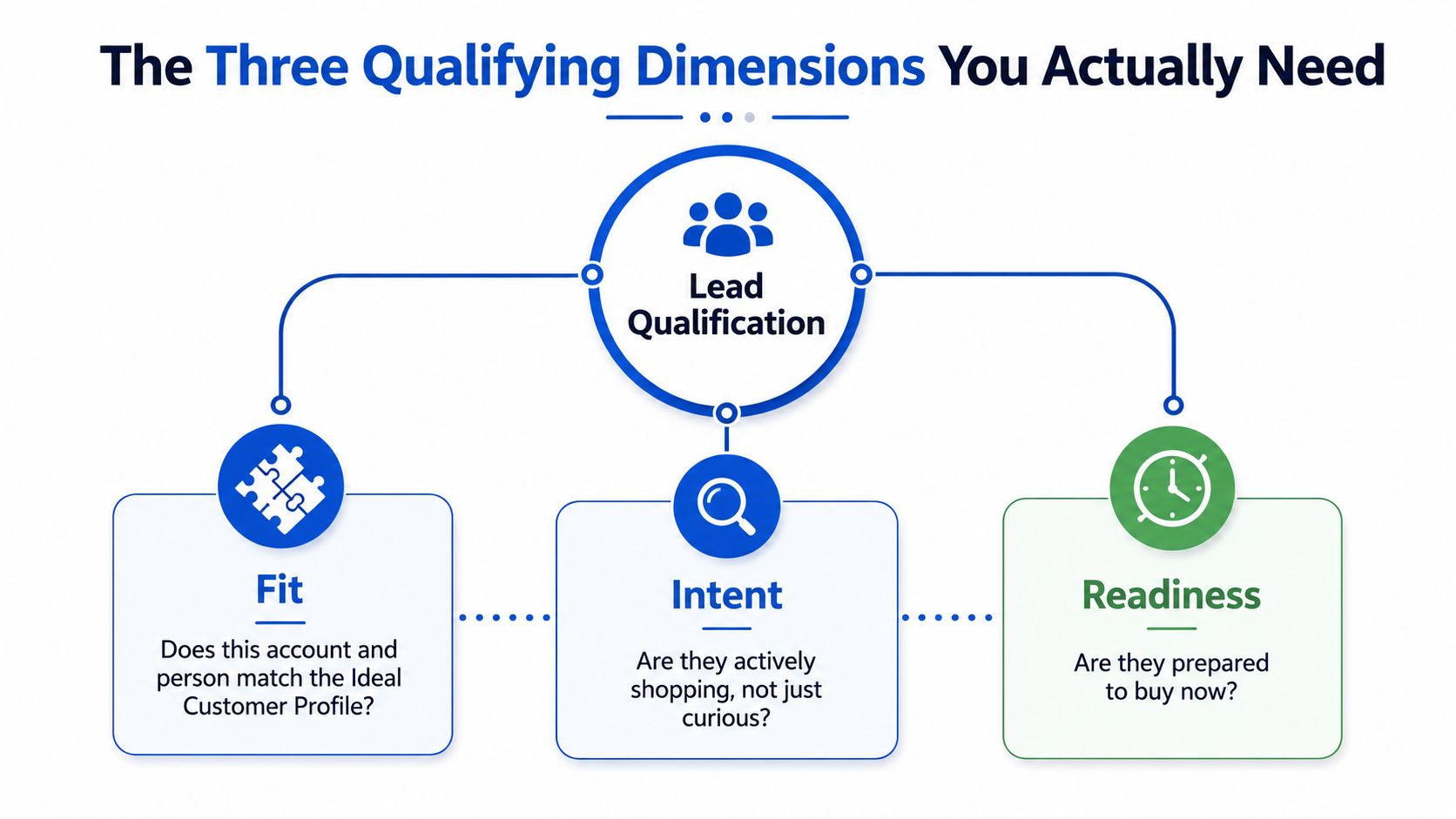
Most frameworks look different on paper, but they're usually testing the same three things. If you strip away the acronyms, you're left with fit, intent, and readiness.
Fit, intent and readiness in plain language
Think of a nightclub bouncer. Fit is whether the person is on the guest list. Intent is whether they want to be at this club tonight. Readiness is whether they can pay the cover and stay past last call.
Fit is usually the easiest to check early. A form can ask for company size, location, use case, or territory, and enrichment tools can confirm whether the person belongs in your ICP. A simple disqualifier here is obvious, wrong geography, wrong business type, or a contact profile that doesn't match the segment you serve.
Intent is different. A form can ask what problem they're trying to solve, what page they came from, or what they want help with, and those answers tell you whether the lead is browsing or buying. The disqualifier is weak or irrelevant motivation, especially when the person is only collecting info and has no real purchase event in sight.
Readiness is the hardest part to settle from a form alone. Budget, authority, and timing are the usual checks, but a live conversation still does the final work because real buying readiness often shows up in follow-up detail, not in a single checkbox.
Fit can be decided before the form finishes loading. Intent is best captured in the form. Readiness usually needs a human conversation.
That's why qualification has to be a system, not a single field. You can score fit before capture, ask for intent during capture, and confirm readiness after the lead is routed. The whole point is to move the right people forward without forcing every prospect through the same blunt process.
Marketing Qualified vs Sales Qualified Leads
An MQL is a lead marketing believes is worth passing onward because it matches baseline criteria. An SQL is a lead sales has confirmed is worth active pursuit because the person has real need, enough context, and some path to purchase.
The handoff matters more than the label
The mistake many organizations make is treating MQL and SQL like static status labels. They're better understood as a handoff with an SLA attached. Marketing owns the MQL, sales owns the SQL, and RevOps owns the routing and reporting that keep the handoff honest.
That's also why definitions drift so easily. If one rep thinks an SQL means “booked demo,” another thinks it means “spoke to a decision-maker,” and marketing thinks it means “downloaded a guide and visited pricing,” then lead-quality complaints are inevitable. A common reference like how Machine Marketing defines SQLs helps because it reminds teams that SQL should mean sales has confirmed enough buying signals to justify active pipeline work.
Here's the simplest way to think about the journey. Marketing captures the first signs of intent, routes the lead, and nurtures if needed. Sales verifies the details that a form can't fully prove, then promotes the lead to SQL only after the criteria are real. For a practical buildout, the handoff logic in how to qualify inbound leads is a useful operational reference.
A solar lead makes this easy to see. Marketing captures project type, zip code, and some budget signal on the form. Sales then checks roof ownership, utility bill access, and decision authority on a discovery call. The lead becomes SQL only after those checks pass, not just because the form looked promising.
Speed matters here, too. Research cited in benchmark roundups says contacting a lead within 1 hour can make a company about 7x more likely to qualify that prospect than waiting 2 hours. That's why speed-to-lead sits right between qualification quality and revenue throughput, not off to the side as an ops metric. Speed-to-lead benchmark roundup
When Stricter Qualification Quietly Kills Conversions
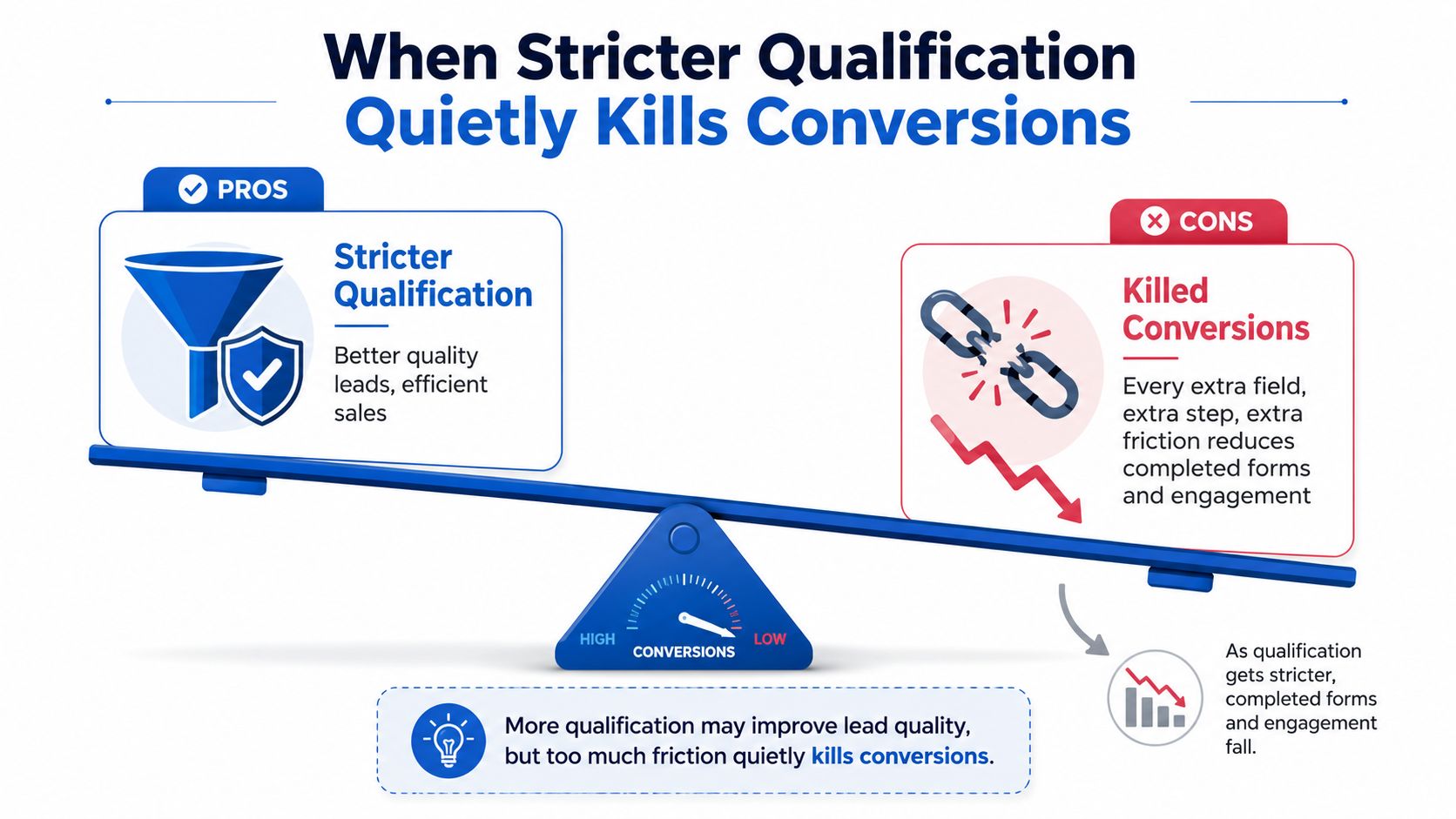
Stricter qualification feels rational until it starts choking the funnel. Every extra field, every extra step, and every extra disqualifier adds friction, and real buyers don't always reward that friction with more patience.
Useful friction versus harmful friction
The useful version of friction removes obvious junk. A form question that filters out a lead outside your service area saves sales time and protects routing quality.
The harmful version slows a real buyer down. That's where the Baymard benchmark matters, because the average cart abandonment rate is about 70.19%, and one major cited reason is being forced to create an account or complete extra steps. That doesn't mean qualification is bad; it means the cost of each added hurdle needs to be justified by the lead quality it improves. Baymard checkout abandonment research
A clean rule set helps. Ask disqualifying questions early, so bad leads exit cheaply. Ask softer qualifying questions only after some commitment is built. Never ask a question you won't act on, because buyers notice when a form collects information for no visible reason.
Three practical filters follow from that:
- Remove bad-fit leads fast: If geography, product line, or business type is wrong, say so early.
- Delay sensitive questions: Budget and authority usually belong later in the flow, after the lead has already invested some attention.
- Keep every field accountable: If a question doesn't change routing, nurture, or disqualification, it's probably just friction.
That tradeoff is why a smarter capture layer matters. Multi-step flows, conditional logic, and verification let teams ask harder questions without asking every visitor to pay the same price in attention.
How the Capture Layer Actually Runs Qualification
The capture layer is where qualification becomes real. Frameworks live in strategy docs, but forms, validation, routing, and instant delivery decide whether the logic reaches the CRM cleanly or gets diluted on the way in.
Multi-step forms, logic and disqualification
A modern form builder like Growform can act as the front end of qualification, but the same principle applies to any tool that supports multi-step flows and conditional logic. The point is to ask the right question at the right time, not to dump every qualifier on the first screen.
A home-services lead flow is a good example. Step one collects zip code and project type, step two asks about budget range and timing, step three verifies the phone number, and the lead is then delivered instantly if it passes the rules. If the zip code is outside service range, the form can route the visitor to a self-serve resource instead of sending a bad lead into a sales queue.
The mechanics matter because they solve different failure points. Progress bars make longer forms feel lighter. Conditional logic asks harder questions only when the earlier answer justifies it. Disqualification branches stop bad-fit leads cleanly. Verification and real-time delivery help screen junk before it wastes buyer or rep time.
The best qualification form doesn't feel like a survey. It feels like a guided decision tree.
This is also where attribution and compliance get glued on. Hidden field capture keeps UTMs and click IDs attached through the flow, and real-time webhooks push clean submissions into systems like HubSpot, Salesforce, GoHighLevel, Boberdoo or LeadsPedia without breaking the trail between ad click and pipeline. For lead-gen operators who need cleaner workflows around recruiting or lead capture, dreach AI for recruiters is one example of a tool category that sits adjacent to the same operational problem.
If you're building your own stack, the lead qualification tools guide is worth comparing against your current form setup. The main test is simple, does the capture layer protect quality without making qualified visitors work harder than they should?
Common Lead Qualification Mistakes and How to Fix Them
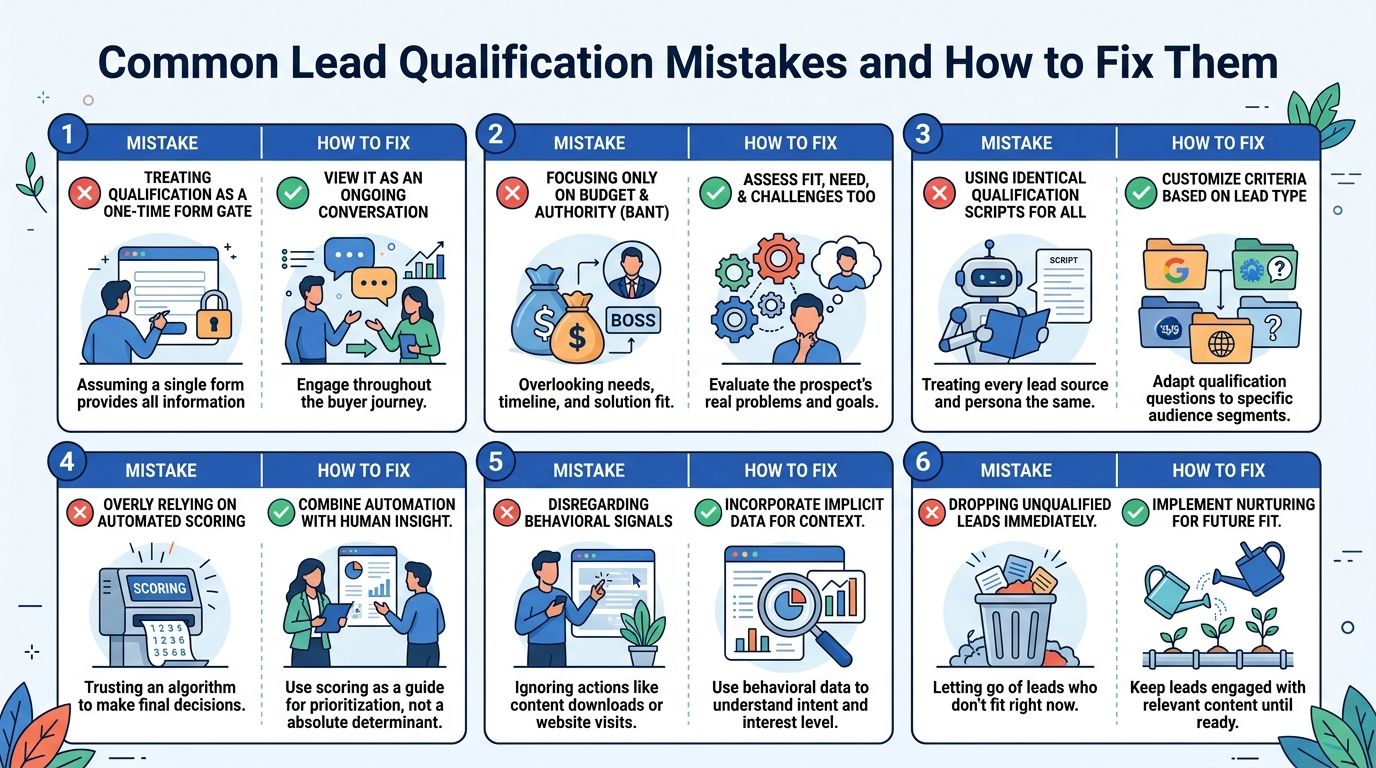
Most lead-qualification problems aren't framework problems. They're execution problems, and they usually start in the form, the CRM, or the handoff rules.
Six mistakes that keep showing up
-
Treating qualification as a one-time gate. Teams ask one form, assign one score, and assume the job is done. Fix: Treat qualification as ongoing, then review the last 20 SQLs to see which questions predicted closed deals.
-
Asking questions sales never uses. Marketing adds fields because they sound smart, not because they change routing or discovery. Fix: Audit the questions your reps ask on calls, then delete anything that doesn't affect next steps.
-
Defining MQL and SQL differently across channels. Paid search, social, outbound, and referral traffic all get judged by different rules. Fix: Write one shared definition set and apply it everywhere, even if the routing outcome changes by channel.
-
Ignoring speed-to-lead because the form feels fast enough. A clean form doesn't matter if the follow-up sits in a queue. Fix: Measure time from submission to first contact, then tighten your routing and alerts until the delay is operationally visible.
-
Relying on native CRM forms that can't branch well. Static embeds force the same path for every visitor. Fix: Move the capture step to a multi-step, conditional builder so qualification can adapt to the response instead of flattening it.
-
Breaking attribution during handoff. UTMs and click IDs disappear before the lead reaches the CRM, so the channel story falls apart. Fix: Pass hidden fields through every step and test the full journey before launching the campaign.
A few operational KPIs tell you whether the system is getting better. Acceptance rate shows whether sales trusts what marketing is passing. SQL-to-opportunity rate shows whether the handoff is producing real pipeline. Cost per qualified lead tells you whether the capture layer is filtering efficiently. Disqualification rate tells you whether the front end is doing real work instead of hiding junk in the CRM.
Putting It Together and Your Next Step
Lead qualification isn't a framework, a field, or a score. It's a shared operating system between marketing, sales, and RevOps, and it only works when every stage uses the same logic.
The five things that matter most are simple. Qualification is a pre-sales gate. Fit and intent can be captured before the call, while readiness still has to be confirmed live. The framework matters less than consistency. Useful friction protects the pipeline, harmful friction destroys it. The capture layer is where most of the wins, and most of the leaks, happen.
For a performance marketer buying paid traffic into a CRM, the next move is to rebuild the qualification form as a multi-step, conditional flow with verification and webhook delivery this week. For a lead-gen operator selling leads into a distribution platform, attach TrustedForm or Jornaya consent evidence and a real-time verification step to every submission. If you want a working scorecard, the lead qualification checklist is the simplest place to pressure-test your current process.
Working checklist: Does the form filter fit, capture intent, confirm readiness, preserve attribution, and route only leads a rep can actually use?
Growform helps teams build multi-step qualification forms with conditional logic, verification, and real-time delivery into CRMs and lead distribution systems. If your current forms are creating junk leads or breaking attribution, visit Growform and compare the capture layer against the way your team qualifies leads.
Related articles

Digital Ad Campaigns That Convert: A 2026 Playbook
You've seen this campaign before. A prospect clicks a Meta ad, reaches a landing page, starts the form, and submits.
September 11, 2026
8 Ad Strategy Examples That Drive Better Leads
A winning ad isn't defined by its hook or click-through rate alone.
September 10, 2026
8 Lead Qualification Questions That Convert
The best qualification question isn't always the first one.
September 4, 2026